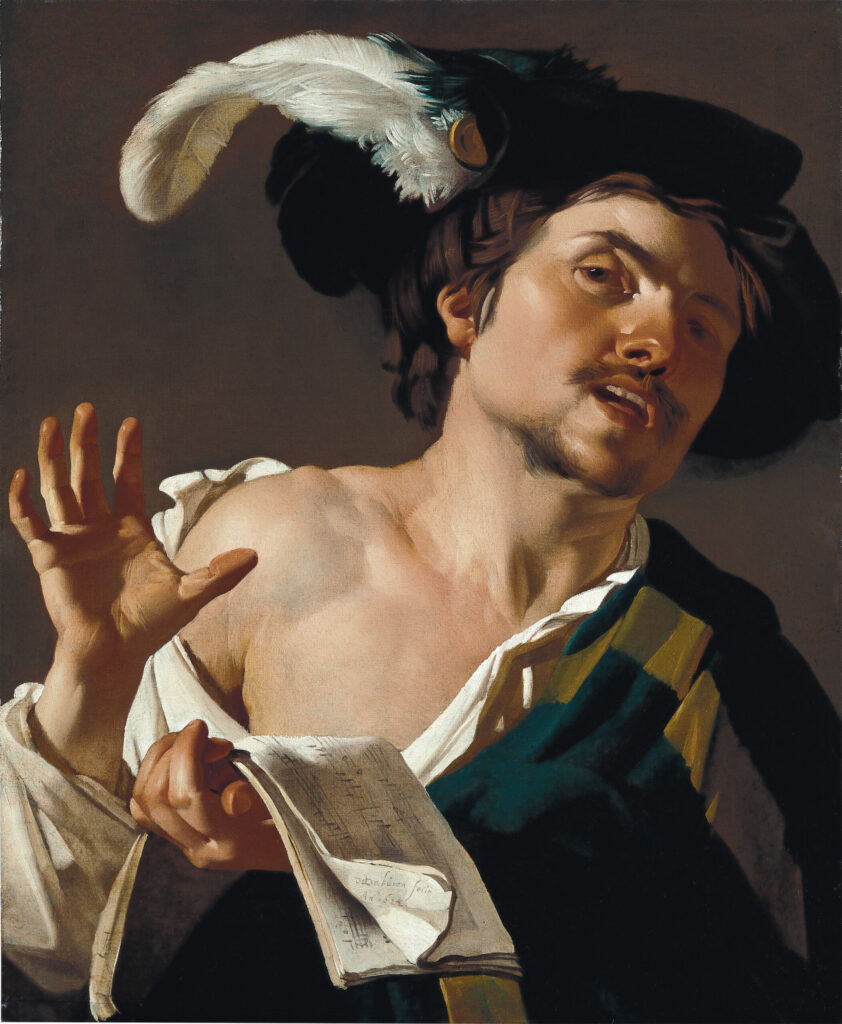
Utrecht, 1622. Dirck van Baburen has just returned from Rome. He paints this young singer in a bold format. The model surges from the canvas, sheet music in hand, mouth half-open on a suspended note. His gaze fixes on us. We are there, before him, spectators of an intimate concert.
A Flamboyant Caravaggism
Observe the singer’s face. Van Baburen masters the legacy of Caravaggio: close-up, dark background that isolates the figure, details chosen with precision. The hat with white plume draws the eye upward, while the music book seems to spring toward us, breaking the boundary between painted space and our reality. The left hand opens in a theatrical gesture, suspended in golden light. The costume evokes characters from the commedia dell’arte. Every element participates in this sophisticated staging, typical of Northern Baroque.
Birth of a Dutch Genre
This oil on canvas marks a turning point in 17th-century Dutch art. Van Baburen imports Roman innovations to Utrecht and creates one of the first examples of “musicians in bust,” a genre that would enjoy considerable success in the United Provinces. These half-figures of singers and instrumentalists responded to the demand of a prosperous bourgeoisie, lovers of art and music. The painting celebrates sensory pleasure and individual expression.
Dirck van Baburen, Caravaggesque Pioneer
Trained in Utrecht, Dirck van Baburen (1595-1624) stayed in Rome between 1617 and 1620. There he discovered Caravaggio and became one of the principal representatives of the “Utrecht Caravaggisti.” His career would be brief—he died at 29—but his influence left a lasting mark on Dutch painting.
Think about it
💭 How does the Caravaggesque style transform a simple portrait of a musician into a theatrical scene?
About This Work
- Young Man Singing
- Dirck van Baburen
- 1622
- Oil on canvas
- 71 × 58.8 cm
- Städel Museum, Frankfurt am Main
- https://sammlung.staedelmuseum.de/en/work/young-man-singing