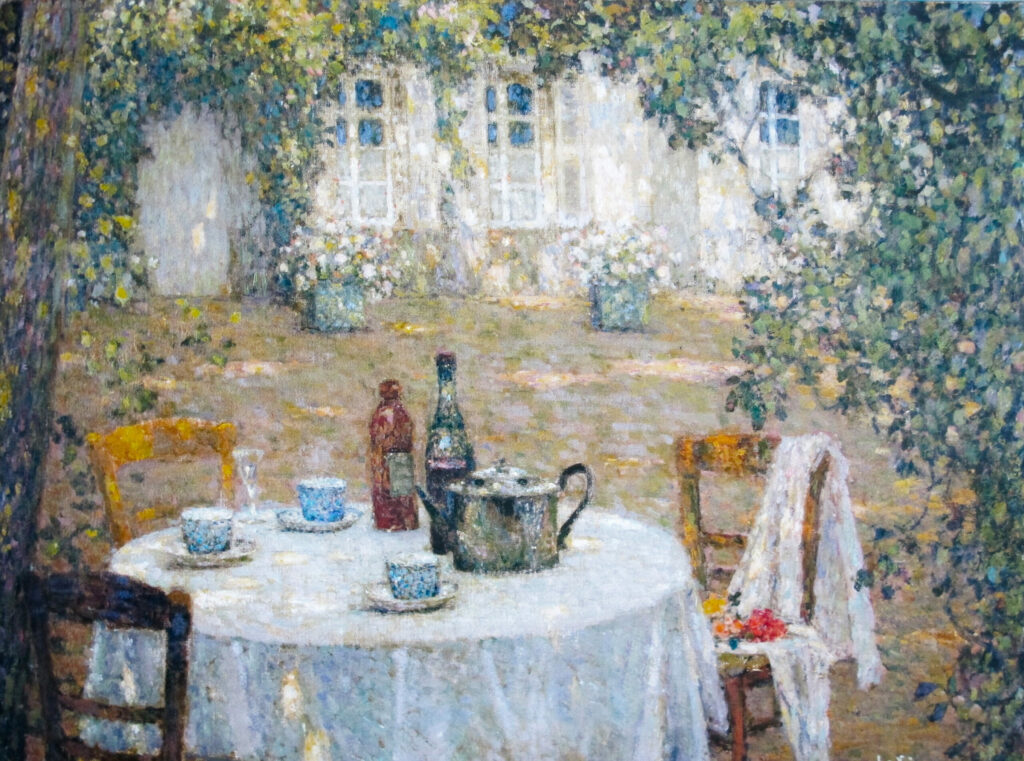
Gerberoy, 1911. In his villa in the Oise, Henri Le Sidaner composes a scene of haunting intimacy: a laid table, empty of human presence, bathed in soft light. The painting captures the suspended moment of a summer afternoon where time seems held still.
A Reimagined Impressionist Atmosphere
Observe this white tablecloth that catches the light in fragmented touches. Le Sidaner applies the paint in small, vibrant brushstrokes, creating an almost hypnotic effect. The blue cups, the red bottle, the gleaming metal teapot: each object vibrates under the sunlight filtered through the foliage. The house façade emerges painted in stippled greens, yellows and blues. This canvas transforms a domestic scene into a contemplative experience. The chairs wait, the table is set, but no one comes. It is this absence that makes the presence so powerful.
Symbolist Intimism Facing Modernity
In the early 20th century, while Cubism fractures forms and the Parisian avant-garde upends conventions, Le Sidaner chooses a singular path. He paints silence, waiting, places inhabited by their own emptiness. “The Table in the Sunlight” bears witness to this poetic quest for suspended time. The artist reworks this canvas, perfecting each nuance of light. In Gerberoy, a village he helped restore, Le Sidaner finds his creative sanctuary.
Le Sidaner, Painter of Silent Gardens
Henri Le Sidaner (1862-1939) developed a unique style between Impressionism and Symbolism. Trained at the École des Beaux-Arts, he rejected urban tumult to celebrate domestic intimacy. His paintings cultivate the mystery of invisible presences.
Think about it
💭 Le Sidaner paints empty tables while Matisse explodes with Fauvist colors: what if silence were also a form of modernity?
About This Work
- La Table au soleil (The Table in the Sunlight)
- Henri Le Sidaner
- 1911
- Oil on canvas
- 65.5 × 81.5 cm
- Musée d’arts de Nantes
- https://www.navigart.fr/museedartsdenantes/artwork/henri-le-sidaner-la-table-au-soleil-110000000002551
Gerberoy: A Village as Permanent Studio
The Table in the Sun was painted at Gerberoy, in the Oise, where Henri Le Sidaner (Port-Louis, 1862 – Paris, 1939) settled in 1901 and made, over forty years, the centre of his pictorial universe. The canvas depicts a set table in his villa’s garden, bathed in filtered light: blue cups, a red bottle, a gleaming teapot against a house facade rendered in pointillist touches of green, yellow, and blue. No figures: only the traces of a recent or imminent presence, the empty place settings, the atmosphere of waiting. Le Sidaner is the painter of this inhabited emptiness, his tables, his gardens, his windows lit behind curtains are images of an intimacy from which the human body is absent but whose emotional charge remains entirely intact.
Between Impressionism and Symbolism
In 1911, the Parisian art world was dominated by Cubism and Fauvism, avant-gardes seeking to fracture form and saturate colour. Le Sidaner chose the opposite direction: to refine, to whisper, to paint silence. This deliberate distance from the noise of modernism won him an international following, he exhibited in Pittsburgh, New York, and Munich, without ever leading him to abandon a vision that was profoundly his own. His practice of the repeated motif, the same garden table at Gerberoy through the changing seasons, anticipates in some ways Monet‘s serial method, but with an entirely different ambition: where Monet pursued the movement of light, Le Sidaner pursued the texture of stillness. The Musée d’arts de Nantes, which holds this canvas, keeps one of the most eloquent examples of what that ambition could produce.