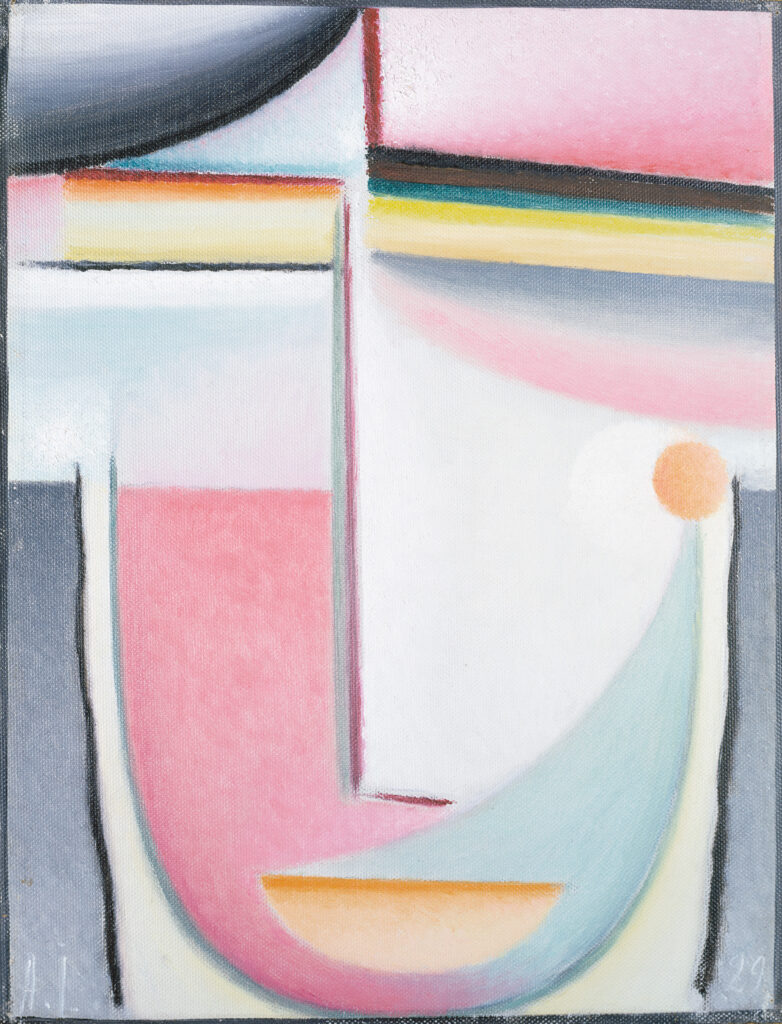
Frankfurt am Main, 1929. In his Wiesbaden studio, Alexej von Jawlensky sets down his brush. Before him, a modern icon: two black strokes for eyes, a vertical line for the nose, an arc for the mouth. The human face reduced to its essence.
Between Abstraction and Spirituality
Colors dialogue softly. Pink dominates, in powdery and intense shades. Horizontal bands structure the composition: gray-blue, pale yellow, white. An orange circle floats on the right, like an inner sun. Jawlensky works in oil with a visible, almost rough touch. Colors are superimposed in flat areas, creating subtle vibrations. This technique recalls the Byzantine sacred art the artist reveres.
The Quest for a Universal Image
A founding member of Der Blaue Reiter, Jawlensky began his “Abstract Heads” series in 1918. He would create 251 versions through 1934. This obsessive research responds to a spiritual question: how to paint the very essence of humanity? Deeply marked by the Russian and Byzantine icons of his childhood, this Orthodox artist seeks to create timeless faces, portraits of the soul rather than the body. Each “Symphony” explores a different chromatic harmony, like musical variations on a single sacred theme.
Alexej von Jawlensky, the Mystic Artist
A Russian émigré to Germany, Jawlensky (1864-1941) developed a unique style between Expressionism and abstraction. Friend of Kandinsky and Klee, he nonetheless pursued a solitary path, profoundly spiritual, transforming portraiture into pictorial meditation.
Think about it
💭 What if the most universal face were also the most abstract? What human traits do you recognize in these refined lines?
About This Work
- Abstract Head: Symphony in Pink
- Alexej von Jawlensky
- 1929
- Oil on canvas, mounted on cardboard
- 36.6 × 27.7 cm
- Städel Museum, Frankfurt am Main
- https://sammlung.staedelmuseum.de/en/work/abstract-head-symphony-in-pink