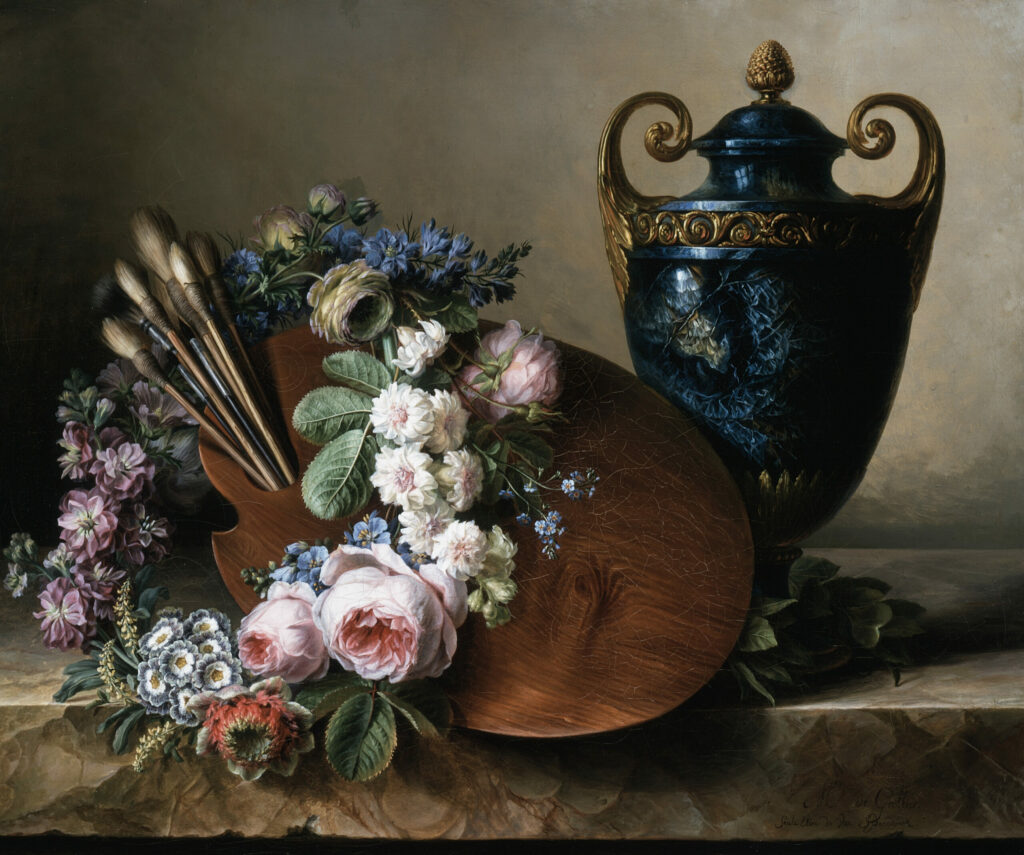
Paris, 1780s. Sophie de Fuligny-Damas, Marquise de Grollier, carefully arranges her palette, her brushes, and this blue vase with golden ornaments. She pays homage to her master Van Spaendonck in a composition where each flower testifies to her exceptional talent.
The Art of Still Life Elevated to Masterpiece
Roses unfold their delicate petals in a cascade. White and mauve flowers dialogue with blue ones. Each is painted with remarkable botanical precision. Light sculpts volumes, reveals the velvety texture of petals, the veining of leaves. The blue porcelain vase, with its golden volute handles, structures the composition. The chromatic palette oscillates between cool and warm tones.
A Virtuoso Recognized by Her Peers
This work belongs to the still life tradition while embodying the French taste for elegance and precision. Van Spaendonck, official painter of the King’s Garden, teaches Sophie de Fuligny-Damas meticulous observation of nature. She becomes one of the few women painters recognized in her time. Élisabeth Vigée Le Brun, her close friend, admires her talent: “She painted flowers with great superiority.” Madame de Genlis emphasizes that she achieved “perfection in this genre through the finish and freshness of her paintings.”
Charlotte Eustache Sophie de Fuligny-Damas, Marquise de Grollier
Born in Dijon, Madame de Grollier (1741-1828) also studied under Greuze. She specializes in floral painting and becomes an essential reference. Her work combines scientific rigor and artistic sensitivity, characteristic of Enlightenment art.
Think about it
💭 Which flowers from your garden would deserve such a pictorial tribute?
About This Work
- Still Life. Homage to Van Spaendonck
- Charlotte Eustache Sophie de Fuligny-Damas, Marquise de Grollier
- circa 1780-1790
- Oil on canvas
- 53.02 × 64.14 cm
- Los Angeles County Museum of Art (LACMA)
- https://collections.lacma.org/node/179391
A Rediscovered Painter of the Ancien Régime
Charlotte Eustache Sophie de Fuligny-Damas, Marquise de Grollier (1741-1828), born in Dijon, is one of the most remarkable flower painters of the second half of the 18th century, and one of the longest neglected. Her Still Life. An Homage to Van Spaendonck pays tribute to Gérard van Spaendonck (1746-1822), official painter to the King’s Garden in Paris and the unrivalled master of French botanical painting in his era, under whom she trained. The composition, roses and white, mauve, and blue flowers in a blue porcelain vase with golden handles, is a demonstration of technical virtuosity in the service of a precise aesthetic sensibility: the light that models each petal and makes the reflections of the vase vibrate, the precise rendering of veins on the leaves and the texture of the corollas, the chromatic range cooled by the dark ground reveal a mastery worthy of the greatest specialists in the genre.
Vigée Le Brun, Genlis, and Recognition by Peers
What distinguishes Madame de Grollier in the artistic landscape of her era is that she was recognized not by official institutions, the Académie royale de peinture remaining largely closed to women, but by her most celebrated female peers. Élisabeth Vigée Le Brun praised her talent as superior in the floral domain. Madame de Genlis noted that she had achieved “perfection in this genre through the finish and freshness of her paintings.” This dual artistic and social endorsement says much about the parallel circuits through which women painters of the Ancien Régime built reputations outside official academic channels. The title “An Homage to Van Spaendonck” is not a gesture of servile deference but a statement of belonging: by placing herself under the sign of her master, Madame de Grollier asserts that she is part of the same tradition of excellence.