Rome, early 16th century. A man collapses beneath the weight of a cross. The crowd presses around him. Sebastiano del Piombo seizes this moment with absolute intensity.
Flesh and wood
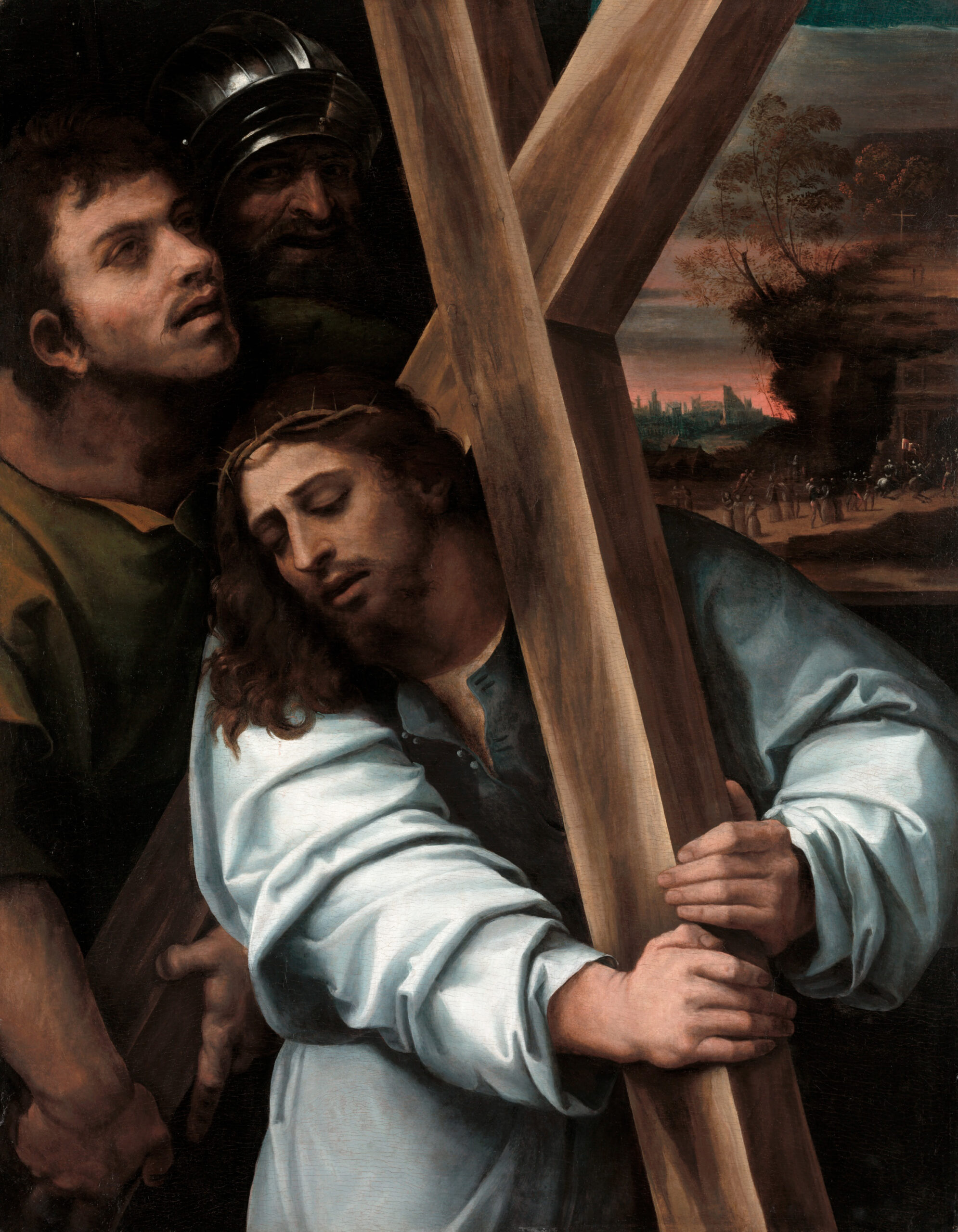
Christ occupies the centre of the composition. His face tilts downward, the crown of thorns visible. He wears a luminous white tunic against the surrounding darkness. Simon of Cyrene grips the cross with both hands. Behind them, a Roman soldier in armour looks on, his gaze hard. The powerful diagonals of the cross cut through the picture like blades. Sebastiano paints with a commanding mastery of chiaroscuro, inherited from Venice, amplified by Michelangelo. Every face is a portrait.
A popular devotion
In the 16th century, devotional paintings of Christ carrying the cross are in high demand. They adorn private chapels and oratories. Sebastiano del Piombo produced several versions, responding to a growing hunger for personal spirituality. This work belongs to the High Roman Renaissance, a period of tension between classical grandeur and dramatic expressiveness. The blazing landscape in the background, a military procession, a distant city, roots the scene in a vivid historical reality. Suffering becomes universal.
Sebastiano del Piombo
Born in Venice c. 1485, Sebastiano del Piombo trained under Giovanni Bellini and Giorgione. Having settled in Rome, he became a close friend and collaborator of Michelangelo and a direct rival of Raphael. The favourite painter of Pope Clement VII, he embodies the perfect synthesis of Venetian colourisim and Roman monumentality.
Think about it
💭 Standing before this painting, a question presents itself: which gaze do you recognise yourself in, the one who carries, the one who helps, or the one who watches?
About this work
- Christ Carrying the Cross
- Sebastiano del Piombo
- c. 1515–1517
- Oil on panel
- 118 × 92 cm
- The Art Institute of Chicago
- https://www.artic.edu/artworks/234781/christ-carrying-the-cross
Venice, Rome, and the Synthesis of a Hybrid Genius
To understand Christ Carrying the Cross, one must grasp the singular trajectory of Sebastiano del Piombo (c. 1485-1547): born and trained in Venice, most likely in the workshop of Giovanni Bellini and then in that of Giorgione, he settled in Rome in 1511 under the patronage of Agostino Chigi, the papal banker who commissioned decorations for him at the Villa Farnesina. In Rome, from around 1515, he formed a decisive friendship with Michelangelo, who became his intellectual collaborator and occasionally supplied him with preparatory drawings. From this dual allegiance, the Venetian colorism that favours luminous flesh and atmospheric grounds, and the Roman monumentality that sculpts figures in light, emerged a painting without precise equivalent in the production of his time. Christ Carrying the Cross is one of its most accomplished expressions: the white mantle of Christ blazes with an almost supernatural brilliance against the dark mass of the crowd pressing around him, and the powerful diagonals of the cross cut through the composition with the force of a sculpture.
A Work in Multiple Versions
The Art Institute canvas is an autograph replica, executed by Sebastiano himself, not by a collaborator, of an original painting made for Jerónimo Vich y Valterra, the Spanish ambassador to Rome, now held at the Museo del Prado in Madrid. The existence of several high-quality versions, at the Hermitage in Saint Petersburg, at the Monasterio de las Descalzas Reales in Madrid, and at the Museum of Fine Arts in Budapest, reflects the intense demand that this devotional subject generated in the aristocratic and diplomatic circles of early 16th-century Rome. The Passion of Christ, and more precisely this moment of Christ carrying the cross where divine suffering appears in a human face, answered needs for private meditation that the commissioning of dedicated small-format works fulfilled.
Simon of Cyrene and the Crowd as Moral Background
Sebastiano’s composition introduces several figures around Christ: Simon of Cyrene helping carry the cross, a Roman soldier in the shadow of the background, the procession toward Golgotha visible in the distant landscape. Each face is treated as an individual portrait, a device that gives the religious scene a human and contemporary texture. Christ, crowned with thorns, does not collapse: he advances, eyes half-closed, in a dignity that transcends physical effort. This image of noble suffering rather than exhibited pain corresponds to the aesthetic of humanist devotion that Sebastiano, Michelangelo, and their circle sought to advance against the sentimentality of popular devotional images.