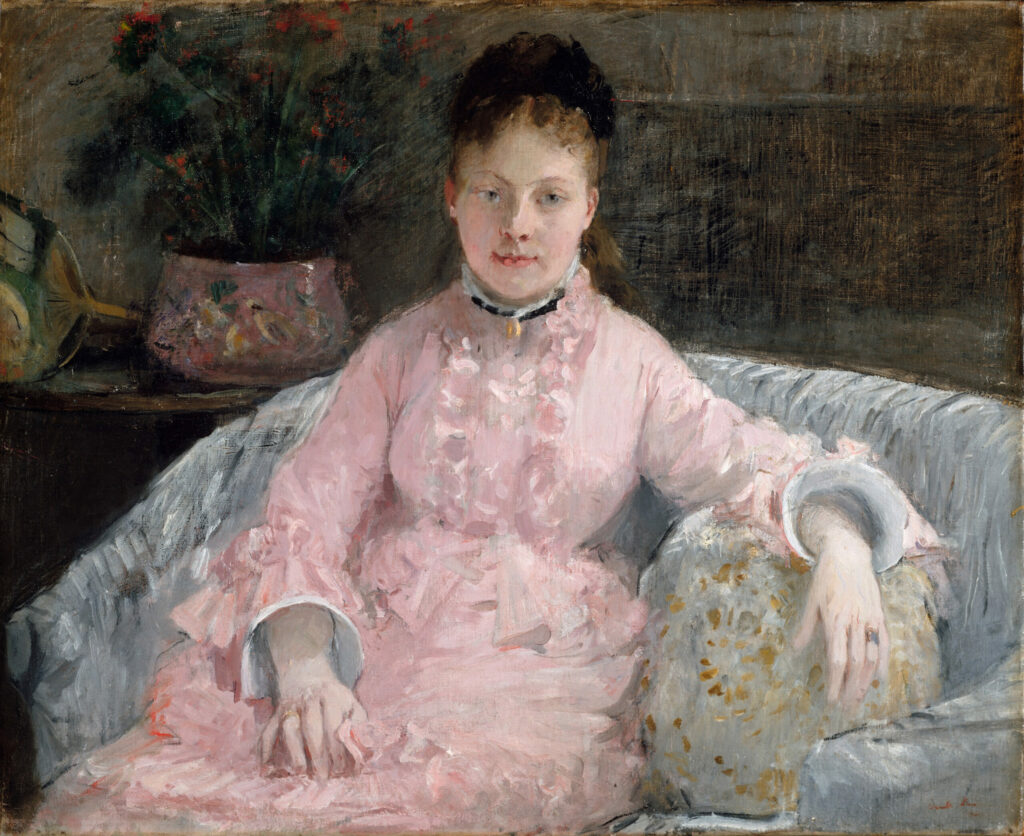
1870. In the Villa Fodor, Berthe Morisot sets up her easel facing Marguerite Carré dressed in an elegant pink gown. The artist hesitates, reworks, erases. Jacques-Émile Blanche, painter and privileged witness, recounts this obstinate quest for rightness.
A Composition Bathed in Light
Morisot captures Marguerite seated on a sofa. The pink dress dominates the composition with its brilliant luminosity and rapid touches that create an effect of shimmering fabric. The brushstrokes remain visible, assertive. Morisot does not smooth, she constructs through fragments of color. This technique eliminates heavy shadows in favor of subtle nuances. The result: a vibrant work that seems to capture the very instant.
A Modernity in Gestation
This portrait belongs to the years preceding the official birth of Impressionism. Morisot already explores the painting that Renoir or Monet would champion. She breaks with dark academicism to privilege natural light and spontaneity of gesture. Jacques-Émile Blanche testifies to her perfectionism: she endlessly repainted between sittings. This rigor explains why so few early works survived. The Pink Dress thus becomes a rare document on the evolution of a major 19th-century artist.
Berthe Morisot, Pioneer of Impressionism
Berthe Morisot (1841-1895) was one of the rare women admitted to the Impressionist circle. A student of Corot, she exhibited at the official Salon from 1864 before joining the Impressionists in 1874. Her style privileges feminine intimacy and bourgeois life, treated with audacious pictorial freedom.
Think about it
💭 And you, what does this young woman frozen in her luminous dress inspire in you?
About This Work
- The Pink Dress (Albertie-Marguerite Carré, later Madame Ferdinand-Henri Himmes)
- Berthe Morisot
- circa 1870
- Oil on canvas
- 80.6 × 99.7 cm
- The Metropolitan Museum of Art, New York
- https://www.metmuseum.org/art/collection/search/438009
A Canvas Painted Before Impressionism Was Born
The Pink Dress dates from around 1870, four years before the first Impressionist exhibition of 1874. Berthe Morisot had not yet made a formal break with the Salon: she had been exhibiting there since 1864 and continued to do so until her alignment with the Impressionists. This painting illustrates precisely that transitional moment, in which the young painter was finding her way between the teaching of Corot, whose pupil she had been, and the new demands of a painting that rejected academic convention. The visible brushwork, the luminous highlights on the dress, and the absence of heavy shadows already point toward the manner she would fully embrace in the years that followed.
The Model: Albertie-Marguerite Carré
The young woman depicted is not an anonymous model. She is Albertie-Marguerite Carré (1854-1935), who would later become, through marriage, Madame Ferdinand-Henri Himmes. This type of portrait, rooted in the bourgeois and feminine world that Morisot inhabited, is characteristic of her work: the painter rarely depicted strangers, preferring figures from her immediate circle, her sisters, her friends, her family. The model’s full name, preserved in the official title of the work at the Metropolitan Museum of Art in New York, reflects the care with which the museum has documented the identity of this real historical figure.
Corot, Morisot’s First Teacher
Before turning toward Impressionism, Berthe Morisot trained under Jean-Baptiste Camille Corot, one of the most significant landscape painters of the 19th century. From Corot she took in particular a sensitivity to diffuse light and the ability to render an atmosphere without recourse to rigid draughtsmanship. This inheritance is discernible in the overall tone of The Pink Dress, where light envelops the model with a softness that owes more to atmospheric observation than to any academic construction.