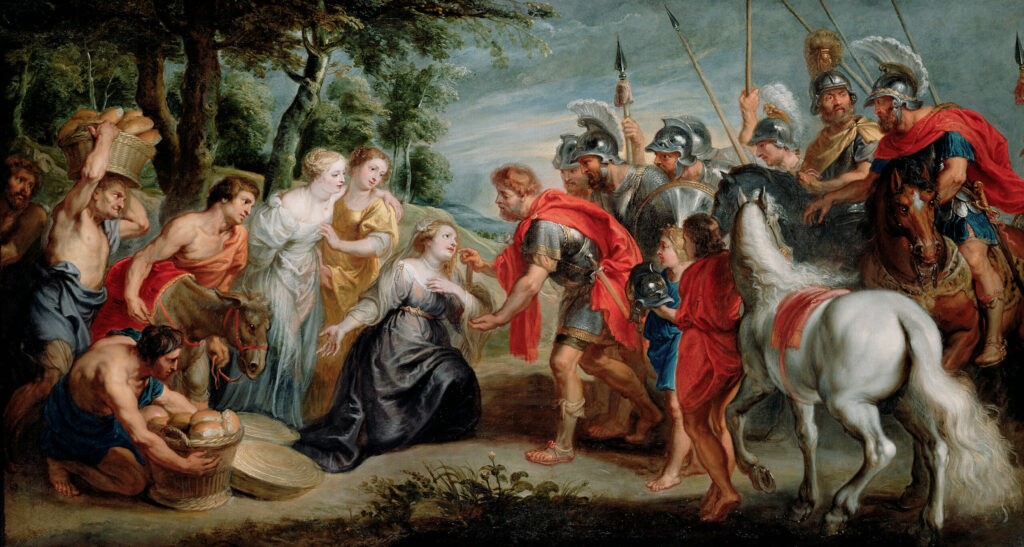
Early 1630s, Antwerp. Rubens’s workshop bustles with activity. A large horizontal canvas unfolds a biblical drama: the meeting between David and Abigail. The young warrior, haloed in his military glory, is about to massacre Nabal’s household. But a woman kneels in his path, laden with offerings.
A Living Frieze
The composition evokes an antique frieze. On the left, Abigail and her servants offer provisions. Shimmering silk robes explode in vibrant reds, deep blues, and luminous yellows. On the right, David dismounts from his white horse. The armor of his soldiers captures the light. Every helmet gleams, every lance rises toward the sky. Rubens multiplies expressive faces, eloquent gestures. The kneeling woman implores, the warrior hesitates. Observe the tension between violence and forgiveness, between anger and seduction.
A Moral Narrative in Service of Power
This scene illustrates the First Book of Samuel. Nabal refused to pay for the protection offered by David. A fatal gesture that would have cost the lives of his entire family. Abigail, through her beauty and diplomatic intelligence, transforms vengeance into clemency. Rubens’s workshop excelled in these large canvases destined for European palaces. Patrons read in them a political lesson: wisdom tempers violence.
The Workshop of Rubens, Master of Antwerp
Peter Paul Rubens (1577-1640) then directed the largest workshop in Northern Europe. His collaborators executed his compositions under his supervision. This system allowed abundant production of quality. The Flemish Baroque style triumphs: movement, color, theatricality.
Think about it
💭 Which gesture of Abigail touches you most: her courage facing armed soldiers or her forgiveness for her husband’s offense?
About This Work
- David Meeting Abigail
- Workshop of Peter Paul Rubens
- early 1630s
- Oil on canvas
- 123.2 × 228 cm
- The J. Paul Getty Museum, Los Angeles
- https://www.getty.edu/art/collection/object/103RCW
The Antwerp Workshop and Large-Scale Production
David Meeting Abigail is a work produced in the workshop of Peter Paul Rubens rather than by the master’s hand alone, a distinction that 20th-century art historians gradually established through stylistic analysis and archival documentation. Rubens (1577-1640) ran one of the most productive studios in Europe from his house in Antwerp: collaborators including Jan Brueghel the Younger, Frans Snyders, and Antoon van Dyck executed compositions that the master had designed, to which he sometimes added final touches. The painting’s large format, nearly 228 cm wide, corresponds precisely to the type of commission the workshop produced for aristocratic patrons and European courts in search of monumental decorations.
Abigail: Diplomacy as the Highest Virtue
The scene illustrates an episode from the First Book of Samuel (25:18-35): Abigail, wife of the wealthy but brutish Nabal, goes out to meet the future king David, who is preparing to slaughter her husband’s entire household in retaliation for an insult. She comes in procession, with donkeys laden with provisions, and through persuasive rhetoric diverts David from vengeance. Rubens’s workshop treats this encounter as an antique frieze: the figures are arranged in depth across the full width of the canvas, while a white horse anchors the centre of the composition. The silks of the robes, brilliant reds, deep blues, golden yellows, make the draperies the primary vehicle of technical display. The political message was legible to any 17th-century patron: diplomatic wisdom, embodied by a woman, can temper the violence of military power. The painting’s acquisition by J. Paul Getty in 1973 brought it into a collection where Flemish Baroque is among the strongest holdings.