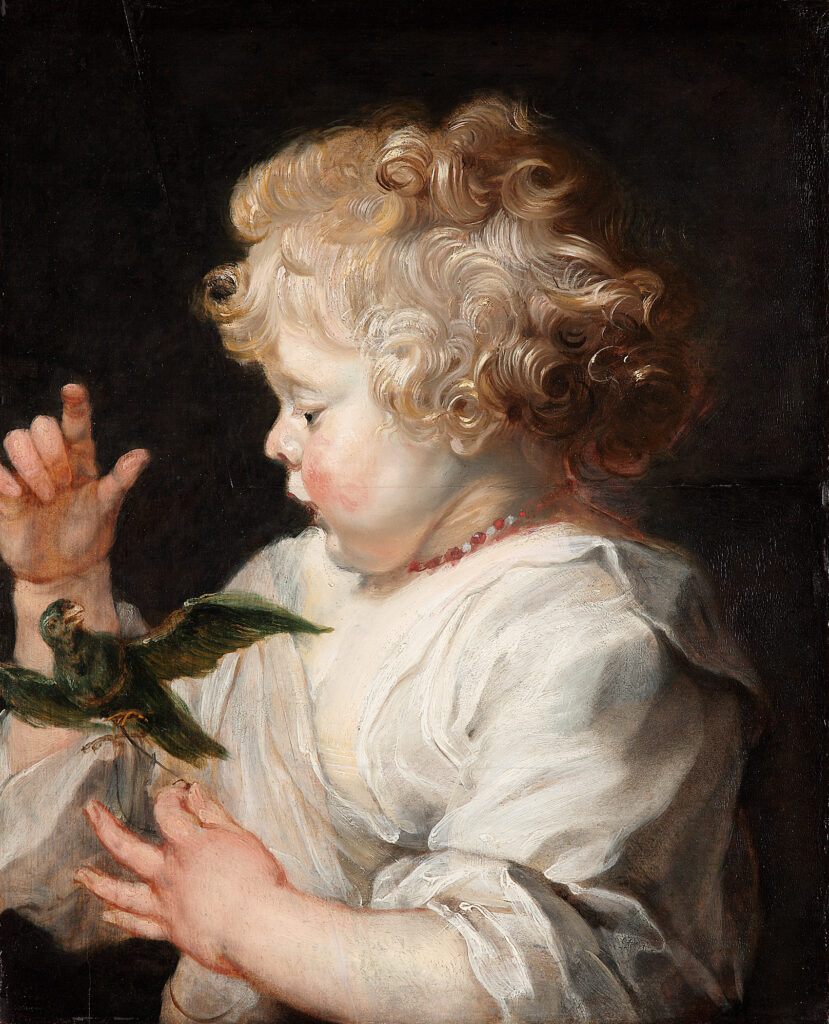
Antwerp, circa 1614. In his flourishing workshop, Rubens captures a child’s face. His nephew Philipp, barely three years old, poses before him. The Flemish master creates a head study for his own use.
A Portrait Captured from Life
Observe this perfect profile. Blond curls spiral in luminous volutes against a dark background. The rosy complexion glows. Each brushstroke celebrates childhood in its natural grace. The little boy wears a red coral necklace, a symbol of protection and vitality in the 17th century. His chubby hands hold a finch attached by a short cord. This profile view remains unique in Antwerp Baroque painting. No frozen pose: the child lives before our eyes. But this work hides a secret. After 1625, a workshop assistant enlarged the panel. He added the hands and the bird. The pigments differ, the execution changes.
From Workshop Study to Autonomous Work
This head initially served as a model in Rubens’s workshop. The master used it to create putti in his compositions. This same face appears in the Virgin with a Garland of Flowers in Munich. Peter Paul Rubens thus transformed his studies into veritable image banks. The bird symbolizes childhood education, character development. This workshop practice illustrates the production methods of the great Flemish masters responding to numerous commissions.
Peter Paul Rubens
Having returned from Italy in glory, Rubens (1577-1640) directed the most important workshop in Antwerp. He mastered the art of portraiture while training numerous assistants who adapted his models.
Think about it
💭 This study head become painting: where does the work of art begin? In the painter’s intention or in the gaze that consecrates it?
About this Work
- Child with a BirdPeter Paul Rubens
- circa 1614 (revised after 1625)
- Staatliche Museen zu Berlin, Gemäldegalerie / Christoph Schmidt Public Domain
- Oil on oak panel
- 50.9 × 41 cm
- https://recherche.smb.museum/detail/870518/das-kind-mit-dem-vogel