Brussels, 1614. Jan Brueghel commissions Rubens to create an epitaph honoring his father, Pieter Bruegel the Elder. The Flemish master chooses to paint the moment when Christ founds his Church. An instant of divine transmission frozen in oil.
Baroque Monumentality in Service of the Sacred
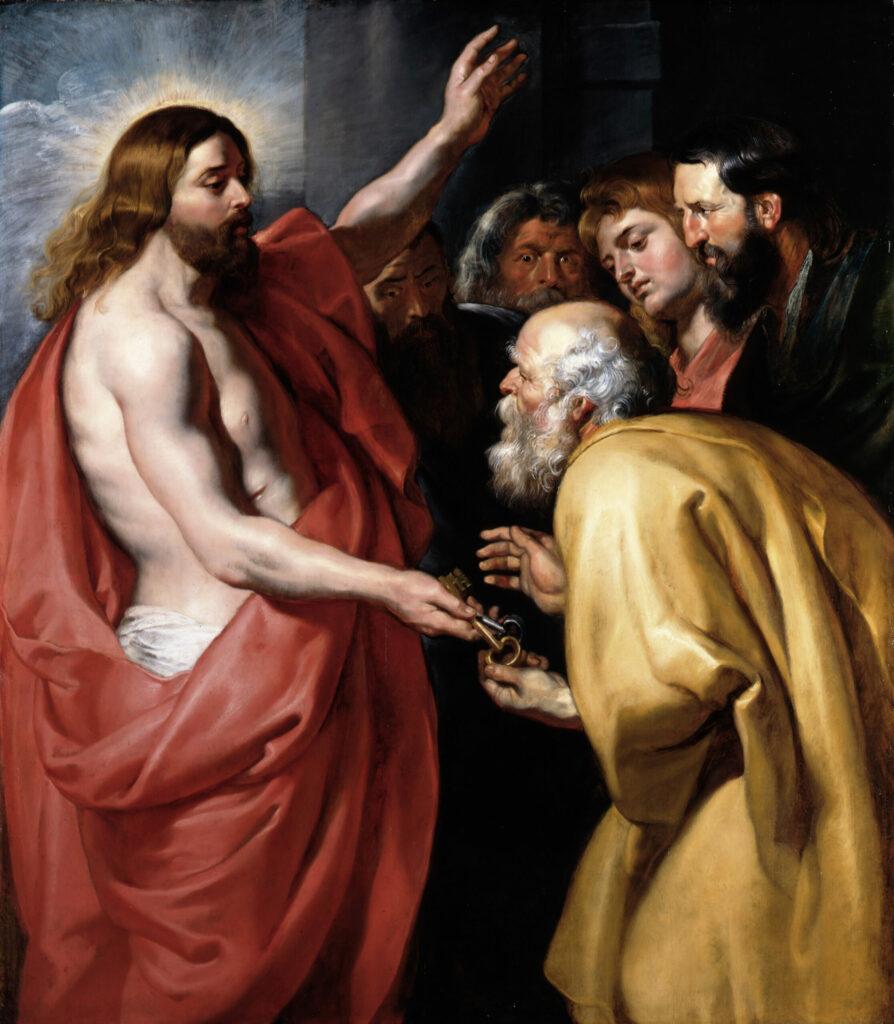
The eye first slides toward those two keys suspended between Christ’s hands and Peter’s. The former fisherman of Galilee is draped in a heavy yellow cloak with generous folds. His gesture mingles gratitude and awe. Christ stands out in his vivid red robe. His right hand points toward heaven.
Behind them, four disciples gather: Paul with his fixed gaze turned toward us, John with youthful and gentle features, James scrutinizing Christ intensely. Peter Paul Rubens composes his painting with breathtaking technical mastery. Luminous contrasts sculpt the bodies, deep shadows dramatize the scene.
One Genius’s Epitaph for Another
This work symbolizes the institution of the papacy, a cherished theme in Italian art but rare in Flanders. Rubens, then a sought-after painter throughout Europe, worked for ecclesiastical and princely patrons. His style absorbed Italian influences, notably Caravaggio’s humanist conception. This composition would serve as a model for numerous artists through an engraving by Pieter de Jode I.
Peter Paul Rubens
Diplomat and Antwerp painter, Rubens (1577-1640) embodied Flemish Baroque. Trained in Italy, he developed a dynamic style combining vibrant colors and monumental compositions. This work illustrates his early Antwerp period.
Think about it
💭 In this scene of spiritual power’s transmission, intended to adorn a tomb, does Baroque art seek to move or to convince the faithful who contemplate it?
About This Work
- Christ Giving the Keys of Heaven to Saint Peter
- Peter Paul Rubens
- circa 1613-1615
- Oil on oak panel
- 182.5 × 159 cm
- Gemäldegalerie, Berlin
- https://recherche.smb.museum/detail/863360/christus-%C3%BCbergibt-dem-heiligen-petrus-die-himmelsschl%C3%BCssel
“Tu es Petrus”: The Foundation of the Church in Paint
Christ Giving the Keys of Heaven to Saint Peter depicts one of the doctrinal foundations of Roman Catholicism: the passage from the Gospel of Matthew (16:18-19) where Christ designates Peter, “thou art Peter, and upon this rock I will build my church”, as the first custodian of the keys of the kingdom of heaven. Rubens chooses to represent not the words but the act: the two suspended keys, passing between the two men’s hands, condense into a single object the transfer of spiritual authority. Peter, wearing a heavy yellow cloak with generous folds, occupies the left side of the composition, while Christ, in brilliant red robes, raises his right hand toward heaven in a gesture of divine command. Four disciples, Paul, John, James, and a fourth apostle, frame the scene as witnesses to an act that binds the future of Christendom.
Rubens and Jan Brueghel: A Friendship Behind the Commission
The painting is closely linked to the relationship between Peter Paul Rubens (1577-1640) and Jan Brueghel the Elder (1568-1625), son of Pieter Bruegel the Elder, with whom Rubens maintained from the early 1600s a deep friendship and regular artistic collaboration. Several sources connect this work to a memorial commission from the Brueghel family. Rubens deploys his full Baroque vocabulary here: the luminous contrasts that sculpt the volumes of the draperies, the monumentality of the figures inherited from Raphael and Michelangelo, and a dramatic tension sustained by the arrangement of bodies inclining toward one another in a circular movement. The Flemish engraver Pieter de Jode I would later disseminate the composition through engraving, extending its influence on subsequent generations of painters.
The Pontifical Theme in Flemish Painting
The subject of the transfer of the keys is relatively rare in 17th-century Flemish art, where the majority Protestant painters avoided themes linked to papal authority. That Rubens, a devout Catholic and diplomat in the service of the Spanish Habsburgs, chose this subject is not accidental. His Italian sojourns between 1600 and 1608, notably in Rome where he studied the frescoes of Raphael and Michelangelo, had deeply shaped his understanding of religious history painting. Christ Giving the Keys of Heaven to Saint Peter belongs to this ambition to rival the great Roman tradition and transplant it into the Catholic Southern Netherlands.