Antwerp, c. 1620. Rubens seizes upon an ancient myth and transforms it into a hymn to nascent love. He orchestrates the encounter between a hero and a princess on the edge of the abyss.
The Baroque Breath of Liberation
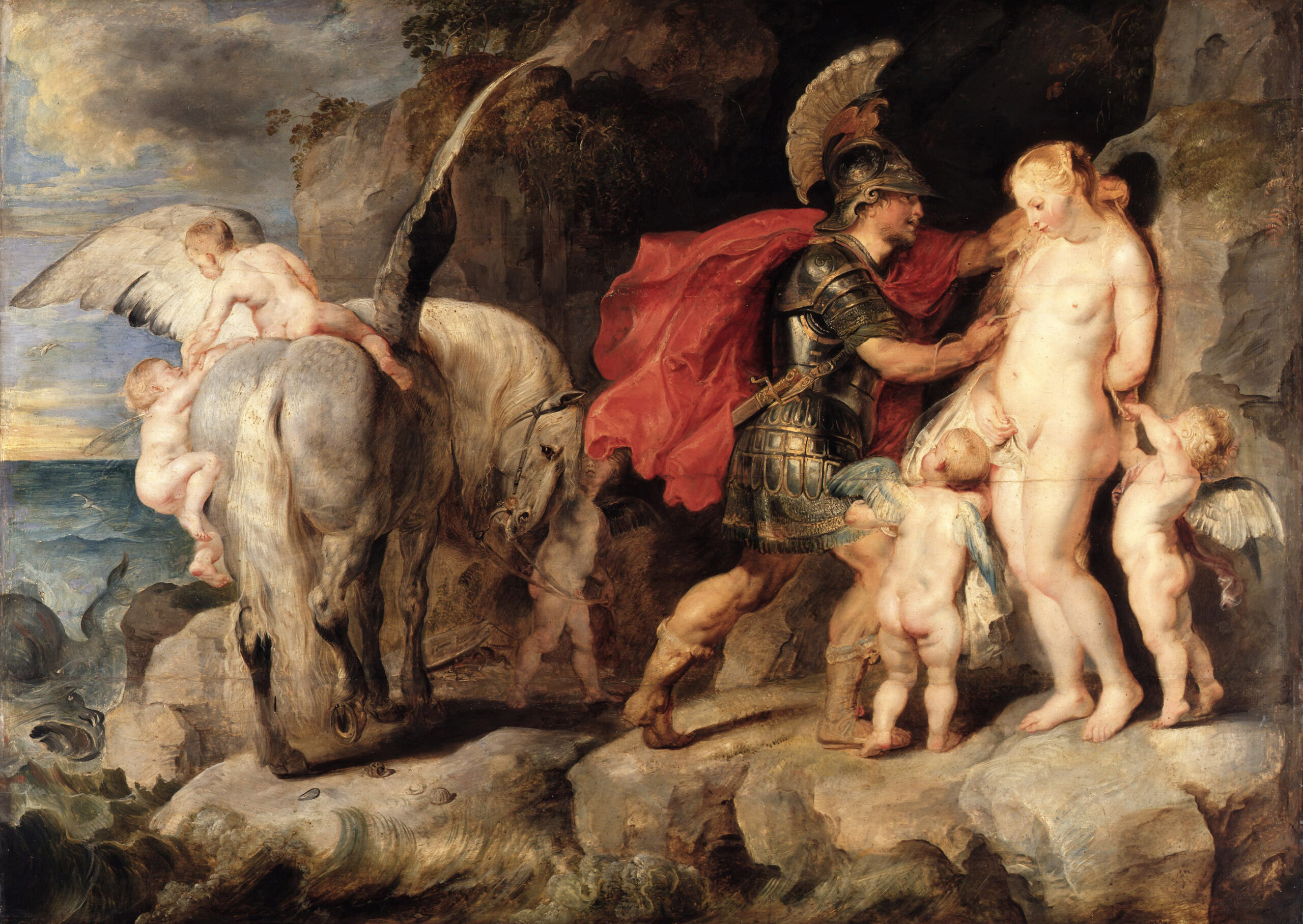
Read the scene from left to right. In the dark waves, the carcass of the sea monster still floats. Pegasus, a powerful winged horse with a pearlescent coat, commands the centre. The eye is drawn toward Perseus. Clad in dark steel armour and draped in a brilliant red cloak, he grasps the bonds that hold Andromeda. The princess, bathed in golden light, tilts her head. Her delicately modelled body draws inspiration from the Venus Felix in the Vatican collections. Rubens’s brushwork is free and vibrant. The flesh tones pulse with life. The deep red of the cloak throbs. Everything is movement.
Ovid Reread by a Flemish Genius
In his Metamorphoses, the poet Ovid separated the encounter from the combat. Rubens fuses both moments into one. Andromeda, daughter of the Ethiopian king Cepheus, had been chained to a rock to atone for the pride of her mother Cassiopeia, who had dared challenge the Nereids. Here, mythological narrative becomes the pretext for a masterful composition. The scene unfolds on a rocky ledge. Each figure contributes to an ascending rhythm. The virile power of the hero answers the trusting abandon of the young woman. The chosen moment is the one where victory gives way to the stirring of love.
Peter Paul Rubens
Rubens (1577-1640), born in Siegen and trained in Italy, is the undisputed master of Flemish Baroque painting. A diplomat and humanist, he infused his art with learned references to antiquity. This panel is a striking example.
Think about it
💭 What catches your eye first: the hero’s strength or Andromeda’s silent grace?
About This Work
- Perseus Freeing Andromeda
- Peter Paul Rubens
- 1620–1622
- Oil on oak panel
- 99.7 × 139.6 cm
- Gemäldegalerie, Staatliche Museen zu Berlin
- https://recherche.smb.museum/detail/871562/perseus-befreit-andromeda
Victory and Love in a Single Gesture
Perseus Freeing Andromeda is one of the most celebrated readings of the Ovidian myth by Pierre Paul Rubens (Siegen, 1577 – Antwerp, 1640). The composition fuses into one instant two moments that Ovid’s Metamorphoses presents in sequence: the combat with the sea monster, whose remains sink into dark waves at the left, and the first encounter between the victorious hero and the liberated princess. Perseus, armored and draped in a vivid red cape, grasps Andromeda’s chains. The princess, bathed in golden light, inclines her head in a gesture of gratitude and wonder. Pegasus occupies the center, while putti hover in the upper register.
Rubens and Mythology: Erudition and Sensuality
In Rubens’s painting, mythology is never a decorative pretext but living material approached with the rigor of a humanist and the sensuality of a great painter. For Perseus Freeing Andromeda, he drew on the Venus Felix in the Vatican collections as a model for Andromeda’s figure, a reference to ancient sculpture that grounds the figure in classical tradition while lending her an immediate physical presence. The palette, warm reds, golds, deep blues, and the upward rhythm of the composition, from the defeated monster to Pegasus in flight, give visual form to the passage from threat to deliverance. The Gemäldegalerie in Berlin holds this canvas as one of the outstanding works of Flemish Baroque in its collection, and among Rubens’s mythological paintings it remains among the most legible in its emotional arc: the movement from darkness to light, from violence to tenderness, resolved in a single painted moment.