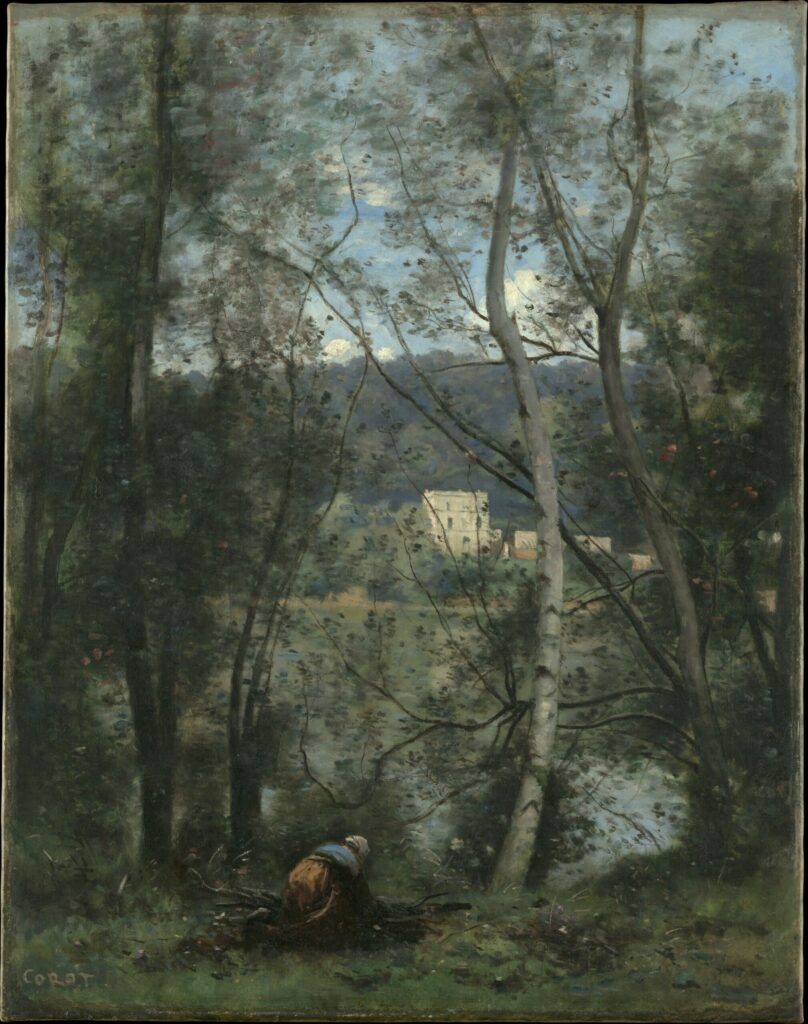
Camille Corot offers us here a poetic vision of Ville-d’Avray, where nature becomes both sanctuary and theater of daily life.
Through a delicate curtain of silver-tinted trees, the gaze slips toward a clearing bathed in diaphanous light. In the foreground, a humble woman, bent over her task, gathers faggots, a solitary silhouette that anchors the work in earthly reality while conferring an timeless dimension. The slender trunks, veritable living columns, create a mysterious depth while the luminous opening at the center reveals, as if by happy indiscretion, the distant presence of a peaceful dwelling.
Corot handles his palette here with an almost musical sensitivity: the tender greens, pearly grays, and subtle touches of blue compose a visual symphony in which vibrate the freshness of the air and the gentle melancholy of the woodland undergrowth.
Additional Information
- Title: “Woman Gathering Faggots at Ville-d’Avray” by Camille Corot, circa 1871-1874
- Dimensions: 28 3/8 x 22 1/2 in. (72.1 x 57.2 cm)
- Location: The Metropolitan Museum of Art, Fifth Avenue, New York, exhibited in Gallery 803
- https://www.metmuseum.org/art/collection/search/435990
Jean-Baptiste Camille Corot (1796-1875), a figure of 19th-century French landscape painting, renewed the genre through his unique atmospheric sensitivity. Trained in the neoclassical tradition, he gradually freed himself from it to develop a personal style where light becomes the protagonist.
Corot established an essential bridge between classicism and nascent impressionism. Ville-d’Avray, his family’s anchor place, became his privileged laboratory, where he perfected this lyrical vision of nature that would profoundly influence subsequent generations. His vaporous technique, sometimes compared to the effects of photography, reveals an artist in constant search, whose work transcends categories to reach a universal truth about the fleeting beauty of the world.
Ville-d’Avray: The Laboratory of a Lifetime
A Woman Gathering Faggots at Ville-d’Avray is one of the last paintings of Jean-Baptiste-Camille Corot (Paris, 1796 – Paris, 1875), executed in the final four years of his life. Ville-d’Avray, a commune in the Hauts-de-Seine, today absorbed into the western suburbs of Paris, is the thread that runs through his entire career. The Corot family owned a country house there from his childhood, and it was on the banks of its ponds and in its woodlands that he forged his vision of French landscape. Corot returned to Ville-d’Avray throughout his life, producing hundreds of studies and finished paintings: from the early plein-air works of the 1820s, still disciplined by the neoclassical teaching of his master Achille-Etna Michallon, to the vaporous silvery compositions of his old age that earned him extraordinary popularity in the Parisian salons of the 1860s and 1870s.
The Touch of Old Age: Silver, Mist, and Poetry
What Corot produces here, deep in his final period, is the most accomplished expression of his “grey manner”, those landscapes of unified silver tonality in which tree trunks rise like columns in luminous mist, and vegetation dissolves into masses of almost immaterial texture. The woman gathering faggots in the foreground is not the primary subject: she is a human accent, a silhouette that roots the composition in time and everyday life without ever competing with the presence of the trees and the light. A contemporary critic of Corot observed: “what he sees everywhere is not what is in nature, it is what is in himself.” That formulation captures what the Impressionists would owe him, not a technique, but a permission to allow the painter’s interiority to transform observed reality. The suggestion that the characteristic blur of his late foliage may reflect influence from nineteenth-century photography, whose long exposures produced movement blur, has been noted by art historians as a plausible element in the visual culture Corot absorbed in his final decade. Now at the Metropolitan Museum in New York, this canvas is evidence of a painter who at seventy-five handled his brushes with a freedom and quiet assurance that only a lifetime of practice can produce.