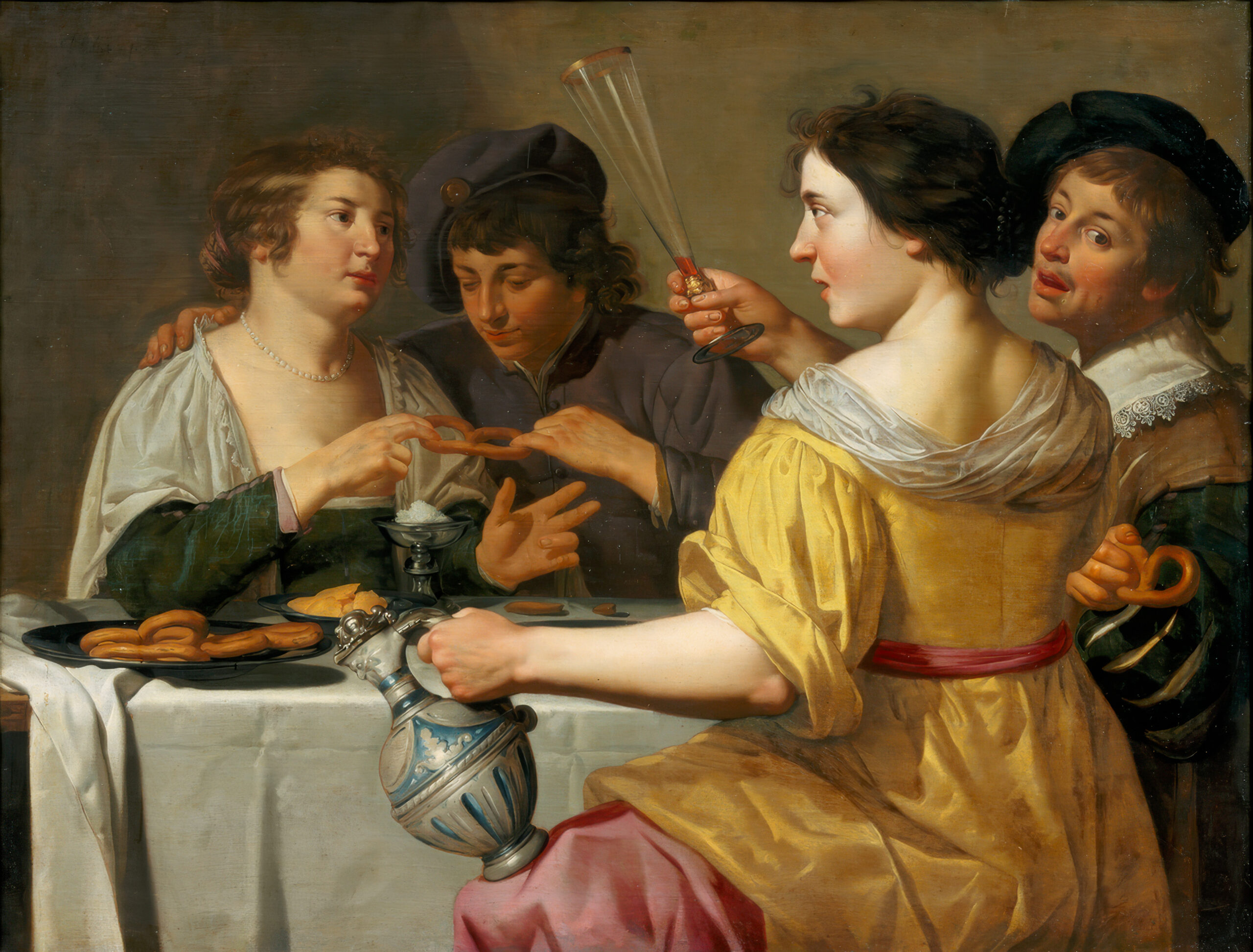
This scene strikes me at once as a joyful gathering among friends. It took me a moment to notice the pretzel game itself: although it is the central motif of the painting, it remains discreetly placed in shadow, almost withdrawn from the light that illuminates the faces. The two figures each pull on one end of the pretzel, hoping to win the larger piece and, with it, the granting of a wish.
What strikes me most is the exchange of glances between the protagonists. Not a word is spoken, and yet everything seems to be conveyed through the eyes: Van Bijlert chose to capture the moment just before the outcome, when nothing is yet decided. A slight tension builds, almost teasing, for the game has only just begun, the third figure is seen holding out the pastry to his companion, in a gesture inviting her to join in.
This is a lively, good-humoured genre scene, characteristic of the Dutch taste for the simple pleasures of sociability. Yet as is often the case in Golden Age painting, this apparent lightness may conceal a graver meaning: the pretzel, as quickly broken as it is shared, can be read as a quiet reminder of the fragility and brevity of life, a veiled echo of the vanitas theme so dear to painters of the period.
Your eye is drawn first to those two fingers closing around the golden dough of a pretzel. Around them, four faces lean in, a glass is raised, a jug pours its water.
What lies beneath the surface
Jan van Bijlert painted this tavern scene around 1630–1640, in the warm brown tones of Utrecht Caravaggism. Light falls on the hands and faces, leaving the pretzel almost in shadow. Those two fingers closing around the dough may hint at cheating, in a game where each player pulls to claim the larger half. On the table: a silver jug, more pretzels, a bowl of salt.
The artist and his time
Van Bijlert was born in Utrecht around 1597. Trained under Abraham Bloemaert, he travelled to Rome, where he discovered the art of Caravaggio. Back in his native city, he joined the Utrecht Caravaggisti, alongside Honthorst and Ter Brugghen. He painted lively genre scenes before turning to more classical religious subjects later in his career.
Timely resonance
In 2026, the Centraal Museum in Utrecht, home to Jan van Bijlert’s The Pretzel Game, is presenting its first major retrospective devoted to Gerard van Honthorst (1592–1656), titled Gerard van Honthorst – Different to Rembrandt, on view from 25 April to 13 September 2026. The exhibition brings together some sixty paintings and thirty drawings from international collections, including the Musée du Louvre, the British Royal Collection, and the Galleria Borghese. Honthorst, like van Bijlert, was among the leading figures of the Utrecht Caravaggisti, a movement shaped by Caravaggio’s influence and his bold contrasts of light.
Source: Centraal Museum
A question for you
💭 What detail in this painting catches your eye first?
About this work
- The Pretzel Game
- Jan van Bijlert
- c. 1630–1640
- Oil on canvas
- 108.5 x 137.4 cm
- Centraal Museum, Utrecht
- https://collectie.centraalmuseum.nl/details/collection/13294