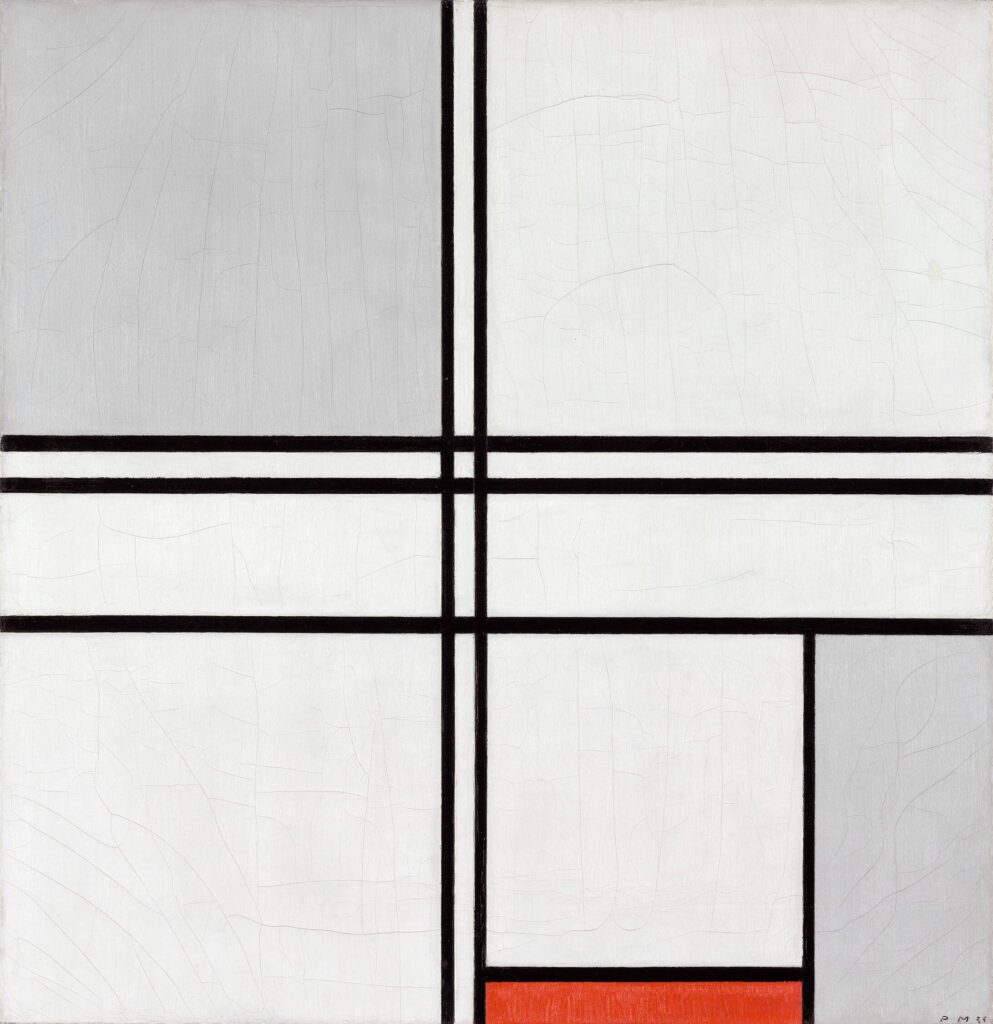
In this iconic work, Mondrian offers us a visual symphony of absolute rigor. The undisputed master of geometric abstraction deploys his refined plastic language to its very essence.
The black lines, with mathematical precision, structure the pictorial space by creating a grid with carefully calculated proportions. This rigorous architecture generates rectangular planes where the dominant white, symbol of purity and infinity, dialogues with touches of gray and a vibrant red that irresistibly draws the eye. This deliberately reduced chromaticism gives the whole a dynamic tension. Each element seems to find its rightful place in a balance between movement and stability, between silence and resonance. Mondrian succeeds here in transcending the limits of the canvas to invite us to a contemplative experience that approaches spiritual meditation.
Artwork Details
- Title: Composition (No. 1) Gray-Red
- Artist: Piet Mondrian
- Date: 1935
- Dimensions: 57.5 × 55.6 cm
- Location: The Art Institute of Chicago, Modern Art, Gallery 393
- https://www.artic.edu/artworks/65821/composition-no-1-gray-red
About the Artist
Piet Mondrian (1872-1944) remains one of the most influential figures in modern art. After figurative beginnings marked by the influence of symbolism and cubism, the Dutch artist gradually evolved toward radical geometric abstraction that he called “neoplasticism.” Co-founder of the De Stijl movement in 1917, Mondrian developed an aesthetic theory where reduction to essential elements, straight lines, right angles, primary colors, aims to express universal harmony.
This mystical quest for balance between opposing forces runs throughout his work. He considerably influenced 20th-century architecture, design, and graphic arts. His utopian vision of pure art, capable of contributing to social harmony, makes him a visionary artist.
Neoplasticism: Reducing to the Universal
Composition (No. 1) Gray-Red (1935, Art Institute of Chicago, Gallery 393, 57.5 × 55.6 cm) is a work from Mondrian’s full maturity. Piet Mondrian (1872-1944) co-founded the De Stijl movement in 1917 with Theo van Doesburg and other Dutch artists, developing within it the theory of Neoplasticism: the idea that painting can and must reduce itself to its most fundamental elements, the straight line, the right angle, the primary colours (red, blue, yellow) and the non-colours (white, grey, black). For Mondrian, this reduction was not an impoverishment but a revelation: by eliminating everything particular, anecdotal, or subjective, painting reaches a universal truth that transcends the visible. By 1935, settled in Paris since 1919, Mondrian was applying these principles with millimetric rigour.
The Grid and the Red Accent
In Composition (No. 1) Gray-Red, the orthogonal grid of black lines structures a space dominated by white and grey planes, animated by a single red rectangle in the lower left corner. This chromatic economy is deliberate: Mondrian weighs each colour plane, each line thickness, each proportion of empty space the way a composer weighs silences. The red accent, small but magnetic, illustrates the theory of “dynamic oppositions”: in a composition founded on neutrality, a single coloured element generates a tension that radiates across the whole. The near-square format (57.5 × 55.6 cm) reinforces balance without falling into symmetry.
From Paris to New York: The Final Years
This work was painted in Paris, where Mondrian resided from 1919 to 1938 — a period of quiet gestation contrasting with the two final acts of his life: London (1938-1940), then New York (1940-1944), where his last canvases (Broadway Boogie-Woogie, 1942-1943) took on a colour and rhythm unprecedented in his work, under the influence of American jazz. Composition (No. 1) Gray-Red belongs to the most austere Parisian period, when his mastery was complete and the reduction had been carried to its extreme, before the city of New York reintroduced an unexpected chromatic jubilation into the Neoplastic vocabulary.
The Legacy of De Stijl in Contemporary Design
The influence of Mondrian and De Stijl extends far beyond painting. Architecture (Gerrit Rietveld and the Rietveld Schröder House, 1924), graphic design, typography, furniture, and fashion have all absorbed and transformed the Mondrian vocabulary. Composition (No. 1) Gray-Red is one of those works whose form generated a universally recognizable iconography, to the point that Mondrian’s black and red grid has become, in the visual culture of the 20th century, a symbol of modernity itself.