Genoa, 1621. Van Dyck arrives in Italy and meets one of the most powerful men in the Republic. He must immortalize him. The challenge is immense.
The crimson that devours the canvas
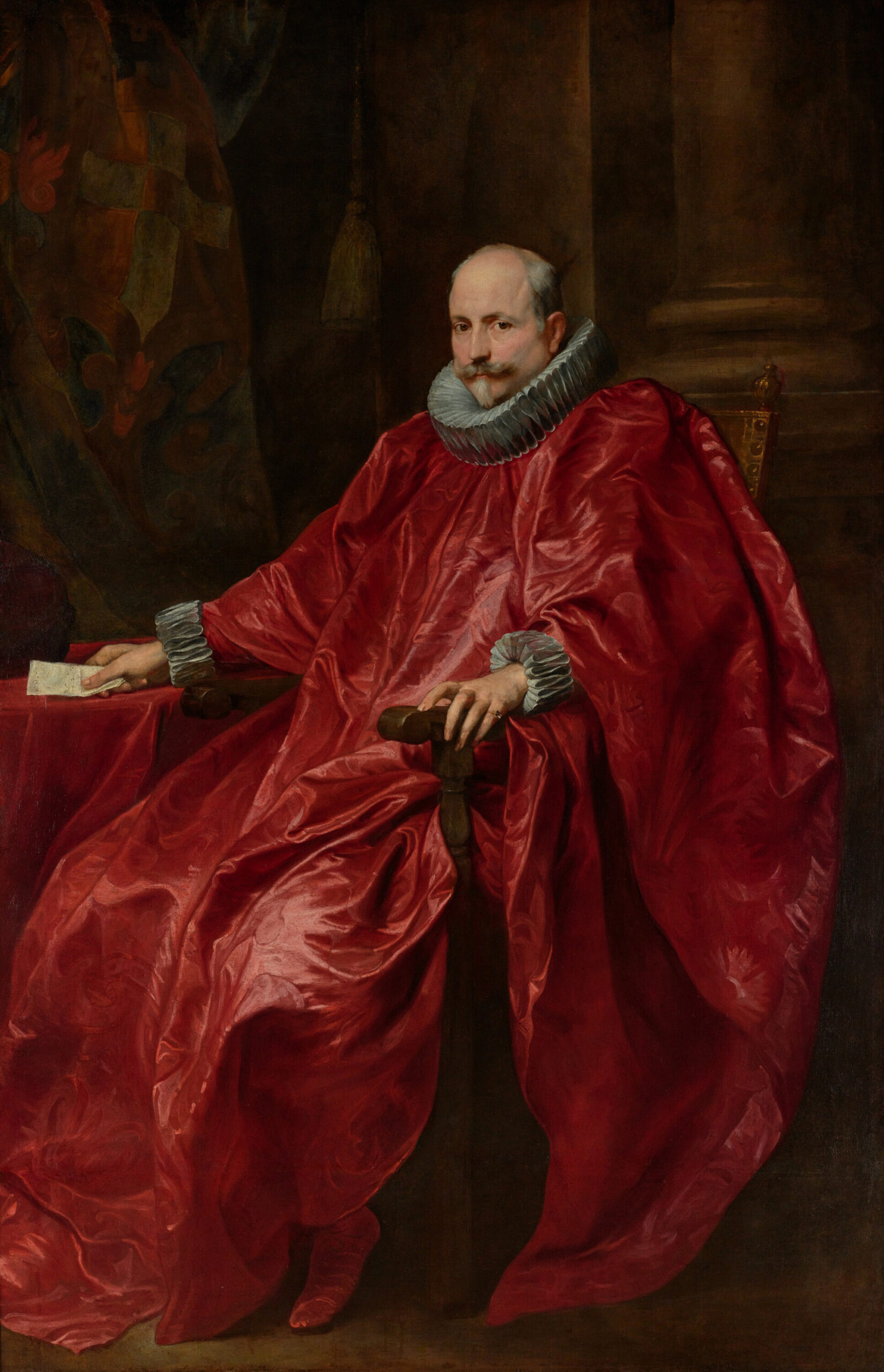
Look at this red — it floods nearly every inch of the space. The crimson silk robe of Agostino Pallavicini seems to possess a life of its own. Van Dyck renders it with breathtaking virtuosity: every fold catches the light differently. The sitter himself seems almost secondary. A pleated ruff frames the serene face of a mature man, his gaze calm and assured. His left hand holds a document. His right rests on the armrest. Two gestures, two forms of power: diplomacy and rank.
An ambassador before the newly elected pope
This portrait commemorates a specific mission. Pallavicini has just served as ambassador of the Republic of Genoa to Pope Gregory XV, elected in February 1621. The red of his robe is no aesthetic choice: it is an official costume, a mark of authority. In the background to the left, the Pallavicini family coat of arms is discreetly woven into the drapery, anchoring the sitter’s identity with documentary certainty. This kind of ceremonial portrait was as much a political instrument as an artistic one. To display one’s power was already to wield it.
Van Dyck, portraitist to the European elite
Anthony van Dyck (1599-1641) left Antwerp in 1621 for a five-year stay in Italy. He discovered the great masters, private collections, and aristocratic courts. This painting ranks among his very first Italian works — one in which he forged the style that would bring him lasting fame: sovereign elegance, subtle psychology, and sensuously rendered materials.
A question for you
💭 Caravaggio shook Rome with shadow. Van Dyck answered with light on silk. Two ways of inhabiting the Baroque — which speaks to you more?
About this work
- Portrait of Agostino Pallavicini
- Anthony van Dyck
- c. 1621
- Oil on canvas
- 85⅝ × 56 in. (217.5 × 142.2 cm)
- J. Paul Getty Museum, Los Angeles
- https://www.getty.edu/art/collection/object/103R9N