A Sublime Vision of the Dutch Countryside. In this masterpiece of 17th-century Dutch painting, Ruisdael offers a sublime vision of the Netherlands countryside where a dialogue unfolds between sky and earth.
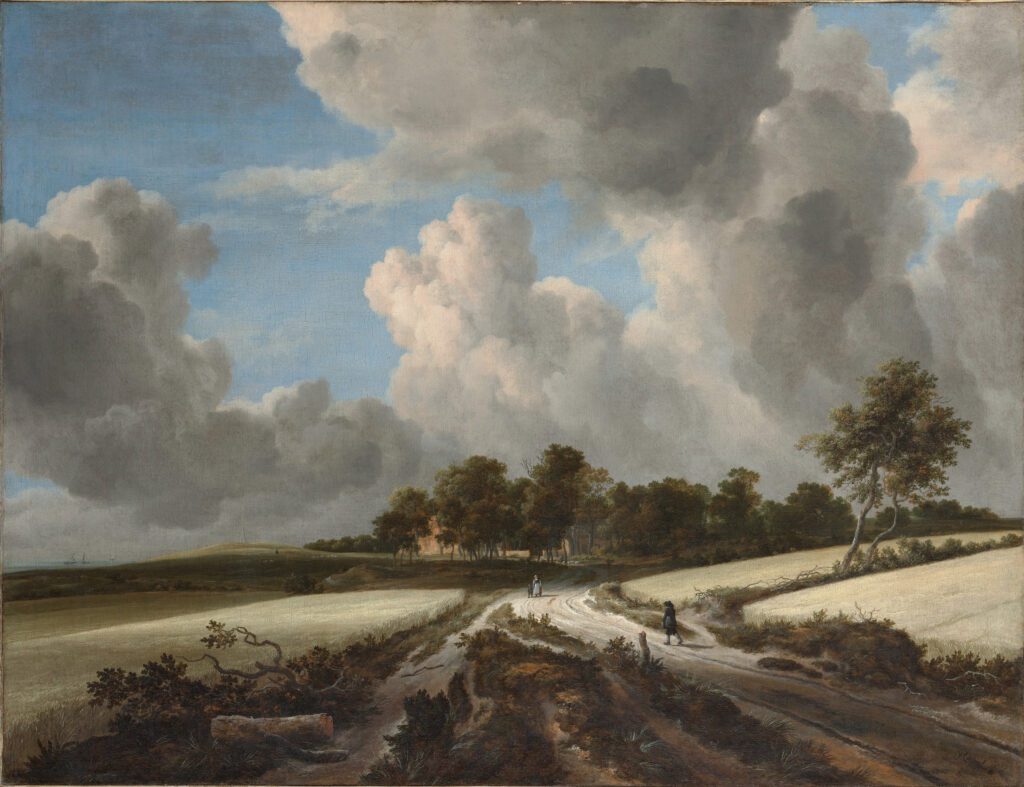
“Wheat Fields” captivates first through its sky, a veritable operatic theater where a dramatic ballet of monumental clouds plays out. This celestial choreography occupies two-thirds of the composition, asserting the predominance of natural forces over humble human activity. Below, a winding path guides our gaze across the fields toward a grove of trees silhouetted against the horizon. The tiny figures of strollers emphasize the scale of the landscape and our insignificance against the elements.
The subtle palette, dominated by muted greens and silvery blues, reveals perfect mastery of luminous transitions and atmospheric values, capturing with remarkable accuracy the very essence of the Dutch landscape.
Essential Information
- Wheat Fields by Jacob van Ruisdael, circa 1670
- Dimensions: 100 x 130.2 cm
- Location: The Metropolitan Museum of Art, Fifth Avenue, New York, Gallery 615
- https://www.metmuseum.org/art/collection/search/437549
Jacob van Ruisdael (circa 1628-1682) was undoubtedly the greatest landscape painter of the Dutch Golden Age, elevating this genre, considered minor at the time, to the level of high pictorial poetry. Born in Haarlem to a family of artists, this precocious genius developed a personal style very early in his career. Unlike his contemporaries who often painted idealized landscapes, Ruisdael found transcendent material in ordinary scenes of his native country. His vision transformed these everyday views into meditations on the human condition and the forces of nature.
Ruisdael’s influence was decisive for subsequent generations of landscape painters, from Constable to the Romantics, who recognized him as the first artist to capture not only the appearance of landscape but also its spiritual and emotional dimensions.
The Altman Bequest and Entry into the Metropolitan
Wheat Fields (c. 1670) entered the Metropolitan Museum of Art in New York in 1914 as part of the bequest of Benjamin Altman (accession number 14.40.623), one of the institution’s great benefactors. Altman (1840-1913), founder of the New York department store B. Altman and Company, devoted his fortune to assembling a collection of major European paintings, with particular focus on the Dutch and Flemish masters of the 17th century. His bequest to the Metropolitan includes several masterworks of the Dutch Golden Age. Wheat Fields is currently on view in gallery 615 of the museum. The art historian Thomas Craven regarded this composition as one of Ruisdael’s finest, originally intended for display above a fireplace, which accounts for its particularly imposing format (100 × 130 cm).
The Sky as Principal Subject
What distinguishes Wheat Fields from the majority of 17th-century Dutch landscapes is the proportion given to the sky: it occupies two-thirds of the canvas surface, leaving the lower third to the earth, the winding path, and the silhouettes of trees on the horizon line. Ruisdael does not treat the sky as a simple backdrop, he makes it the painting’s dynamic subject. The moving clouds, rendered in ranges of grey and bluish white, possess a mass and energy that contrast with the quietude of the agricultural landscape below. This attention to the sky would deeply influence English Romantic painters, and notably John Constable, who studied Ruisdael closely and credited him with having “invented” the emotional representation of the sky in landscape painting.