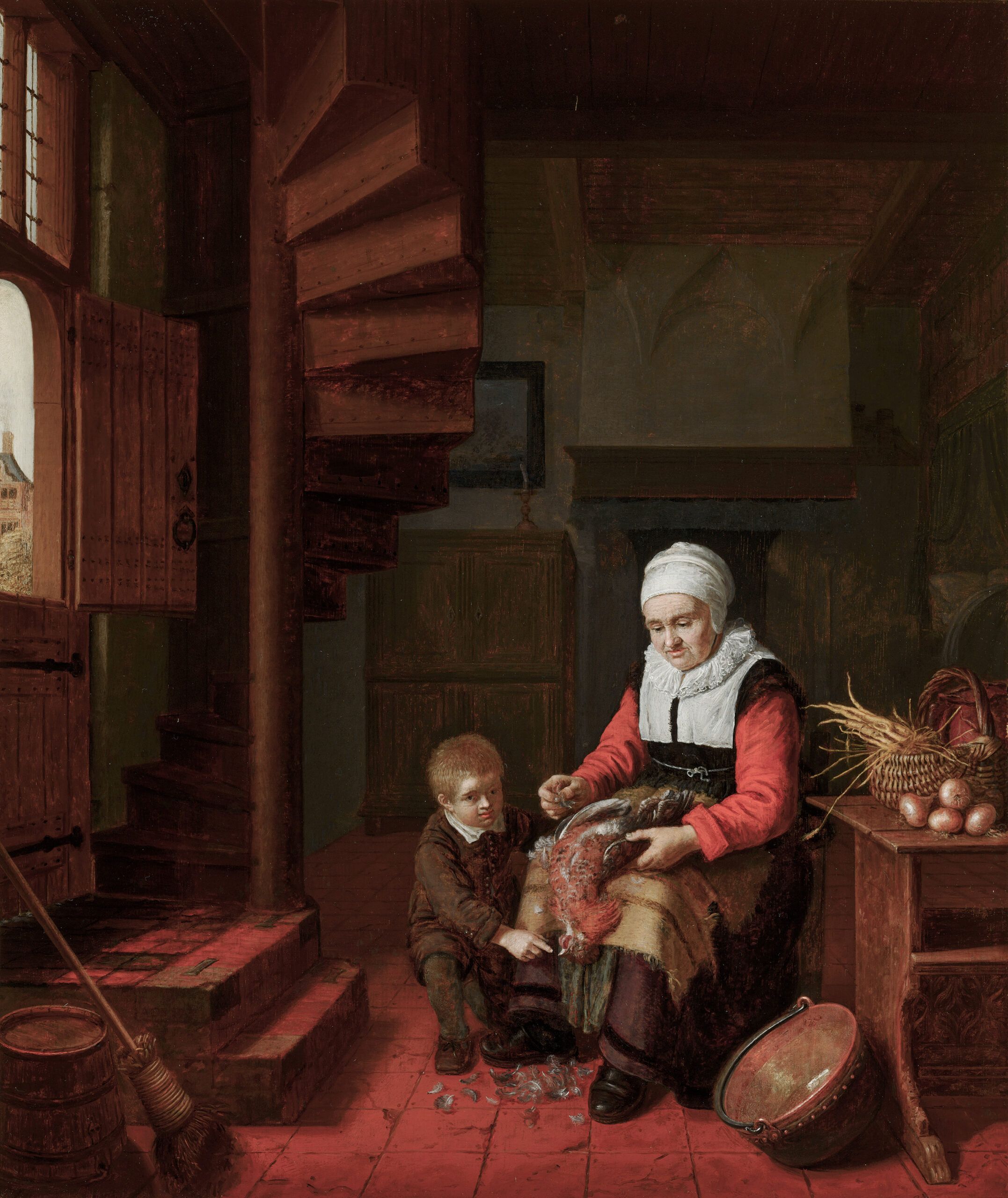
Leiden, c. 1650. In a Dutch kitchen, an old woman plucks a cockerel. A child watches, motionless. The scene is humble. It is immortal.
Light in the service of the everyday
Look at this woman. Her bonnet catches the light from a nearby window. Her wrinkled hands grip the feathers with precision. The vivid red of her jacket stands out against the brown tones of the interior. Abraham de Pape works on a wood panel with a tight, meticulous touch, inherited from the fijnschilders (“fine painters”) of Leiden. The details accumulate: the spiral staircase, the wicker basket, the onions. Every object breathes. Feathers fall onto the red flagstones. The child watches, wide-eyed.
Genre painting at the heart of the Dutch Golden Age
In the 17th century, the United Provinces enjoyed unprecedented commercial prosperity. A cultivated middle class commissioned scenes of daily life — kitchens, markets, interiors. These paintings are far from trivial. They celebrate Puritan values: labour, order. Preparing a cockerel for the table means feeding the family. It is the founding act of domestic life. The presence of the child reinforces this didactic dimension: knowledge passes from one generation to the next.
Abraham de Pape, disciple of the intimate
Born and active in Leiden, Abraham de Pape (1621–1666) was one of the founding members of the city’s painters’ guild. His style, closely aligned with that of Gerrit Dou, master of the fijnschilders, is distinguished by a remarkable fineness of execution. He excels in interiors populated with figures from ordinary life.
A question for you
💭 The fijnschilders elevated genre painting to the rank of high art. Is it the meticulous realism or the human warmth that makes these small-format works so powerful even today?
About this work
- Old Woman Plucking a Cock, Abraham de Pape, c. 1650, Mauritshuis, The Hague
- Oil on panel, 49 × 41.2 cm
- Mauritshuis, The Hague
- https://www.mauritshuis.nl/fr/decouvrir-la-collection/oeuvres-d-art/130-old-woman-plucking-a-cock
Abraham de Pape and the Leiden School
Abraham de Pape was born before 1621 and died in 1666 in Leiden. He was one of the founding members of the city’s painters guild, a distinction that speaks to the recognition he enjoyed among his peers from early in his career. His style belongs to the fijnschilder tradition: an exceptionally meticulous approach to painting, built on layers of pigment applied with near-microscopic precision to produce surfaces of almost photographic delicacy. This tradition is inseparable from Leiden itself, a prosperous university city whose educated bourgeoisie formed an exacting clientele for this type of intimate, highly finished work.
The Guiding Influence of Gerrit Dou
Abraham de Pape’s style derives directly from that of Gerrit Dou, the undisputed master of the Leiden School. Dou was Rembrandt’s first pupil before developing his own manner, grounded in extreme technical precision and carefully orchestrated light effects in small formats. De Pape follows closely in that tradition: domestic interiors lit by a single lateral light source, elderly figures absorbed in everyday tasks, meticulous attention to accessories such as baskets, utensils, and architectural backdrops. Few of De Pape’s paintings have survived to the present day, which makes every preserved work all the more significant for our understanding of this refined corner of Dutch Golden Age painting.
A Domestic Scene Laden with Meaning
The cock’s feathers and the vegetables visible in the composition are not mere naturalistic details. In 17th-century Dutch painting, scenes of food preparation frequently carried a symbolic dimension connected to temporality and vanity: the meal being prepared will be eaten, and then it will be gone. The presence of the child observing the old woman introduces a parallel reflection on the transmission of domestic knowledge between generations. This layered quality of meaning helps explain why the Mauritshuis, one of the most selective collections of Old Masters in Europe, chose to preserve this work within its walls.