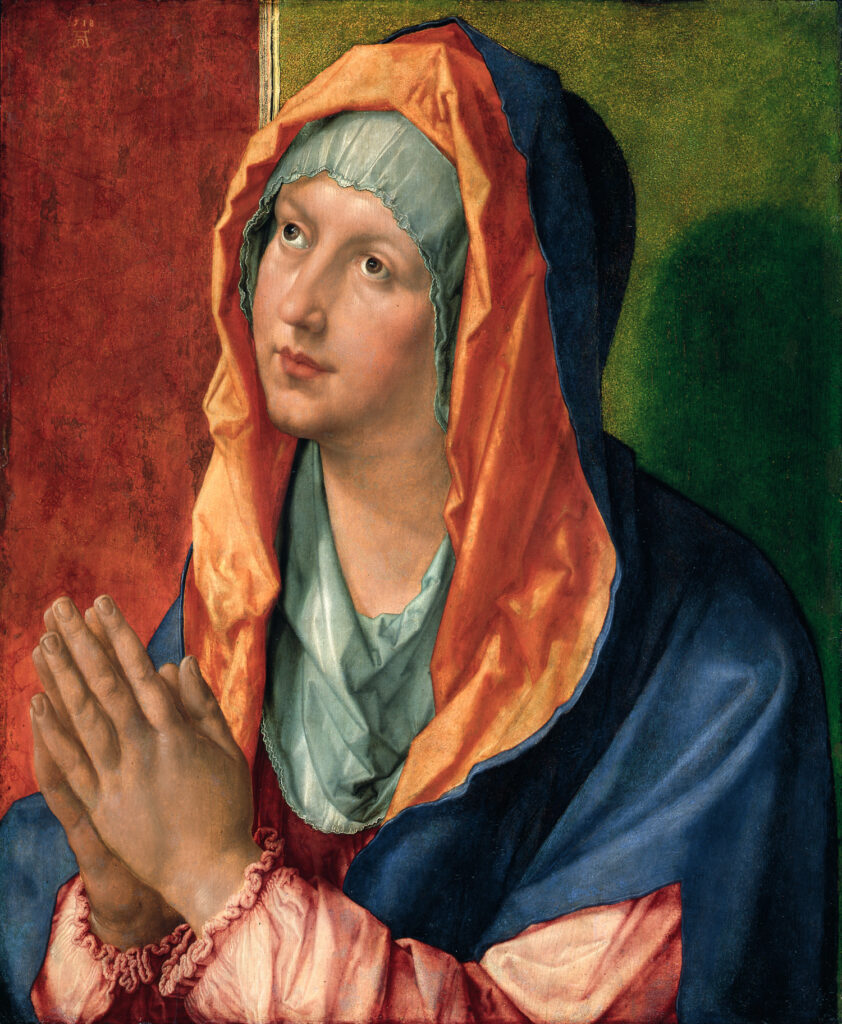
Nuremberg, 1518. Albrecht Dürer completes a panel destined for prayer. The Virgin Mary stands within, hands joined, gaze turned to the left, where Christ was meant to appear. An intimate diptych, conceived for private devotion.
Venetian Colors in Service of the Sacred
First observe the drapery: a pale blue veil frames the face, surmounted by a luminous orange mantle bordered in deep blue. Dürer paints with meticulous precision each fold of fabric sculpted by light. The joined hands emerge from a pink robe, a realistic detail that anchors this Mary in humanity. The background in flat red and green makes the central figure vibrate. The chromatic luminosity betrays the influence of Giovanni Bellini, whom Dürer admired during his Venetian stay between 1505 and 1507. The German master transposes here the palette of the Serenissima into a Northern composition.
A Silent Dialogue with the Absent Christ
This panel formed the right half of a devotional diptych. On the left should have appeared Christ blessing or suffering, the sole legitimate recipient of Marian veneration. This tradition of the bust diptych dates back to 14th-century Bohemian painting. Albrecht Dürer updates this format with a Renaissance approach: anatomical realism, facial psychology, mastery of color.
Dürer, a Bridge Between North and South
Albrecht Dürer (1471-1528) embodies the synthesis between Germanic rigor and Italian splendor. A celebrated engraver, theorist of perspective, he renewed German painting by integrating the achievements of the Venetian Renaissance. This Mary in Prayer perfectly illustrates his capacity to fuse Northern traditions with Mediterranean modernity.
Think about it
💭 Can this Mary incarnate the dialogue between North and South that Dürer carried throughout his life?
About This Work
- The Virgin in Prayer
- Albrecht Dürer
- 1518
- Linden wood
- 54.9 × 45.3 cm
- Gemäldegalerie, Staatliche Museen zu Berlin
- https://recherche.smb.museum/detail/869163/betende-maria
A Devotional Diptych: Mary Facing Christ
The Virgin in Prayer was originally the right wing of a devotional diptych: the Virgin, hands clasped and gaze directed to the left, addresses an image of Christ that would have occupied the now lost or separated left wing. This diptych format, two complementary panels designed to be contemplated together, revives a tradition of private devotional painting from the 14th and 15th centuries, notably Bohemian in origin, that Dürer reactivates in 1518 with the formal and chromatic resources of the High Renaissance. The Virgin wears a pale blue veil framing her face, surmounted by an orange mantle bordered in deep blue and a pink robe that anchors the figure in human reality. The green and red ground creates a chromatic vibration around the face that reflects the direct influence of Venetian painting that Dürer absorbed during his two Italian sojourns.
Venice and Colour: Dürer’s Two Italian Journeys
Albrecht Dürer (1471-1528), born in Nuremberg, made two Italian sojourns decisive for his career. The first, in 1494-1495, brought him into contact with Mantegna’s painting and Italian printmaking. The second, in 1505-1507, revealed to him Giovanni Bellini in Venice: Dürer, who visited the master in his studio, admired the command of colour and atmospheric light of the octogenarian Venetian painter. This encounter left a lasting mark. In The Virgin in Prayer, the softness of the flesh modelling, the harmony of the draperies, and the way light envelops the face rather than sculpting it through strong chiaroscuro all betray this Venetian contribution, so different from the graphic rigour of the Germanic tradition in which Dürer was first formed.
Drapery as Northern Heritage
What Dürer does not yield to Italian influence is the near-microscopic precision of his textile rendering. The folds of the orange mantle, the reflections of the silk veil, the embroidered border in deep blue are treated with the meticulousness of a painter formed in the Flemish and Germanic tradition, heir to Van Eyck and Hans Memling. This capacity to render materials, to convey the weight and texture of a fabric, is one of Dürer’s most consistent signatures, whether in his copper engravings, watercolours, or panel paintings. It contributes to making The Virgin in Prayer a painting that achieves the synthesis Dürer pursued throughout his career: uniting the colour and light of the South with the precision of the Northern gaze.