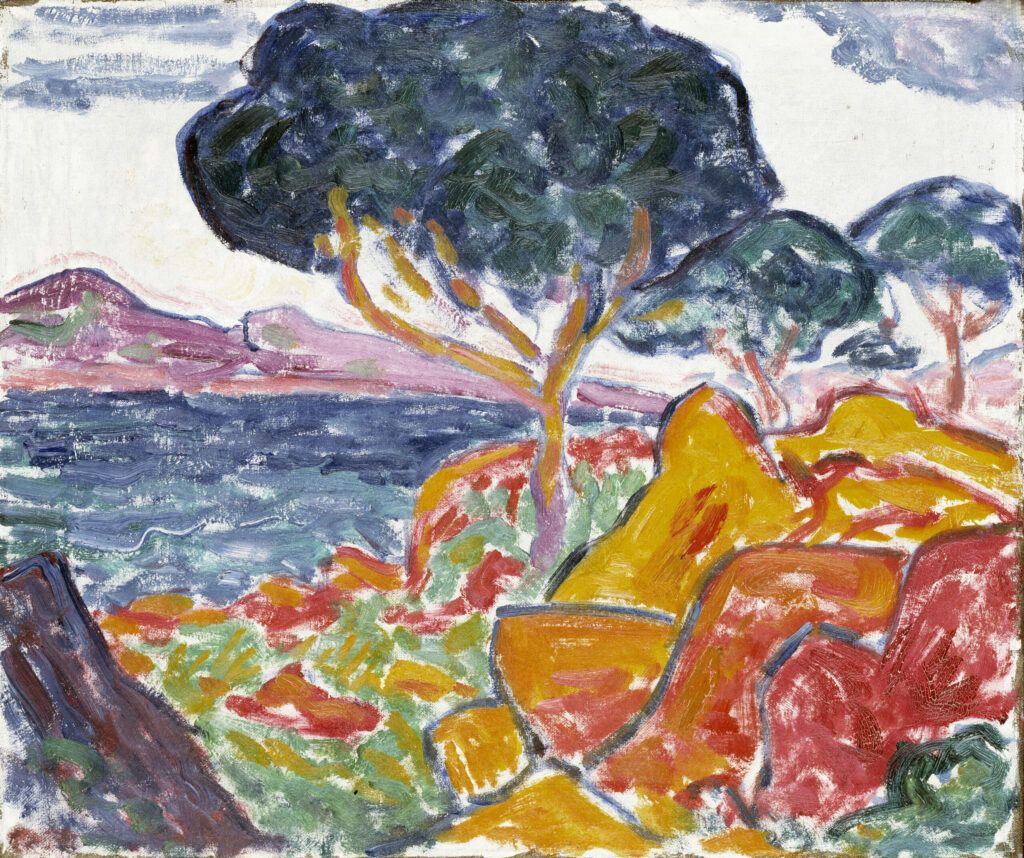
Early 20th century. Carl Newman chooses to set the canvas ablaze with pure colors. Brilliant yellows rival orange-reds, deep blues dialogue with delicate mauves. This landscape vibrates with an energy that transforms nature into a chromatic symphony.
A Fauvist Explosion
Newman applies oil paint in broad, expressive, and spontaneous strokes. Masses of color are juxtaposed without soft transitions. In the foreground, golden and coral rock formations structure the composition. A central tree with a golden-yellow trunk unfolds its dark blue-green foliage, an organic form that anchors the gaze. The sea spreads out in horizontal bands of intense blue. In the background, pink hills take shape beneath a clear sky. The canvas mounted on fiberboard demonstrates a mixed technique characteristic of the period.
The Influence of American Fauvism
Between 1909 and 1914, Newman aligns himself with the Fauvist movement that revolutionizes Western painting. Artists reject naturalistic representation in favor of the emotive intensity of color. This period marks the height of this chromatic revolution in the United States. Newman translates the intense light of the South through bold chromatic contrasts rather than through traditional modeling.
Carl Newman
Carl Newman (1858-1932) develops a personal approach to Fauvism, combining rigorous compositional structure with gestural freedom. His work dialogues with Matisse and Derain while asserting an American sensibility. This canvas illustrates his talent for transforming observation into pure visual sensation.
Think about it
💭 What emotions do these vivid colors awaken in you when you imagine this maritime landscape?
About This Work
- Landscape
- Carl Newman
- ca. 1909-1914
- Oil on canvas mounted on fiberboard
- 50.5 × 60.9 cm
- Smithsonian American Art Museum, Washington, gift of Anna McCleery Newton, 1968.121.7
- https://americanart.si.edu/artwork/landscape-18475
Carl Newman and American Fauvism
Carl Newman (1858-1932) belongs to a generation of American artists who, in the early 20th century, engaged with the upheavals of the European avant-garde while seeking to develop a sensibility rooted in their own experience of the American landscape. Between 1909 and 1914, he adopted an approach close to Fauvism, the movement that emerged in France around Matisse and Derain at the Salon d’Automne of 1905, characterised by the use of non-naturalistic colours applied with great gestural freedom. Newman was not a passive follower: he integrated these influences into a compositional structure that was distinctly his own, organising coloured masses according to a rigorous formal logic.
A Work at the Smithsonian American Art Museum
Landscape is held at the Smithsonian American Art Museum in Washington (formerly the National Collection of Fine Arts), one of the most important institutions dedicated to American art in the world. The work entered the collection through the gift of Anna McCleery Newton in 1968 (acquisition number 1968.121.7). Painted in oil on canvas mounted on fiberboard, it measures 50.5 × 60.9 cm. The Smithsonian American Art Museum holds more than 40,000 works tracing the history of art in the United States from the 18th century onward, and Newman’s presence in its collections places him among the artists considered representative of their era by the institution’s curators.
The South as a Chromatic Laboratory
The golden and coral rock formations, the golden-yellow trunk of the central tree, the intense blue of the sea, and the pink hills in the background make no attempt to reproduce a real place faithfully. They translate the optical and emotional sensation of an intense southern light, perceived and recomposed by the painter. This approach, inherited from Cézanne as much as from the Fauves, treats colour not as an attribute of objects but as an autonomous force that structures pictorial space. Newman thus aligns himself with one of the central interrogations of modern painting.