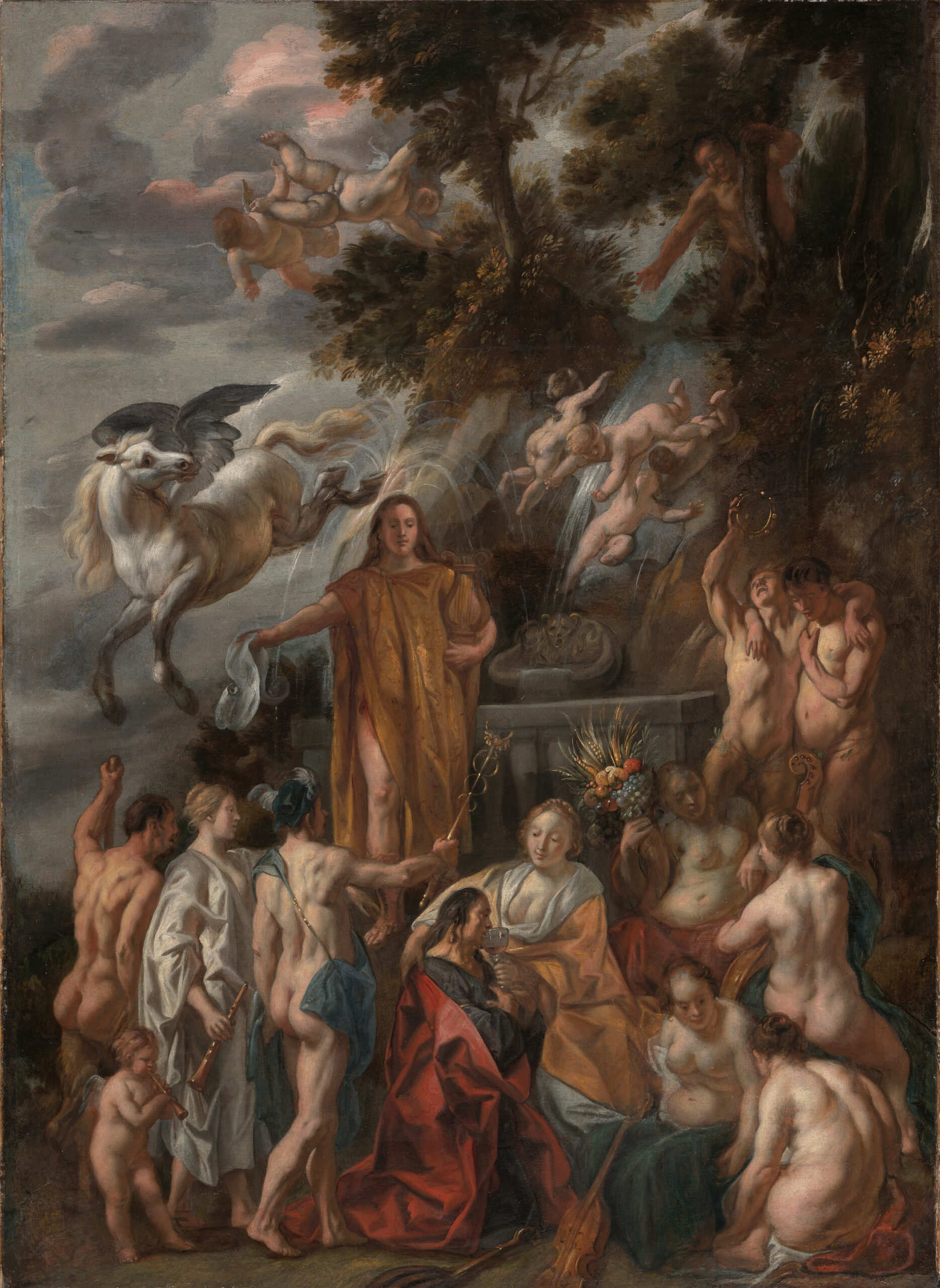
Antwerp, c. 1660. A poet stands taut with anticipation, reaching toward inspiration. Polymnia, muse of lyric poetry, raises a cup to his lips. The waters of the Hippocrene are about to flow. Genius, perhaps, is about to be born.
A scene inhabited by golden light
At the centre, a figure draped in ochre holds a lyre. She presides over an assembly of figures: pearly-skinned muses, child musicians, allegorical forms. Jacob Jordaens paints broadly, generously. His touch is fleshy, almost sculptural. In the background, a waterfall surges. In the dramatic sky, putti swirl and tumble. And high above, to the left, Pegasus, the winged horse, leaps from the summit of Mount Parnassus.
The Flemish Parnassus
In the 17th century, poetry is a noble art, a divine pursuit. Jordaens lays out here a precise iconographic programme: Polymnia offers the poet the sacred waters of the Hippocrene, the spring born from the hoof-strike of Pegasus on Mount Helicon, which Baroque tradition frequently conflates with Parnassus. To drink these waters is to receive inspiration. This kind of learned allegory flourishes in Flemish humanist circles and courtly settings. The painting is a celebration of creative power.
Jacob Jordaens
Jacob Jordaens (1593–1678) stands as one of the pillars of Flemish Baroque, alongside Rubens, whose pupil and collaborator he was. An Antwerper all his life, he developed a powerful and sensuous pictorial language: robust bodies, expressive drapery, and contrasted light inherited from Caravaggism. He painted with boundless energy, never at the expense of precision. This canvas is a perfect illustration, Baroque in form, humanist in spirit.
Think about it
💭 In the 17th century, inspiration was something one received. Today, we say it must be earned through work. Was Jordaens wrong?
About this work
- Allegory of the Poet
- Jacob Jordaens
- c. 1660
- Oil on canvas
- 162.56 × 117.48 cm
- Los Angeles County Museum of Art (LACMA)
- https://collections.lacma.org/node/206280
Parnassus and Its Waters: An Iconographic Programme
Allegory of the Poet draws on a precise iconographic programme rooted in 17th-century humanist culture. At the top of the composition, Pegasus leaps from Mount Parnassus, the mythical summit sacred to the Muses. With a stroke of his hoof, the winged horse causes the Hippocrene spring to gush forth on Mount Helicon: according to ancient tradition, drinking from these waters confers poetic inspiration. In the painting, Polymnia, Muse of lyric poetry, holds out a vessel of these sacred waters to the central poet, lyre in hand. Water as a vehicle of divine inspiration is thus represented literally, in an allegorical language that Flemish scholars and the connoisseurs of European courts could decipher with ease. This kind of learned programme reflects Jordaens’s integration into the intellectual circles of Antwerp, a merchant and humanist city, even if his painting is more often associated with popular and bacchic subjects.
Jordaens in American Collections: A Long European Provenance
Allegory of the Poet (c. 1660) entered the Los Angeles County Museum of Art in 2003, acquired with support from the Ahmanson Foundation from the Parisian gallery of Eric Coatelem (accession number M.2003.121). The documented provenance of the work is old: it may appear in the 1734 estate sale of Talbot Yelverton, 1st Earl of Sussex, before passing through a Christie’s sale in London in 1949, entering a Swiss private collection in the 1950s, and then moving to the Paris art market. This trajectory, an 18th-century English sale, the post-war English market, a Swiss collection, a French gallery, an American museum, is representative of the circuits through which major Flemish Baroque canvases migrated to American institutions over the course of the 20th century.
The Third Master of Antwerp
Jacob Jordaens (1593-1678) is often presented as the “third great” painter of the 17th-century Antwerp school, after Rubens and Van Dyck. Unlike his contemporaries, however, Jordaens neither travelled to Italy nor served at foreign princely courts. He stayed in Antwerp, in the workshop of his father-in-law Adam van Noort, and developed a large-scale, sensual, and physical style of painting strongly influenced by Caravaggism in its treatment of light. After Rubens’s death in 1640, he became the leading painter of Antwerp and produced major decorative commissions for courts across northern Europe.