Paris, c. 1880. The lesson is in full swing. In the rehearsal room, bodies stretch, adjust, catch their breath. Degas watches. His eye takes in everything: the grace, the effort, the instant suspended between two exercises.
The Studio as a Scene of Life
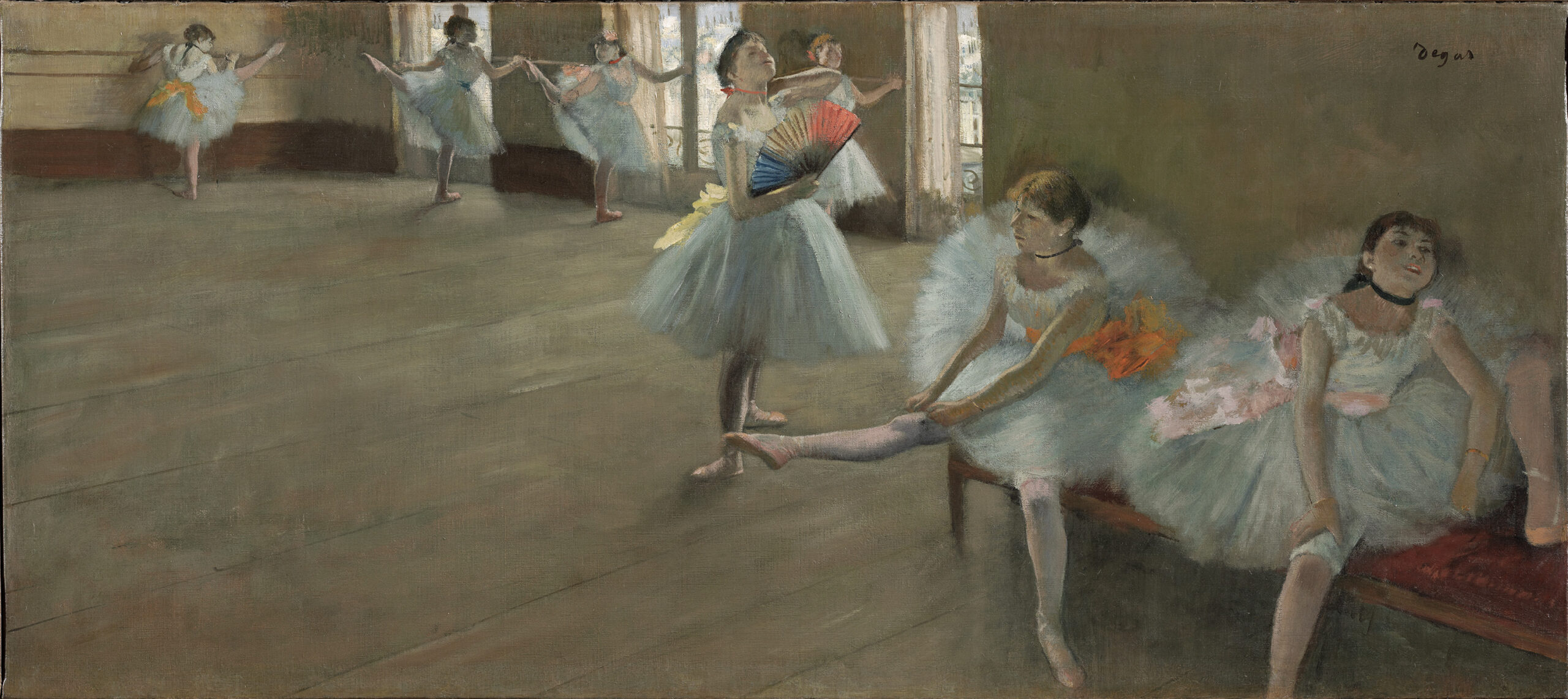
The gaze slides across an empty floor, vast, almost vertiginous. Degas chooses a boldly horizontal composition. On the left, dancers work at the barre, arms raised, backs taut. At the centre, a ballerina holds a red-and-blue fan, her head tilted back. On the right, two dancers rest on a red bench. One of them adjusts her stocking with casual indifference. The handling is light, trembling. The tutus dissolve in the light from the tall windows. The plunging perspective unsettles, draws the viewer in. One enters the painting.
Nine Revisions for a Single Leg
In the late 1870s, Edgar Degas undertook a series of large horizontal canvases devoted to the rehearsal rooms of the Paris Opéra. These works upended the representation of dance. Gone was the idealised spectacle: Degas shows the labour, the fatigue, the concentration. The composition is the fruit of painstaking work. The position of the outstretched leg of the dancer adjusting her stocking was reworked at least nine times. Impressionism here is not spontaneous: it is constructed, weighed, corrected.
Edgar Degas
Edgar Degas (1834–1917) was one of the leading figures of the Impressionist movement, of which he was a close companion, though he always set himself apart through his commitment to drawing and composition. Fascinated by movement and artificial light, he made dance his territory of predilection. His ballerinas, far from being icons, are working women.
A Question for You
💭 Look at that empty floor occupying nearly half the canvas. Why does Degas leave so much room for emptiness? What does that silence say about the world of dance?
About this work
- Dancers in the Classroom
- Edgar Degas
- c. 1880
- Oil on canvas
- 39.4 × 88.4 cm
- Clark Art Institute, Williamstown, Massachusetts
- https://www.clarkart.edu/ArtPiece/Detail/Dancers-in-the-Classroom
The Empty Floor as Subject: An Unusual Composition
Dancers in the Classroom is one of the most daring compositions in Edgar Degas’s (Paris, 1834 – Paris, 1917) long series devoted to the dance. The format is extreme: a canvas almost twice as wide as it is tall, half of which is occupied by the empty classroom floor, that bare surface, rigorously rendered with its reflections and parallel boards, is as much the painting’s subject as the dancers themselves. To the left, dancers work at the barre, arms raised, backs strained with effort; at the centre, a figure holds a red and blue fan in a moment of rest. What Degas represents is rehearsal, daily exercise, bodily fatigue, the prosaic underside of the magic of evenings at the Palais Garnier. Since 1872 he had frequented the backstage spaces and rehearsal rooms of the Paris Opéra, sketchbook in hand, accumulating the studies that would feed a production of several hundred dance-related works across four decades.
A Constructed Composition, Not an Improvised One
What strikes specialists in Dancers in the Classroom is the evidence of rigorous elaboration that Degas conceals beneath an appearance of spontaneity. Technical examination of the canvas reveals that he revised the position of the outstretched leg of the left-hand dancer at least nine times before reaching the final solution. This perfectionist persistence contradicts the myth of instinctive Impressionism: Degas was above all a draughtsman trained in the school of Ingres, for whom line takes precedence over colour and construction over freedom. The horizontal frieze framing, the deliberate void of the parquet, the calculated asymmetry between the movement on the left and the calm on the right are all considered compositional decisions, indebted as much to the Japanese woodblock prints that Degas had collected passionately since the 1860s as to direct observation of life at the Opéra.
The Dancer as Worker
Degas’s treatment of the dance is inseparable from his refusal of idealisation. These are not the ethereal creatures of Romantic ballet poster imagery: they are workers, with the unglamorous physicality of the barre, the visible effort of maintaining a position, the fan deployed not as a prop of coquetry but as relief from the heat of the rehearsal room. The fan held in the central figure’s hand, red and blue, solid and ordinary, is a detail that says more about Degas’s vision of the dance than any number of tutus.
The Clark Art Institute
The Clark Art Institute in Williamstown, Massachusetts, founded by Robert Sterling Clark and his wife Francine in 1955, holds one of the finest concentrations of Impressionist painting in North America. Dancers in the Classroom is among the highlights of the collection, alongside works by Renoir, Monet, Pissarro, and Sargent, a reflection of Sterling Clark’s particular taste for the French painting of the 1870s and 1880s.