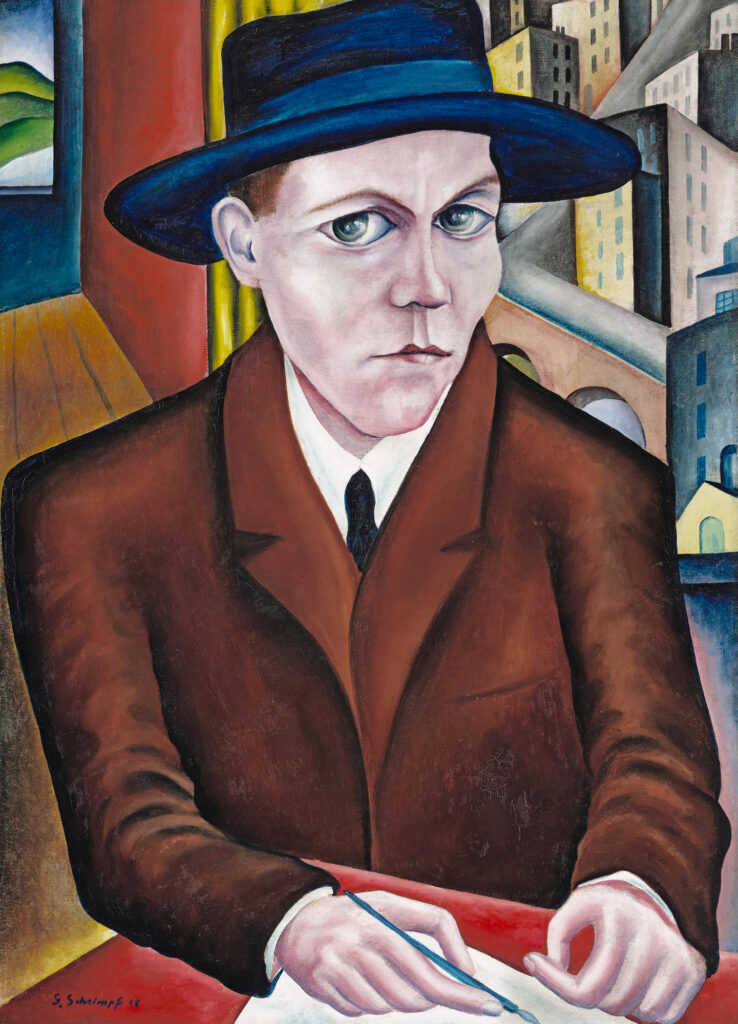
Munich, 1918. In his Bavarian studio, Georg Schrimpf turns his gaze upon the writer Oskar Maria Graf. The painter takes up his brush to immortalize this young rebel intellectual in a work that would mark German New Objectivity.
A Portrait of Pure Lines
Schrimpf constructs a rigorously geometric composition. The sitter stands facing the viewer, hands resting on a bright red table. His brown suit with simplified volumes dialogues with a deep blue hat that crowns his head. The facial features are stylized, almost sculpted in pictorial matter. The artist applies oil in sober flat areas, eliminating superfluous details. Behind the figure, a cubist city fragments into colored planes. This canvas reveals a precise technique where each form finds its place in the overall balance.
Between Tradition and Modernity
This work was born in the aftermath of World War I, a period of profound upheaval in Germany. Schrimpf belongs to the New Objectivity movement, which rejected emotional Expressionism to recover formal clarity. He borrows from Italian Quattrocento art its constructive rigor while integrating Cubist achievements in the treatment of space. Graf, an anarchist and pacifist writer, perfectly embodies the contradictions of this era.
Georg Schrimpf’s Journey
A self-taught artist, Schrimpf (1889-1938) discovered painting late in life. He frequented Munich’s avant-garde artistic circles and developed a refined style, diametrically opposed to Expressionist agitation. His portraits combine monumentality and psychological introspection, characteristics visible in this representation of Graf.
A Question for You
💭 Observe the painting: how does Schrimpf create a subtle visual tension?
About This Work
- Oskar Maria Graf
- Georg Schrimpf
- 1918
- Oil on canvas
- 65.2 x 47 cm
- Städtische Galerie im Lenbachhaus und Kunstbau Munich
- https://www.lenbachhaus.de/en/digital/collection-online/detail/oskar-maria-graf-30014201
Two Self-Taught Men in an Anarchist Colony
Georg Schrimpf’s portrait of Oskar Maria Graf is first and foremost a record of a defining friendship. The two men met in 1913 at an anarchist colony in Switzerland, where both worked as bakers. Graf (1894-1967) would go on to become one of the great Bavarian novelists of the 20th century, known for his committed opposition to Nazism. Schrimpf (1889-1938) was an almost entirely self-taught painter: he attended Munich’s painting school for just eight days in 1913. It was Graf who, before anyone else, believed in his talent and encouraged him to show his work. The 1918 portrait, painted in Schrimpf’s Munich studio, is therefore far more than a formal exercise: it is a visual record of an intellectual and political solidarity between two men who shared the same refusal of the established order.
New Objectivity Against Expressionism
Oskar Maria Graf was painted in 1918, amid the chaos of the final phase of the First World War, at a moment when Schrimpf was actively involved in Munich’s left-wing political life. The following year, he took part in the Munich Soviet Republic and was arrested when it was crushed. This political context illuminates the painting’s style: the New Objectivity (Neue Sachlichkeit) with which Schrimpf is associated was precisely a reaction against Expressionist agitation, in favour of cold formal clarity and geometric simplification of forms, a return to order after chaos. Schrimpf belonged to the “romantic” wing of this movement, distinct from the “verist” faction represented by Otto Dix and George Grosz.
An Artist Caught Between Two Fates
Schrimpf’s life ended in tragedy. In 1937, his political past, including his membership of the Rote Hilfe, a socialist organisation providing relief to political prisoners, led to his dismissal from the Royal School of Art in Berlin. He died on 19 April 1938 in Berlin, just months after this expulsion. Oskar Maria Graf had left Germany as early as 1933, publicly demanding that his books be burned by the Nazis rather than be spared while his contemporaries were censored. The portrait in the Lenbachhaus in Munich preserves the moment when both men were still free and close, before history drove them apart.