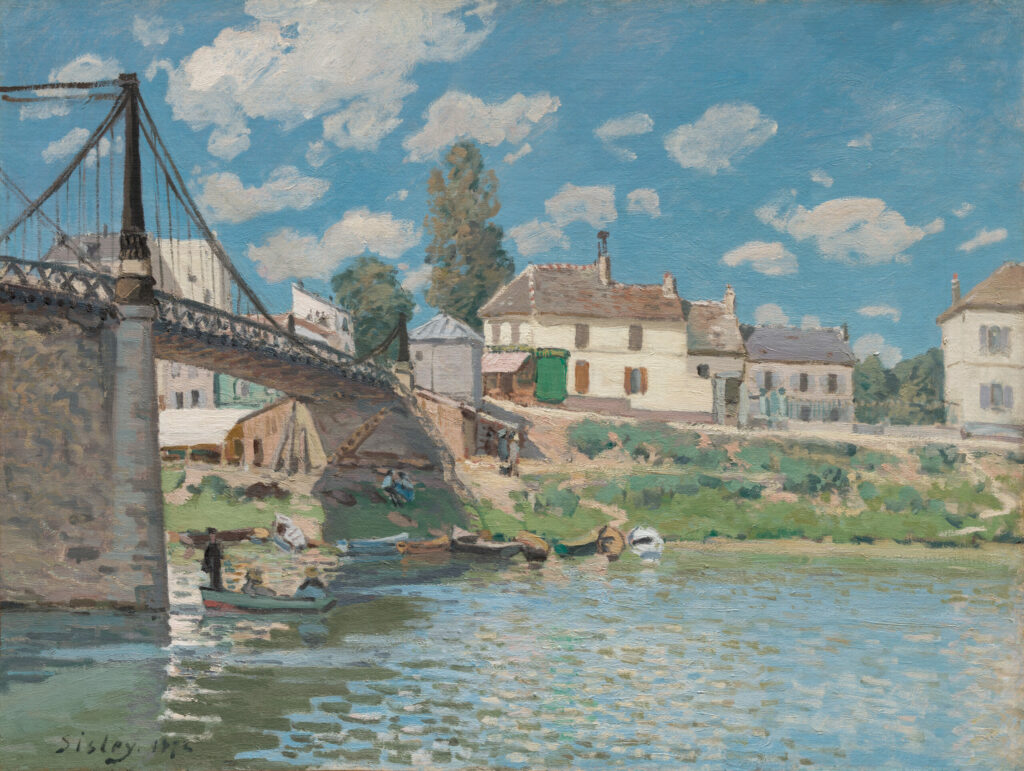
Villeneuve-la-Garenne, 1872. Sisley sets up his easel facing the suspension bridge spanning the Seine. Vacationers enjoy this summer day by the water. The Impressionist painter captures the moment.
A Bridge Between Two Worlds
The cast-iron and stone suspension bridge dominates the composition. Built in 1844, this modern structure connects the village of Villeneuve-la-Garenne to Saint-Denis. Sisley chooses a bold viewpoint, almost at water level. The cables cut across the sky in powerful diagonals. Houses line the riverbank. Boats rest on the Seine. The brushwork is quick and visible, characteristic of nascent Impressionism. Sisley applies the paint in small juxtaposed touches. The blues of the sky are reflected in the water. The tender green of the vegetation contrasts with the buildings. These blocks of color convey the fleeting effect of light.
Modernity at the Heart of Impressionism
The suspension bridge embodies industrial progress. These metal structures were transforming French landscapes. Monet would paint train stations, Caillebotte the Haussmannian streets. Sisley favored the changing Parisian suburbs. Villeneuve-la-Garenne attracted Parisians seeking accessible nature. The railroad brought the capital closer to these riverside villages. The work bears witness to this pivotal era when modernity and leisure converged.
Alfred Sisley, Painter of the Seine’s Banks
Born in Paris, Sisley (1839-1899) devoted his life to Île-de-France landscapes. He favored changing skies, aquatic reflections, and natural light. More discreet than Monet or Renoir, he developed a delicate and luminous Impressionism.
Think about it
💭 These 19th-century vacationers were already seeking refreshment by the water. Where do you find your escape from the city?
About this Work
- The Bridge at Villeneuve-la-Garenne
- Alfred Sisley
- 1872
- Oil on canvas
- 49.5 × 65.4 cm
- The Metropolitan Museum of Art, New York
- https://www.metmuseum.org/art/collection/search/437680