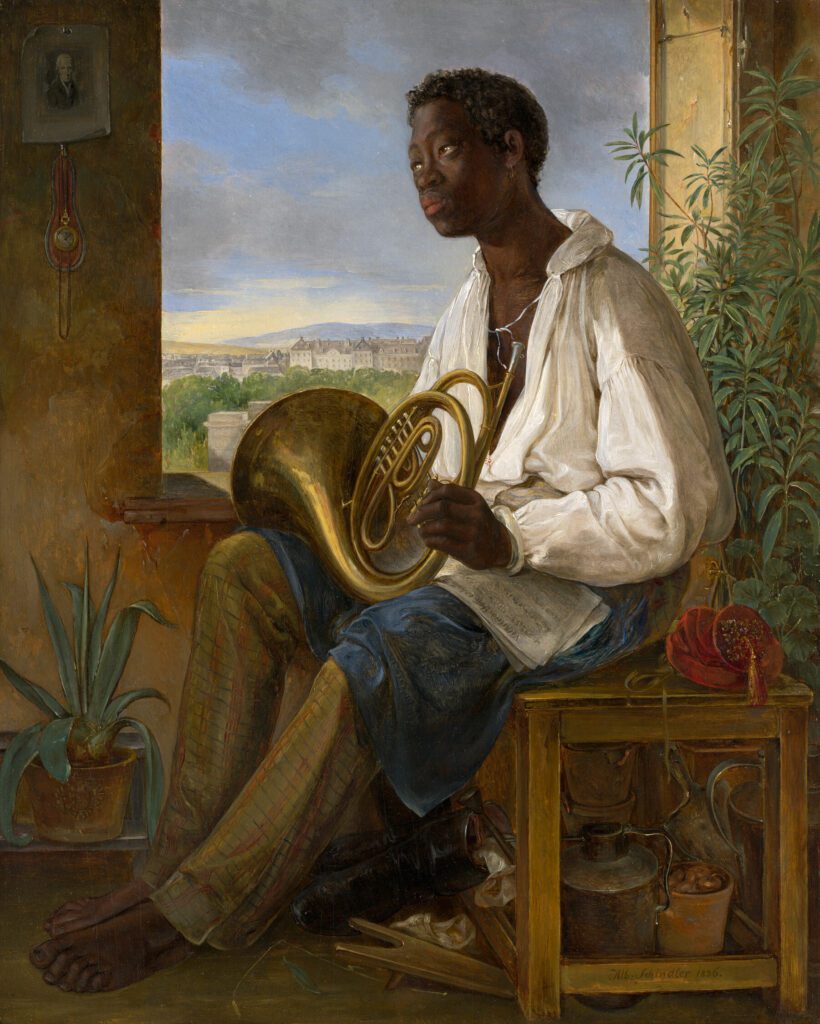
This masterwork by Albert Schindler captures with remarkable sensitivity a musician in an intimate setting, bathed in natural light streaming through a window that opens onto a Viennese landscape.
The subject, dressed in a loose white shirt and blue trousers, is portrayed in a contemplative pose, holding his golden French horn with sheet music resting upon his knees. The artist employs a painting technique of exceptional precision, masterfully balancing realism with emotional depth.
The composition reveals a subtle tension between interior and exterior spaces, between everyday life and artistic pursuit. Significant details enrich the scene: the portrait of Emperor Francis I of Austria on the wall, the gold watch suspended beneath it, an imperial gift, and the indoor plants that frame the space. This work transcends mere representation to become a poignant testimony about identity, exile, and the complex relationships between power and talent in colonial Europe.
Additional Information
- Title: Portrait of Emmanuel Rio, by Albert Schindler, 1836
- Dimensions: 39 × 31.7 cm
- Location: The Art Institute of Chicago, European Paintings and Sculpture, Gallery 221
- https://www.artic.edu/artworks/184372/portrait-of-emmanuel-rio
Albert Schindler (1805-1861), Austrian painter associated with the imperial court of Vienna, distinguished himself through portraits and genre scenes marked by great precision and characteristic lighting. Trained at the Vienna Academy of Fine Arts, he developed a style combining technical mastery with psychological depth.
This portrait of Emmanuel Rio stands among his most moving works, illustrating his ability to capture the dignity of his subjects while revealing the social tensions of his era. His sensitivity to the play of light and capacity to humanize his models establish him as a major artist of Austrian Biedermeier, an artistic movement emphasizing intimacy and everyday life.
Viennese Biedermeier: Intimacy Elevated to a Style
Portrait of Emmanuel Rio belongs to the Biedermeier current, the artistic and decorative style that dominated bourgeois culture in the Germanic countries and the Austro-Hungarian Empire between 1815 and 1848. Biedermeier is not merely a style: it is a philosophy of everyday life, a valorisation of domestic space and private pleasures that responded, by contrast, to the political turbulence of the post-Napoleonic era. Albert Schindler (1805-1861), an Austrian court painter trained at the Vienna Academy of Fine Arts, was one of its most refined practitioners. His portrait of the musician Emmanuel Rio, seated in a Viennese interior bathed in natural light, wearing a white shirt, a golden French horn in his hands and sheets of music on his lap — synthesises the Biedermeier virtues: technical precision, soft light, and the psychological capture of the sitter within his living environment.
Details as Social Language
What distinguishes this portrait from a straightforward representational commission is the density of its symbolic details. On the wall, a portrait of Emperor Francis I of Austria affirms imperial loyalty; an imperial gold pocket watch, an object of prestige and punctuality, rests visibly in the scene. These elements are not incidental: in Biedermeier culture, the domestic interior is a mirror of social identity, and every represented object is a statement. Schindler carries his precision well beyond formal rendering: he documents a moment of life, a mental space, an affiliation. The pictorial technique that combines material realism with emotional warmth is characteristic of his manner and makes this small painting a particularly accomplished example of early 19th-century Austrian intimate portraiture.