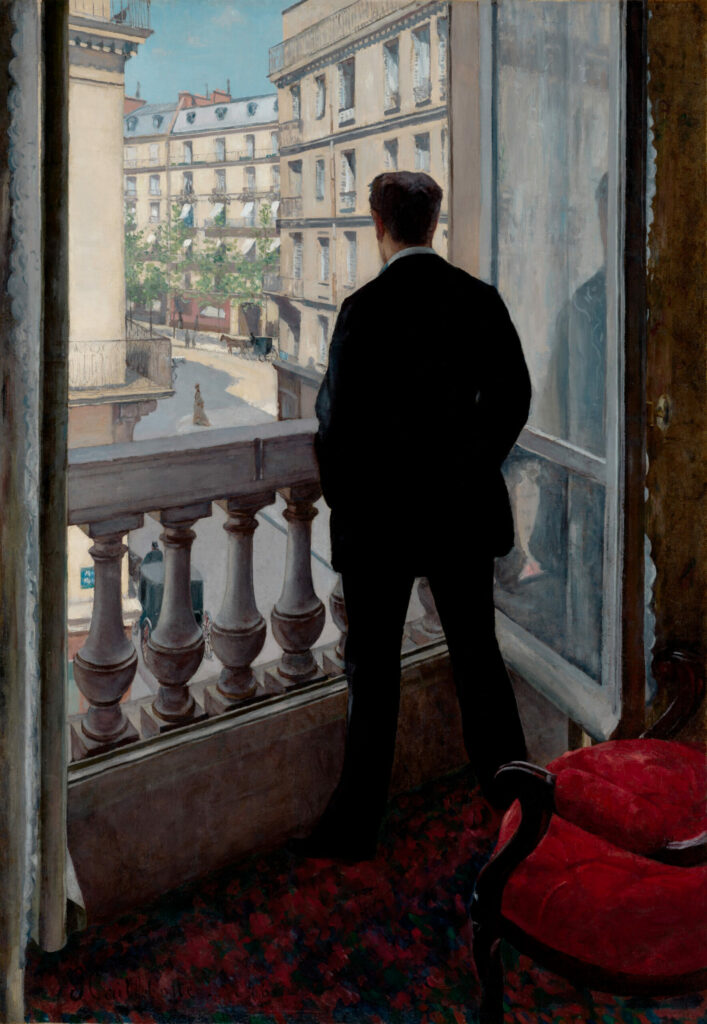
A Silent Meditation on Parisian Modernity. Caillebotte offers us a silent meditation on Parisian modernity. The bold framing places the viewer within the intimacy of a bourgeois apartment, a discreet witness to an everyday scene imbued with mystery.
This young man in a black frock coat, standing confidently on his legs, contemplates the new city unfolding before him.
The artist brilliantly plays with contrasts: the muffled interior with its oriental-patterned carpet and crimson armchair stands in opposition to the brilliant luminosity of the exterior. The geometrically perfect Haussmannian buildings engage in dialogue with the dark silhouette of the protagonist.
Here, the painter captures the spirit of an era when Paris was transforming itself. This window becomes a symbol of the boundary between private and public spheres, between the interior world of the bourgeoisie and the urban bustle below. The isolated presence of a female passerby accentuates this impression of social distancing, so characteristic of this new urbanity.
Additional Information
- Title: “Young Man at His Window” by Gustave Caillebotte, 1876
- Dimensions: 116 x 81 cm (45 11/16 × 31 7/8 in.)
- Location: The J. Paul Getty Museum, Los Angeles, Getty Center, Museum Exhibition Pavilion, Gallery 1
- https://www.getty.edu/art/collection/object/10A2Y1
Gustave Caillebotte (1848-1894), both a painter and generous patron of the Impressionists, occupies a singular place in the history of French art. Born into a wealthy family, he was able to fully devote himself to his artistic passion while financially supporting his friends Monet, Renoir, and Pissarro.
His unique style, combining almost photographic precision with sensitivity to light effects, testifies to an innovative perspective on modern Paris. His exceptional collection of Impressionist works, bequeathed to the French State, today forms the heart of the Musée d’Orsay collection, thus ensuring this artist-collector a privileged place in French cultural heritage.
René Caillebotte and Boulevard Malesherbes
The figure depicted in Young Man at His Window is not anonymous: he is René Caillebotte, the painter’s younger brother. The scene is set in the family apartment on Rue de Miromesnil in Paris, and the vista opening behind him looks out onto Boulevard Malesherbes, one of the Haussmannian arteries driven through the city in the preceding decades. This detail of Parisian topography matters: it anchors the painting in the physical transformation of Paris carried out under Napoleon III and Baron Haussmann, who had radically redrawn the city by replacing its medieval fabric with wide, straight boulevards. For Caillebotte, who belonged to the prosperous bourgeoisie that benefited from this modernisation, painting the city from a window was not a neutral act: it meant observing a world to which he belonged while remaining slightly apart from it, the posture characteristic of the flâneur.
A French National Treasure Acquired by the Getty in 2021
Young Man at His Window is classified as a French National Treasure, which historically placed conditions on its exportation. In November 2021, it was sold at Christie’s New York from the collection of Edwin L. Cox for 53 million dollars, a record for the artist, and entered the collections of the J. Paul Getty Museum in Los Angeles (accession number 2021.67), marking the Getty’s first acquisition of a work by Caillebotte. The painting had been shown at the second Impressionist exhibition in 1876 alongside The Floor Scrapers. Émile Zola, reviewing that exhibition, described it as “anti-artistic, because of the very exactitude of the copying”, which says as much about literary naturalism’s unease with Caillebotte’s photographic rigour as it does about the painting itself.