Key takeaways
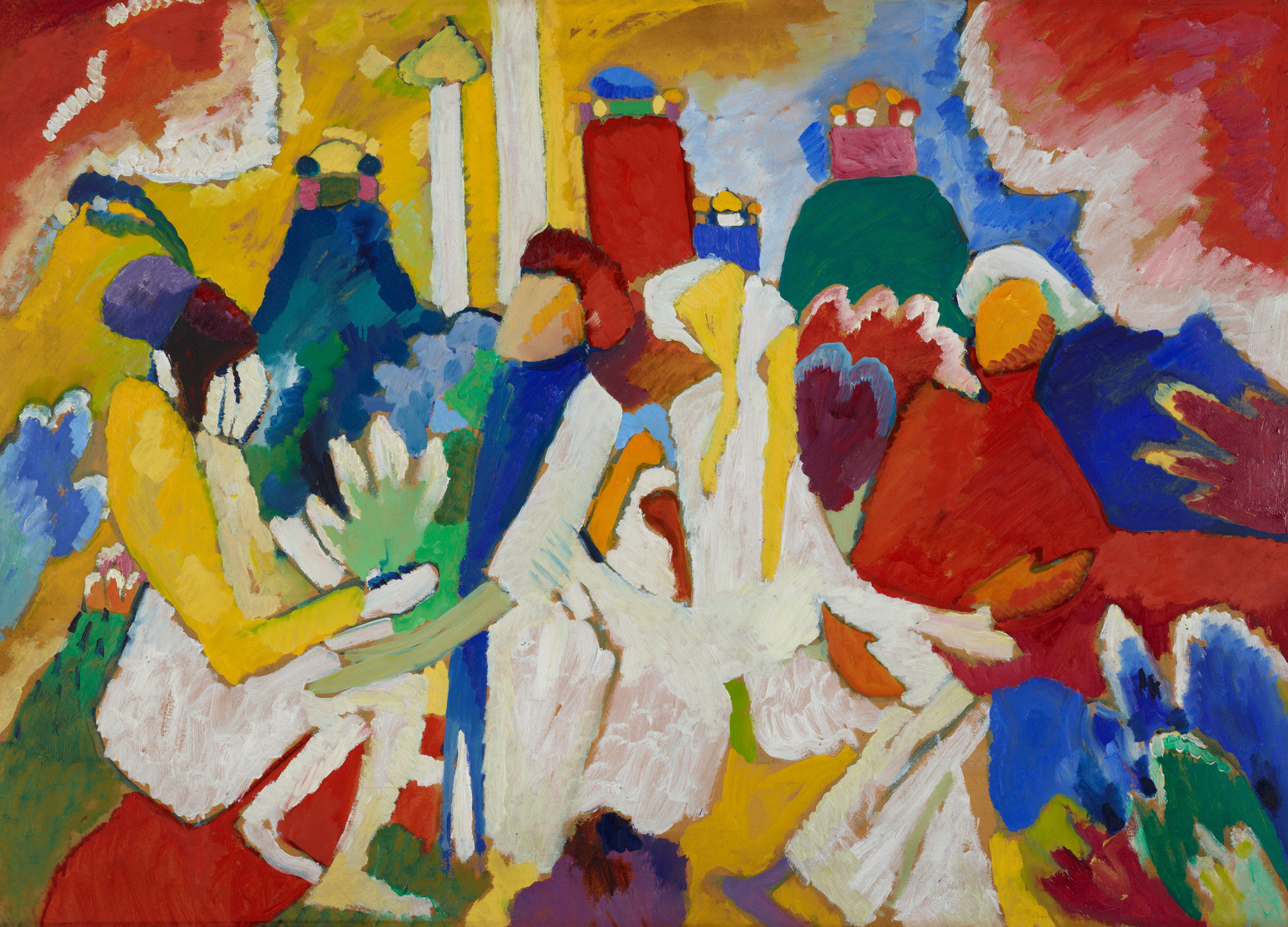
“Oriental” is an oil on cardboard painted by Vassily Kandinsky in 1909, held at the Städtische Galerie im Lenbachhaus in Munich. The work belongs to the artist’s Munich period, the year he founded the New Artists’ Association (NKVM), just before his shift toward abstraction and the founding, in 1911, of the Der Blaue Reiter group with Franz Marc. The painting reflects the Blue Rider’s interest in non-European cultures, a fascination fed by Kandinsky’s 1904 trip to Tunisia and by Russian and Bavarian folk art. It illustrates the moment when color, for the artist, begins to break free from fidelity to the subject.
Kandinsky, like other artists of his time, also sought modernity through his gaze toward other cultures. What strikes me first is this almost insolent chromatic freedom: reds, yellows and blues laid down in vivid flat planes, with no concern for faithfulness to the motif, as if color were racing ahead of the subject rather than serving it. The barely sketched figures dissolve into the same pictorial energy as the background: it becomes hard to tell where the figure ends and the ornament begins. It’s precisely this fluidity between form and color that feels remarkable: Kandinsky will paint abstraction later, but he’s already laying its foundations. In this 1909 canvas, you can already sense a painter breaking away from the subject to keep only its vibration.
Your eyes first look for a face, a scene, a story. Instead they find an organized chaos: red and green wreaths, white fabrics rippling like a wave, an orange hand raised with no precise gesture. Turmoil comes before meaning.
What the surface of Oriental conceals
The oil is applied to cardboard, a quick, almost working support. Kandinsky builds the scene from blocks of pure color, without gradation, without cast shadow. The figures are reduced to masses: a coat becomes a flat red plane, a headdress a green cone. Nothing closely imitates reality.
In 1909, the year of this canvas, Kandinsky founded the New Artists’ Association, the NKVM, in Munich. This group of painters sought to break with classical representation. “Oriental” belongs to this turning point. The motif remains identifiable, but color is already starting to detach itself from it, to exist for its own sake.
The title raises a question it doesn’t resolve: that of an imagined rather than observed Orient. The Blue Rider artists saw in non-European cultures a new visual language, an escape from Western conventions. This gaze was not neutral. It took shape at the time of colonial exhibitions and human zoos, a context the painting carries silently, without naming it.
Kandinsky and his era
Born in Moscow in 1866, Kandinsky arrived in Munich in 1896 to study painting. There he became close to Gabriele Münter. Together, they traveled to Tunisia in 1904. That trip fed his taste for vivid colors and motifs from elsewhere. In 1911, together with Franz Marc, he founded the Der Blaue Reiter group. He would later teach at the Bauhaus, before settling in Paris, where he died in 1944.
News
Since March 10, 2026, the Lenbachhaus in Munich, home to “Oriental,” has been presenting a new installation of its Blue Rider collection, “Beyond the World. The Blue Rider,” on view until September 2027. More than 150 works are on display, as the museum approaches its centenary.
Source: Lenbachhaus
A question for you
Can we still speak of Orientalism when the painter is no longer trying to depict the Orient, but only its color?
About this work
- Oriental
- Wassily Kandinsky
- 1909
- Oil on cardboard
- 69.5 x 96.5 cm
- Städtische Galerie im Lenbachhaus und Kunstbau Munich
- https://www.lenbachhaus.de/en/digital/collection-online/detail/orientalisches-30019034