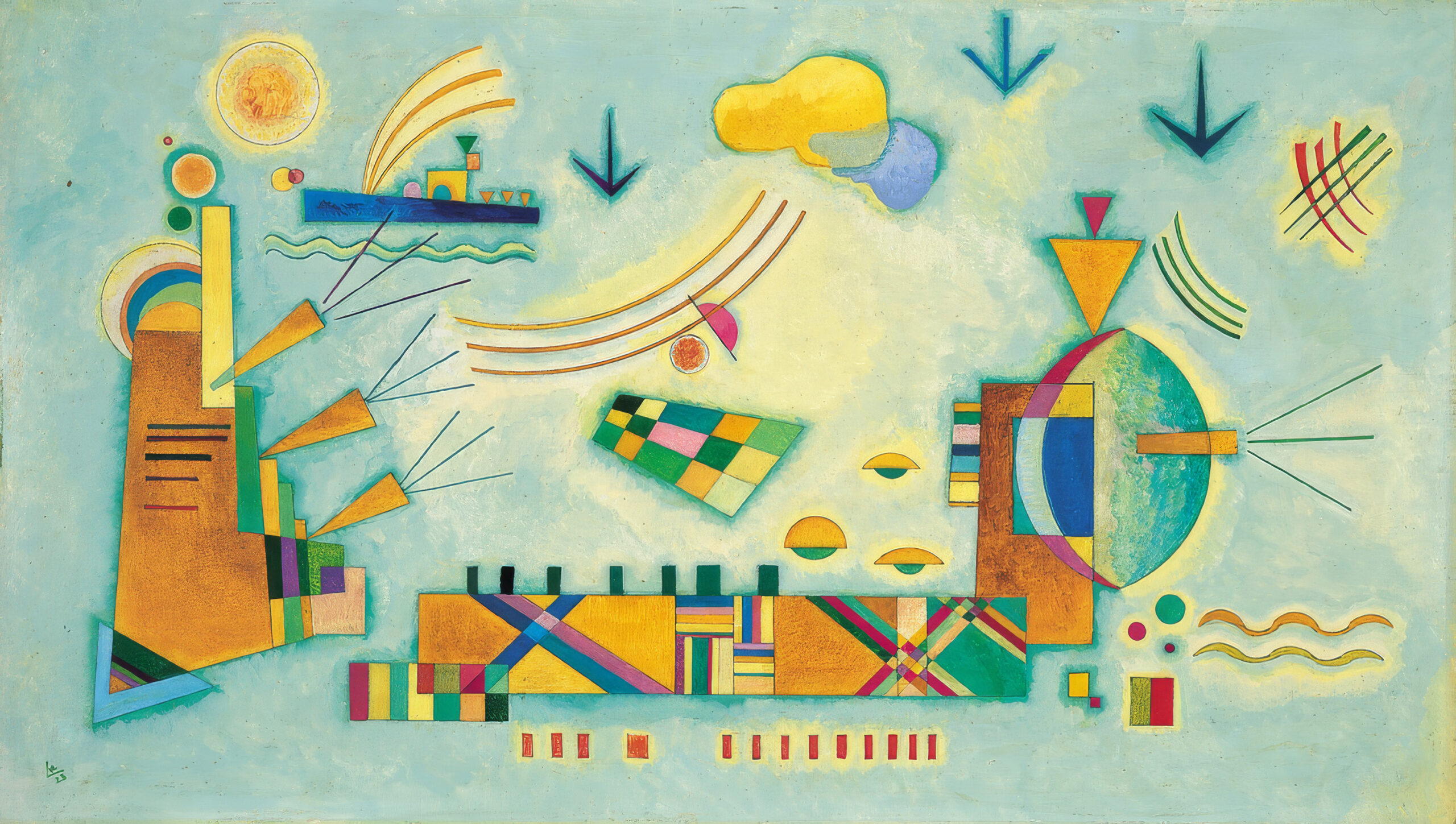
What I encounter here is a joyful gentleness, almost unexpected in Kandinsky’s Bauhaus period, so often associated with geometric rigidity. The colours do not assault: they invite quiet, luminous contemplation. The eye settles, then wanders. The forms seem to know this: some act as subtle prompts to drift back down the canvas, to begin the journey again. You do not leave this painting; you return to it.
The German title Milder Vorgang, literally “gentle event,” is a precious key. Something is indeed happening here, around these forms and between them. Not a dramatic action, but an event in almost a phenomenological sense: a presence, a vibration, a musicality of colour that Kandinsky had been theorising since his Bauhaus writings. The painting becomes a score.
And then there is a dimension I find particularly compelling. Milder Vorgang is perhaps also an allegory of the artistic experience itself. Every encounter with a work is a gentle event, a crossing of time and space between the one who painted and the one who looks. Kandinsky set these forms down in 1928; we receive them today, and something stirs within us.
See
This is not the cold abstraction one might expect. Or rather, it is not only that. On this horizontal cardboard support, a pale turquoise sky receives a constellation of forms: ochre triangles, multicoloured checkerboards, dark arrows pointing downward, concentric arcs, a veined sun nestled in the upper left corner. Everything floats. Everything circulates. The ground itself, worked in near-watercolour washes, breathes beneath the forms like a living atmosphere.
Understand
The year is 1928. Kandinsky has been teaching at the Bauhaus for six years. He is theorising colour, form, their inner resonance. Milder Vorgang belongs to this period of synthesis: the constructivist rigour of the Bauhaus sits alongside an almost childlike lightness. The arrows, far from acting as directive signs, become rhythmic motifs. The geometric forms shed their severity within an airy ground. Kandinsky is working on cardboard, a modest format, yet the composition radiates. Here lies the unresolved tension of this work: a sophisticated visual grammar that produces a sensation of pure freedom.
Feel
Look at the arrows. They point downward, yet the eye travels upward. This paradox may be the heart of the painting. Kandinsky (1866-1944), a Russian painter who abandoned a legal career to become an artist at thirty, and a founding figure of lyrical abstraction, knew that colour acts before thought. Here, yellow sings, green murmurs, turquoise holds. Let your eye move freely. The event is precisely this: a silent conversation between you and the forms.
The Musée d’arts de Nantes today
The Musée d’arts de Nantes, which holds this work in its permanent collection, presents until 30 August 2026 Odyssée de l’oubli, an exhibition by Anne and Patrick Poirier on the fragility of civilisations. With a collection of over 13,000 works spanning the 13th to the 21st century, it ranks among the great fine arts museums of France.
Source: metropole.nantes.fr
A question for you
💭 What if those arrows are not pointing downward to direct you, but to hold you inside the painting a little longer?
About this work
- Milder Vorgang (Gentle Event)
- Wassily Kandinsky
- 1928
- Oil on cardboard
- 39 x 68.2 cm
- Musée d’arts de Nantes
- https://www.navigart.fr/museedartsdenantes/artwork/vassily-kandinsky-milder-vorgang-evenement-doux-110000000002168