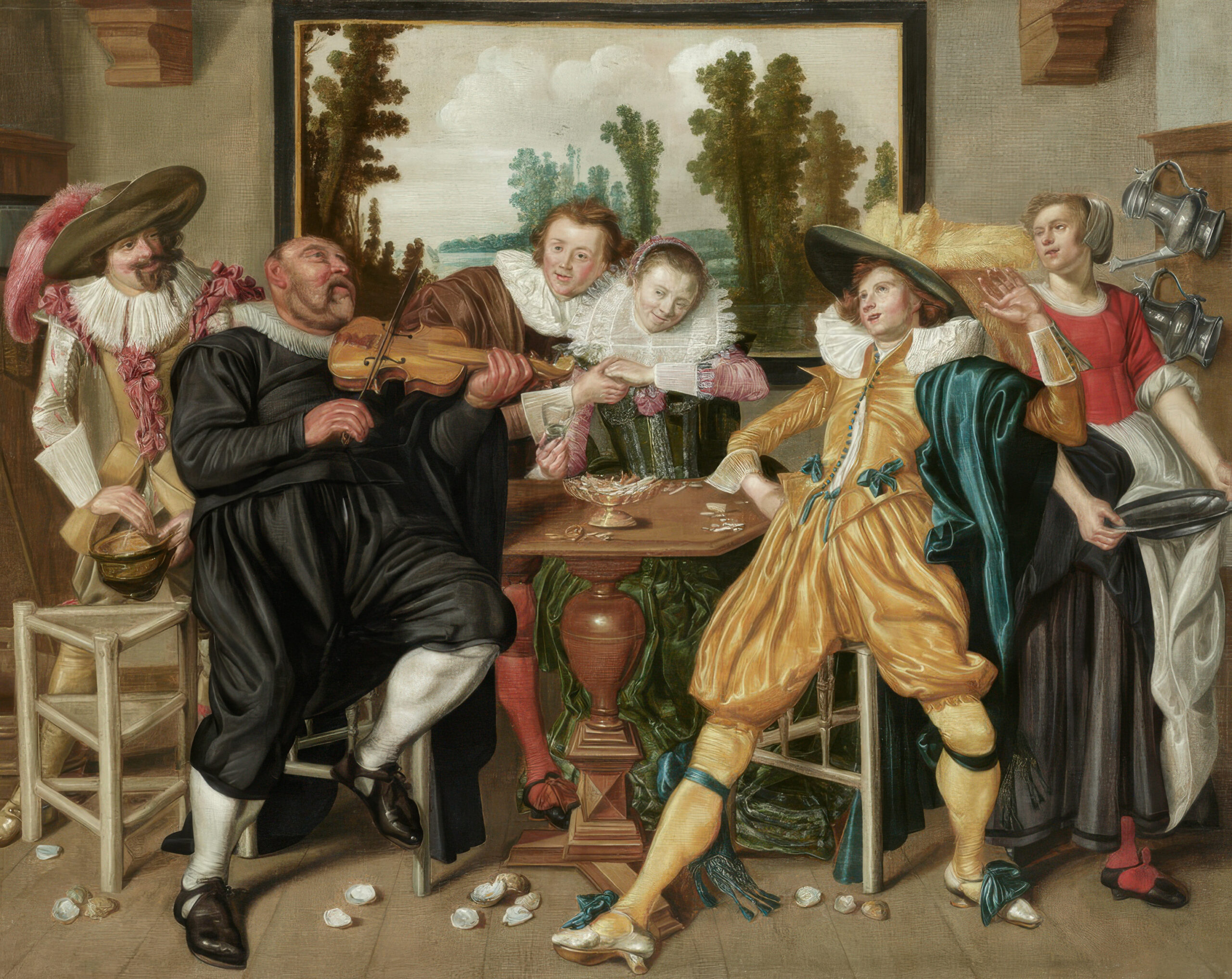
The richness of color in this canvas serves as the true marker of the joyous company: I can almost make out the murmur of conversation, the bursts of laughter, the strains of music that fill the scene. The animated, knowing expressions on the faces, together with the figures leaning toward one another in a natural rhythm, reinforce this impression. I can hear and see this group in the full flush of merrymaking. It is a lively feast caught in the moment, one that makes you want to share in its joy. A picturesque genre scene, in which Buytewech captures with great subtlety the convivial spirit of his age.
Beneath the varnish, a retouched feast
Buytewech renders with precision the texture of black satin, the sheen of pewter jugs hanging on the wall. At the center, an octagonal table holds a glass bowl filled with sweetmeats. A stout old man plays the violin, one leg stretched out on a stool. Oyster shells litter the floor. Six figures are arranged in pairs, in an almost mathematical symmetry. At the center, a man gazes directly at the viewer, wine glass in hand, drawing toward him a young woman with a coquettish smile.
A painting under scrutiny
The “merry company” motif runs throughout early seventeenth-century Dutch painting. Beneath its festive surface, it condemns the dissolute lifestyle of the wealthy classes. A former owner apparently found the scene too indecorous. He had the seated man’s gesture repainted, concealed behind an invented chair. The background landscape was reduced by a third, and the oyster shells on the floor painted over. The Gemäldegalerie recovered the work in its original state prior to its acquisition.
Willem Pietersz. Buytewech, known to his contemporaries as “de gheestige Willem” (“witty Willem”), remains above all a master of drawing and printmaking. He painted this oil on canvas around 1622–1624, one of only eight paintings now attributed to him. Long confused with the work of Dirk Hals, it was reattributed to Buytewech on the strength of an intuition by Wilhelm von Bode.
Current context
The Gemäldegalerie in Berlin devotes a permanent gallery to seventeenth-century Dutch and Flemish painters, including Rembrandt. Portraits, genre scenes, and still lifes there illustrate the thematic specialization of the Dutch Golden Age, the direct context for this “merry company.” Source: Gemäldegalerie, Berlin
A question for you
💭 Has Dutch genre painting ever truly resolved the tension between the moral lesson it claims to offer and the pleasure it gives to look at?
About this work
- Merry Company
- Willem Pietersz. Buytewech
- c. 1622–1624
- Oil on canvas
- 65 × 81.5 cm
- Gemäldegalerie, Berlin
- https://recherche.smb.museum/detail/869413/fr%C3%B6hliche-gesellschaft