In brief
Jacob Jordaens (1593-1678) is, alongside Peter Paul Rubens and Anthony van Dyck, one of the three great masters of Antwerp’s Baroque. Trained under Adam van Noort, whose daughter he married in 1616, he developed an art more physical and more earthbound than Rubens’s, less idealised, marked by the strong contrasts of light he inherited from Caravaggism.
Unlike Rubens and Van Dyck, he never made the journey to Italy and spent his entire life in Antwerp. After Rubens’s death in 1640, he became the dominant figure of Flemish painting and received international commissions, including the decoration of the Oranjezaal at Huis ten Bosch palace near The Hague in 1652. Having declared himself a Calvinist in the 1650s, he nonetheless continued, somewhat paradoxically, to honour Catholic religious commissions until his death in 1678, at the age of 85.
Biography of Jacob Jordaens
Antwerp origins and training (1593-1615)
Jacob Jordaens was born on 19 May 1593 in Antwerp, the eldest of eleven children, into the family of a prosperous linen merchant, Jacob Jordaens the Elder, and Barbara van Wolschaten. At 14, he entered the workshop of Adam van Noort, who had, a few years earlier, been one of the young Rubens’s masters. It is here, to my mind, that part of Jordaens’s destiny takes shape: he shares with Rubens the same artistic lineage, yet without ever benefiting from the same direct, sustained contact with Italian art.
In 1615, he was admitted to the Antwerp Guild of Saint Luke as a “waterschilder”, a painter working in distemper, a technique then used for tapestry cartoons and lower-cost decorative work. This often-overlooked biographical detail sheds light on part of his career: Jordaens designed models for tapestry from a very early stage, an activity that shaped his sense of large-scale composition.
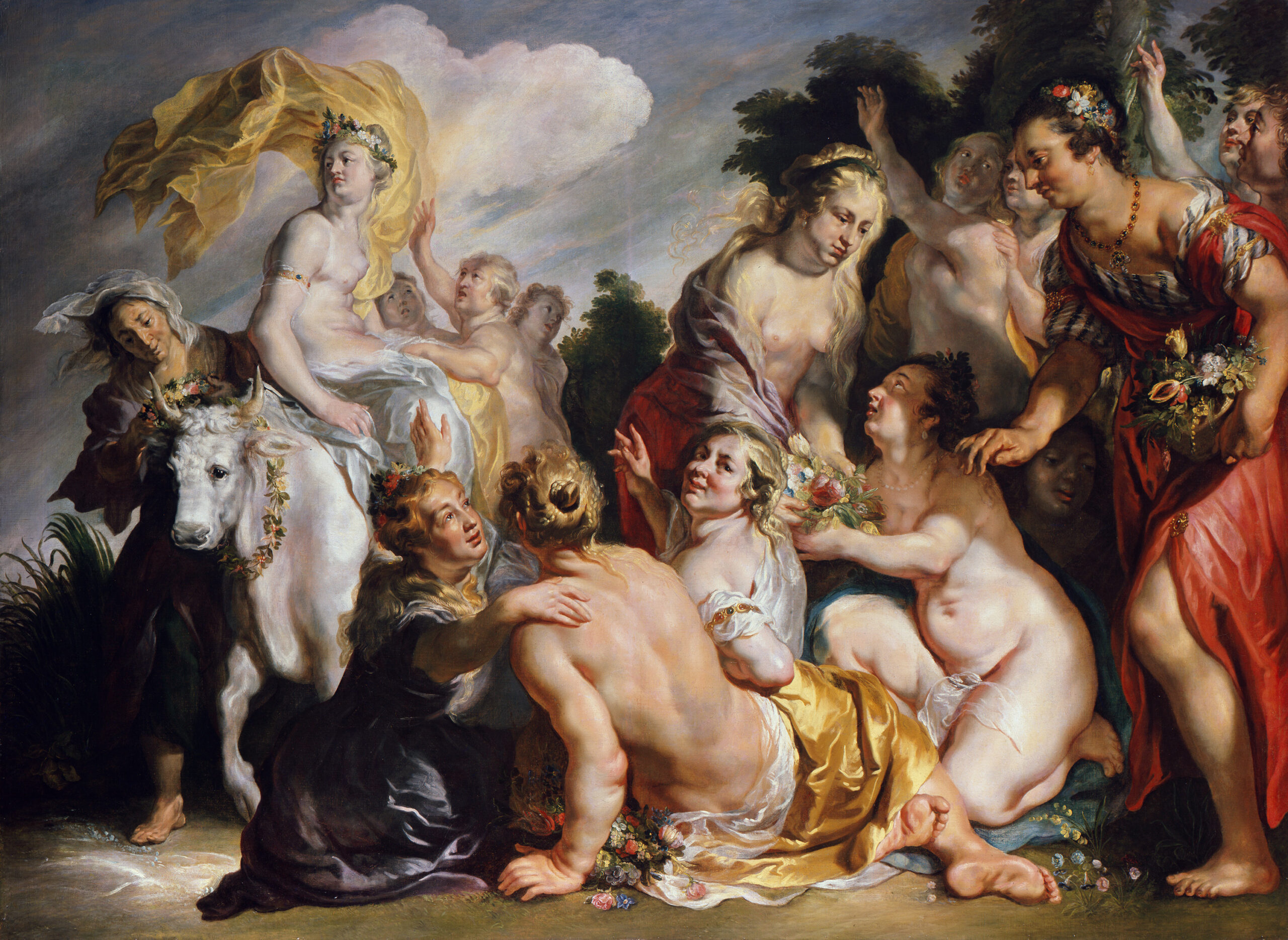
In an early work such as The Kidnapping of Europa (1615-1616), what strikes one first is not the mythological subject, but the handling of the paint. The flesh tones are dense, almost tactile, the very opposite of the smooth glazes favoured by so many court painters of his time. Looking at this canvas alongside other works by Jordaens held in public collections, one quickly understands why this artist, less familiar to general audiences today than Rubens or Van Dyck, was nonetheless regarded in his own lifetime as the foremost painter in Antwerp (after Rubens’s death).
The van Noort marriage and the beginnings of a master (1616-1620)
In 1616, Jordaens married Anna Catharina van Noort, his master’s daughter, with whom he had three children. That same year, he painted one of his earliest documented works, an Adoration of the Shepherds. In 1618, he bought a house on Hoogstraat, in the neighbourhood where he had grown up; he would acquire the adjoining house in 1639 to enlarge his workshop, following the example of the residence Rubens had built for himself two decades earlier.
The works of this decade, such as The Daughters of Cecrops (1617), already reveal the influences that would shape his mature style: Caravaggism in his treatment of light, but also the Venetian painters Bassano and Veronese, whose echo can be traced in the construction of his large, densely populated compositions. This Venetian inheritance within the Baroque can be explored further through the works of Titian on VMuseum.
Within Rubens’s orbit (1620-1640)
Through the 1620s, Jordaens built a flourishing workshop of his own while frequently assisting Rubens on his major commissions. This collaboration culminated in 1636-1637, when Rubens involved him in executing his final commissions for the Spanish crown. In 1639-1640, Jordaens also worked for Charles I of England.
It was during this period that his mature style took shape: a denser handling of paint than Rubens’s, sharper contrasts of light and shade, and more robust, less idealised physical types. The Satyr and the Peasant, a subject drawn from one of Aesop’s fables that he would return to several times over the course of his career, illustrates well this taste for popular subjects treated with realist verve, worlds away from court painting. The same spirit animates his recurring theme of The King Drinks, a boisterous celebration of the Flemish Twelfth Night.

Antwerp’s foremost painter after Rubens (1640-1652)
Peter Paul Rubens died in 1640. Jordaens, who had already secured, not without considerable lobbying against the ageing master, the commission to decorate Huis ten Bosch palace, swiftly became the most sought-after painter in northern Europe. He went on to work for Queen Christina of Sweden, for the House of Orange-Nassau, and for the burgomasters of Amsterdam on the decoration of the town hall.
His most spectacular contribution remains the Triumph of Frederick Henry (1652), an immense canvas over seven metres wide painted for the Oranjezaal at Huis ten Bosch, near The Hague. Commissioned by Amalia van Solms in memory of her late husband, this decorative scheme brought together twelve artists from the Northern and Southern Netherlands under the coordination of Jacob van Campen. That Jordaens was given the most prominent position, at the centre of the hall, speaks volumes about the prestige Rubens had left in his wake. This Dutch commission fits within a broader dialogue between the Flemish and Dutch schools, a subject explored further on VMuseum’s Dutch Golden Age topic page.
Religious conversion and late manner (1650-1678)
In the 1650s, Jordaens declared himself a convert to Calvinism, and Protestant services were regularly held in his home. The fact deserves attention, since it did not in any way prevent him from continuing to honour commissions for Catholic buildings: the religious question, so central to the divided Netherlands of the seventeenth century, appears never to have hindered his career. This flexibility, almost an anomaly for the period, says something of the particular standing a painter of his renown could then command.
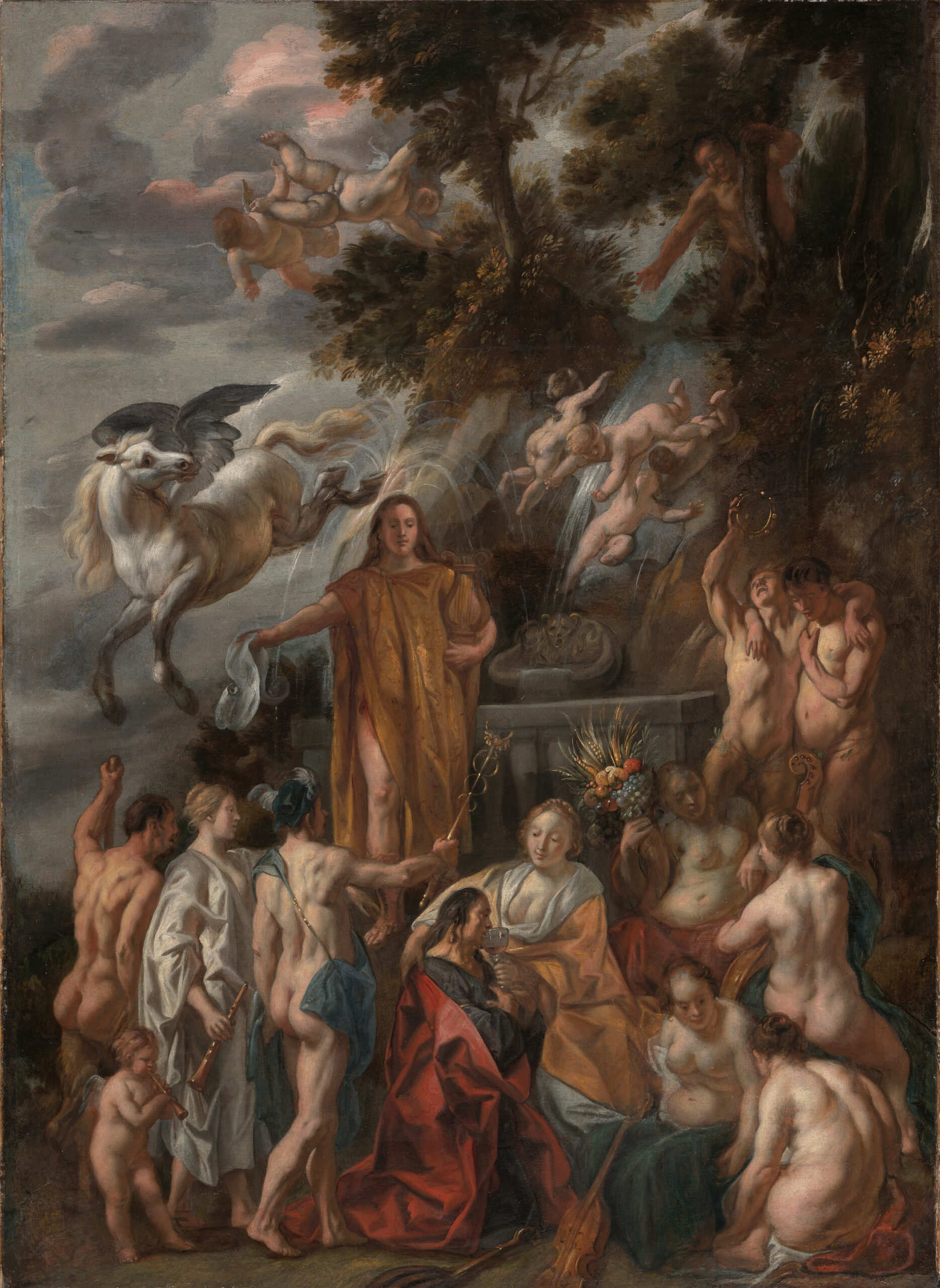
Stylistically, his late manner moved towards cooler tones and graver moral subjects, breaking with the exuberance of his earlier decades. Allegory of the Poet, painted around 1660, belongs to this late phase: its learned iconographic programme, built around Polymnia and Pegasus, reveals a more classicising, more reflective Jordaens, far removed from the popular revelry of his youth. In 1661, he undertook one of the rare journeys of his life, a trip to Holland; apart from this brief episode, he never left the Southern Netherlands.
Jacob Jordaens died in Antwerp on 18 October 1678, at the age of 85, in the Hoogstraat house he had occupied for six decades.
Works to explore on VMuseum
Discover the full analysis of Jacob Jordaens’s works on VMuseum.
Frequently Asked Questions
Was Jacob Jordaens truly Rubens’s successor?
In practical terms, yes, in commissions and social standing: after 1640, he became the most sought-after painter in Antwerp. Artistically, however, I find the relationship more complex than a simple succession. Jordaens never sought to imitate Rubens; rather, he carried forward certain principles, dynamic composition, rich colouring, while steering them towards a more physical, less idealised realism.
Why did Jordaens never travel to Italy?
No source explains this with certainty. Unlike Rubens or Van Dyck, for whom the Italian journey was an almost obligatory step, Jordaens built his entire training on indirect models: prints, copies, works held in Antwerp collections. This absence of an Italian sojourn did not, however, prevent Venetian influence, notably that of Veronese and Bassano, from shaping his painting.
How did his conversion to Calvinism not disrupt his relationship with Catholic patrons?
This is one of the most striking aspects of his biography. The Southern Netherlands of the seventeenth century remained officially Catholic, but Antwerp retained a significant Protestant minority, often tolerated in private practice. Jordaens appears to have navigated between these two worlds without any harm to his professional standing, which says a great deal about the particular status painting could confer at the time.
What distinguishes Jordaens’s style from Rubens’s?
To my mind, the difference lies first in matter and the body. Rubens pursues movement, line, a form of classical idealisation of the human figure. Jordaens favours heavier flesh tones, more generous bodies, sharper contrasts of light inherited from Caravaggism. The result is a less courtly art, closer to ordinary life.
Where can Jacob Jordaens’s works be seen today?
His works are held in major international collections: the Rijksmuseum in Amsterdam, the National Gallery in London, the Royal Museums of Fine Arts of Belgium in Brussels, the Gemäldegalerie in Berlin, and Huis ten Bosch palace in The Hague, where his contribution to the Oranjezaal remains in situ. Several detailed analyses are also available on VMuseum.
His influence
Jordaens’s legacy is measured first at the scale of the Flemish school: he carried forward, into the closing decades of the seventeenth century, an Antwerp pictorial tradition that Rubens and Van Dyck had brought to its height, steering it back towards a more earthbound realism. His genre scenes drawn from Flemish proverbs anticipate a popular vein that would resurface, much later, among certain nineteenth-century genre painters interested in depicting rural life. His involvement in international projects, such as the Oranjezaal, also illustrates the circulation of Flemish artists across Baroque Europe, a phenomenon that can be situated within the broader context of Baroque Art.
Conclusion
Jacob Jordaens occupies a distinctive place in the history of Flemish painting: neither a mere heir to Rubens nor a marginal figure, but an artist who managed, with consistency and without ever leaving his native city, to build a body of work recognised throughout seventeenth-century Europe. His painting, more physical and more direct than that of his illustrious contemporaries, continues to offer a valuable counterpoint to the somewhat smoother image often associated with the Flemish Baroque.
Select bibliography
- Britannica, Jacob Jordaens, revised biographical entry
- Rijksmuseum, collection catalogue, entry on Christ on the Way to Calvary
- National Gallery (London), Jacob Jordaens biographical entry
- Getty Museum, biographical entry and collection record for Jacob Jordaens
- Art UK, Jacob Jordaens entry