In brief
Born on 18 December 1879 near Bern and deceased on 29 June 1940 in Locarno, Paul Klee was a Swiss-German painter who moved through Expressionism, Cubism, and abstraction without ever confining himself to any one of them. Trained in Munich and awakened to his own artistic identity by a journey to Tunisia in 1914, he taught for a decade at the Bauhaus, where he formulated his theories of colour and form. Persecuted by the Nazi regime from 1933 onward and afflicted with scleroderma from 1935, he continued to produce work of ever-increasing intensity until his death, leaving behind nearly ten thousand paintings, watercolours, and drawings.
Paul Klee never belonged to any single school. Neither wholly Expressionist, nor wholly Cubist, nor wholly abstract, he spent a forty-year career building, canvas after canvas, a personal vocabulary in which line wanders freely, colour becomes a substance in its own right, and a single square of colour can suffice to hold an entire landscape together. Few twentieth-century artists theorised their own practice as extensively, leaving behind thousands of pages of pedagogical notes that are still studied today.
Klee in Seven Milestones
| Year | Event |
|---|---|
| 1879 | Born in Münchenbuchsee, near Bern |
| 1898–1901 | Trains at the Munich Academy of Fine Arts |
| 1906 | Marries the pianist Lily Stumpf |
| 1912 | Takes part in the second Blaue Reiter exhibition |
| 1914 | Travels to Tunisia with Macke and Moilliet; a revelation in colour |
| 1921–1931 | Teaches at the Bauhaus, in Weimar and then Dessau |
| 1933–1940 | Exile in Bern; his art branded “degenerate” by the Nazi regime; illness and death |
Paul Klee’s Biography
1. Bern: Music Before Painting
Paul Klee was born on 18 December 1879 in Münchenbuchsee, near Bern, into a family of musicians, his father taught music, his mother sang. Klee himself was a violinist of professional calibre, and for a long time hesitated between the two disciplines before settling on painting. That hesitation was never truly resolved: his entire body of work remains shaped by a musical sensibility for rhythm and polyphony, colour organised in superimposed planes like simultaneous voices.
He studied at the Munich Academy of Fine Arts between 1898 and 1901, notably under Franz von Stuck, and then travelled through Italy. These formative years were marked by uncertainty: Klee’s academic results were middling, and it would take him nearly a decade to find a personal direction. His first published series, satirical etchings gathered under the title Inventions (1903–1905), already reveal a taste for irony and strangeness that would never leave him, well before colour became his central concern. In 1906 he married the pianist Lily Stumpf and settled in Munich. It was through the illustrator Alfred Kubin that he entered the circle of the Blaue Reiter, forging ties with Wassily Kandinsky and Franz Marc; in 1912 he contributed seventeen works to their second group exhibition. To my mind, what mattered most about this encounter was not any direct stylistic influence but the validation it offered: Klee found in it confirmation that his still-tentative work had a place among the avant-gardes of his time.
2. Tunisia, 1914: “Colour Has Taken Hold of Me”
In April 1914, Klee travelled to Tunisia with his painter friends August Macke and Louis Moilliet. The trip lasted barely two weeks, taking in Tunis, Hammamet, and Kairouan, but it transformed his painting. Confronted with the light of the South, Klee noted in his diary that he now felt himself to be a painter in the fullest sense, the moment when colour ceased to be a mere attribute of drawing and became, for him, an autonomous substance.
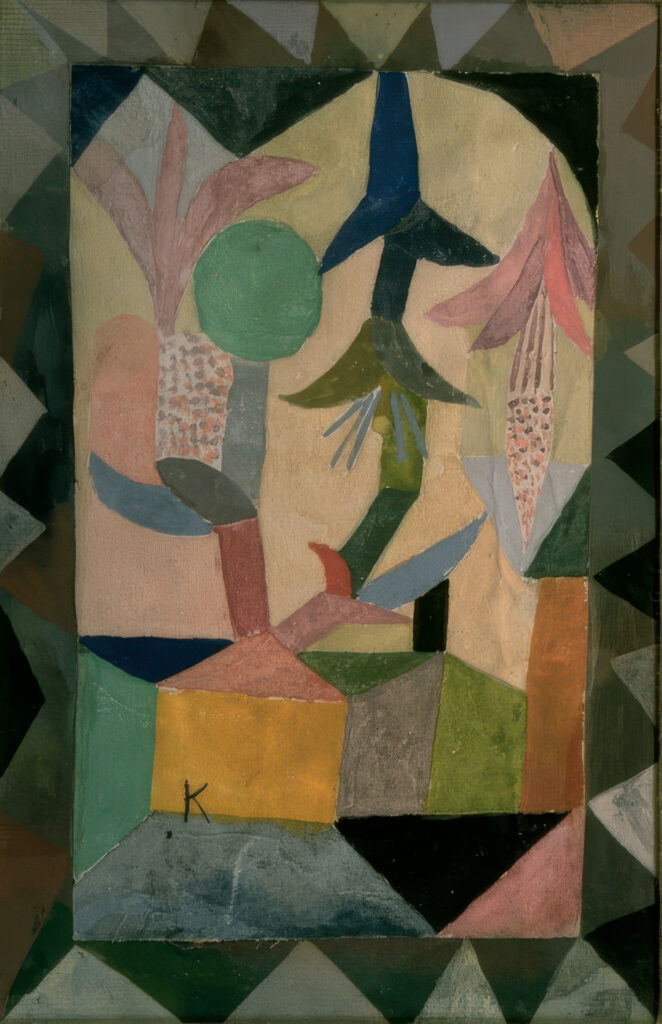
Out of this revelation came a body of work in which tones arrange themselves into checkerboards, bands, and rhythmic harmonies, as in Celestial Flowers above the Yellow House (1917), a small cosmogony in which forms seem to float within a coloured sky. Here already lies what Klee would go on exploring for the rest of his life: colour that constructs space rather than merely describing it.
3. The Bauhaus, or Colour Turned Theory
In October 1920, Walter Gropius invited Klee to teach at the Bauhaus in Weimar. He remained for ten years, first in Weimar and then, from 1925, in Dessau, teaching in turn stained glass, weaving, and eventually the theory of form and colour. His courses gave rise to thousands of pages of notes, since published as the Paul Klee Notebooks, now regarded as a foundational text of modern art pedagogy, comparable, in its significance, to Leonardo da Vinci’s treatise on painting for the Renaissance.
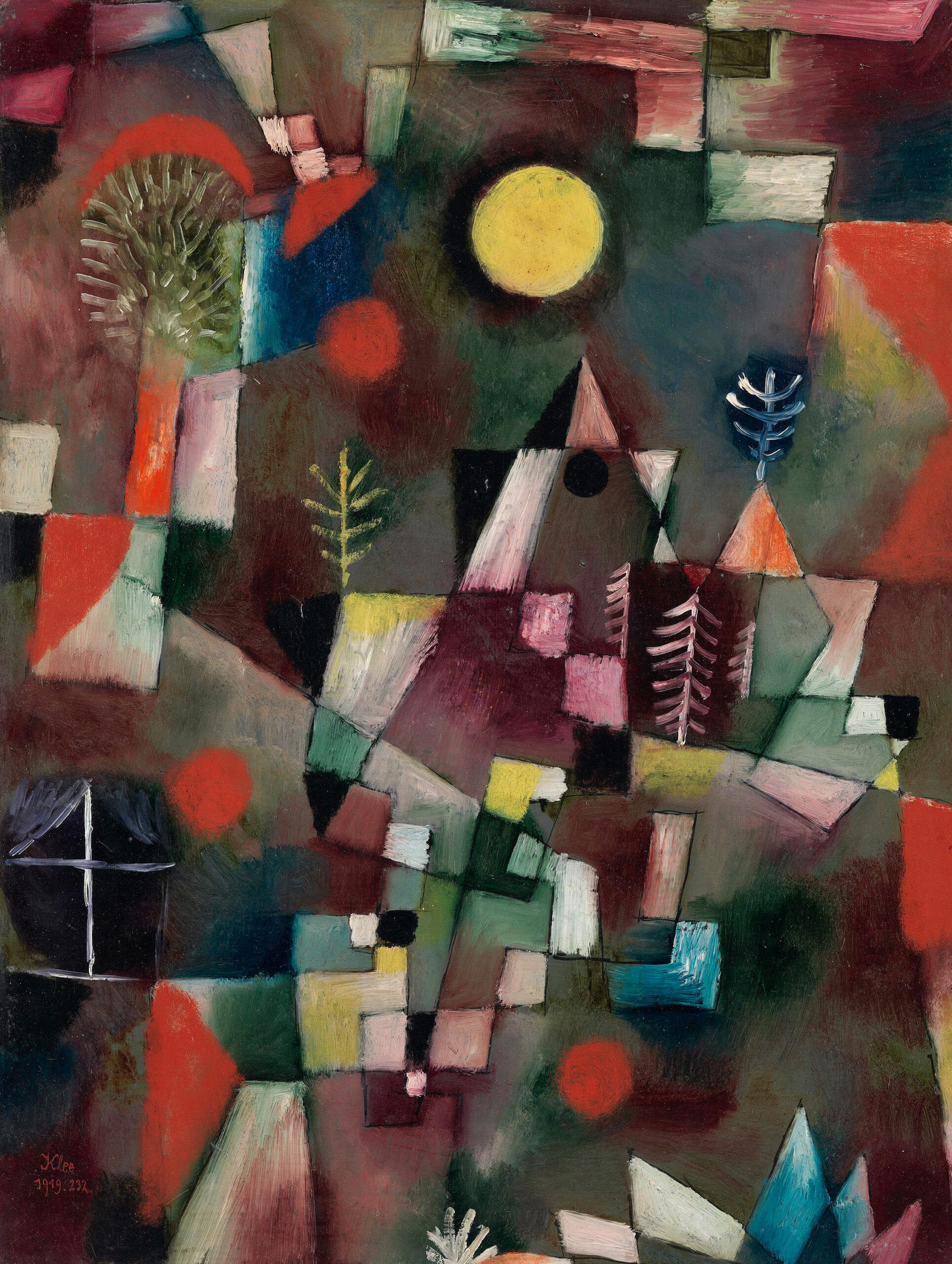
It was during these years that Klee developed his “magic squares,” grids of colour that methodically explored the effects of chromatic contrast and layering. The Full Moon (1919) anticipates this line of research: a simple motif, the moon against a night sky, becomes the pretext for a chord of muted, vibrant colour, poised somewhere between landscape and musical score. His students described him as an undogmatic teacher, equally at ease lecturing on the physical properties of colour with the rigour of a science course and then leaving each of them free to make of it what they would. Klee nonetheless grew weary of the school’s internal tensions, particularly after Gropius’s departure, and in 1931 joined the Düsseldorf Academy.
4. Exile, Illness, and a Final Freedom
In 1933, the Nazis dismissed him from his post in Düsseldorf. Klee left Germany for Bern. In 1937, one hundred and two of his works were confiscated from German museums, and seventeen were included in the propaganda exhibition Entartete Kunst (“Degenerate Art”), alongside works by Kandinsky, Chagall, and Ernst.
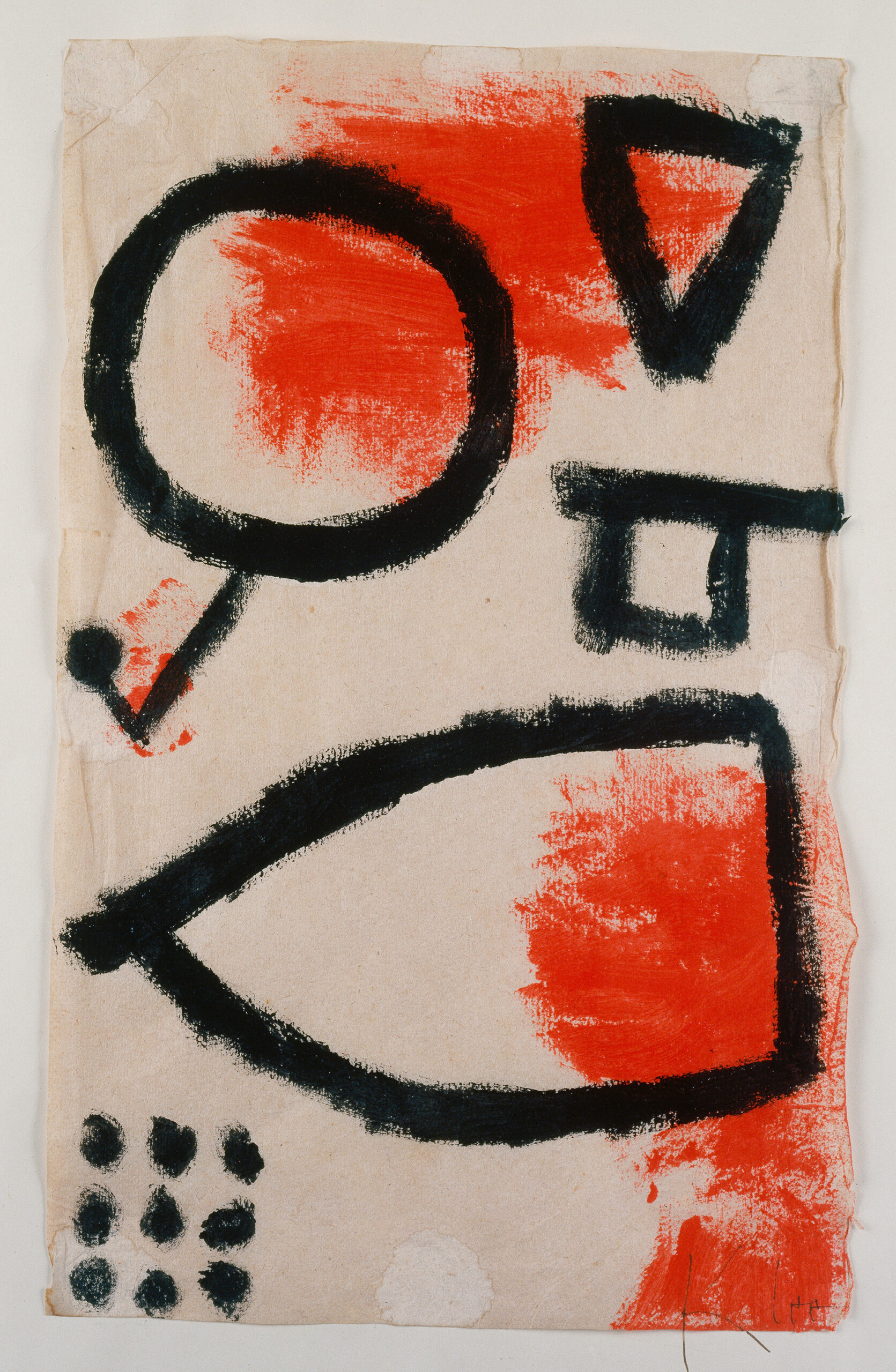
Two years earlier, in 1935, the first symptoms of a rare, incurable illness, scleroderma, which progressively stiffens the skin and joints, had appeared. Against all expectation, his output surged: in 1939 alone he produced more than 1,250 works, a record for his career, even as his hands caused him increasing pain. His line grew heavier, his signs more solemn, as in Alea Jacta (1940), painted in the year of his death. The title, “the die is cast”, captures well enough the spirit of these final years: an artist who continued, against everything, to produce work of undiminished freedom.
Paul Klee died on 29 June 1940 in Locarno, Switzerland, six days before his application for Swiss naturalisation was finally approved.
Spotlight on a Work: Architecture of the Plain (1923)
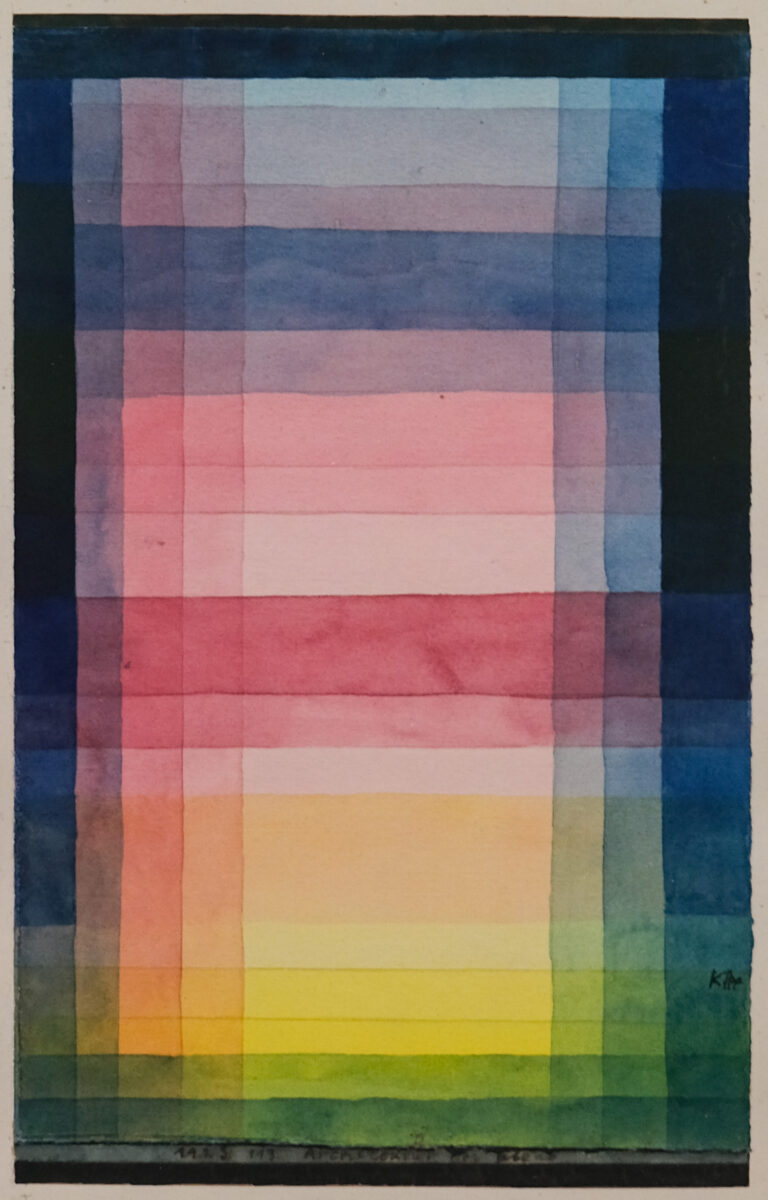
Among Klee’s works, this one holds a particular place in my own regard, and it captures well what the Bauhaus changed in his approach to painting. Architecture of the Plain belongs to the series of “magic squares” Klee developed during his teaching years, grids of colour conceived first as methodical exercises in contrast and chromatic superimposition, and only secondarily as paintings in the traditional sense. The title promises a construction, yet Klee traces no wall, no line of architecture in the literal sense. Colour alone stands in for structure.
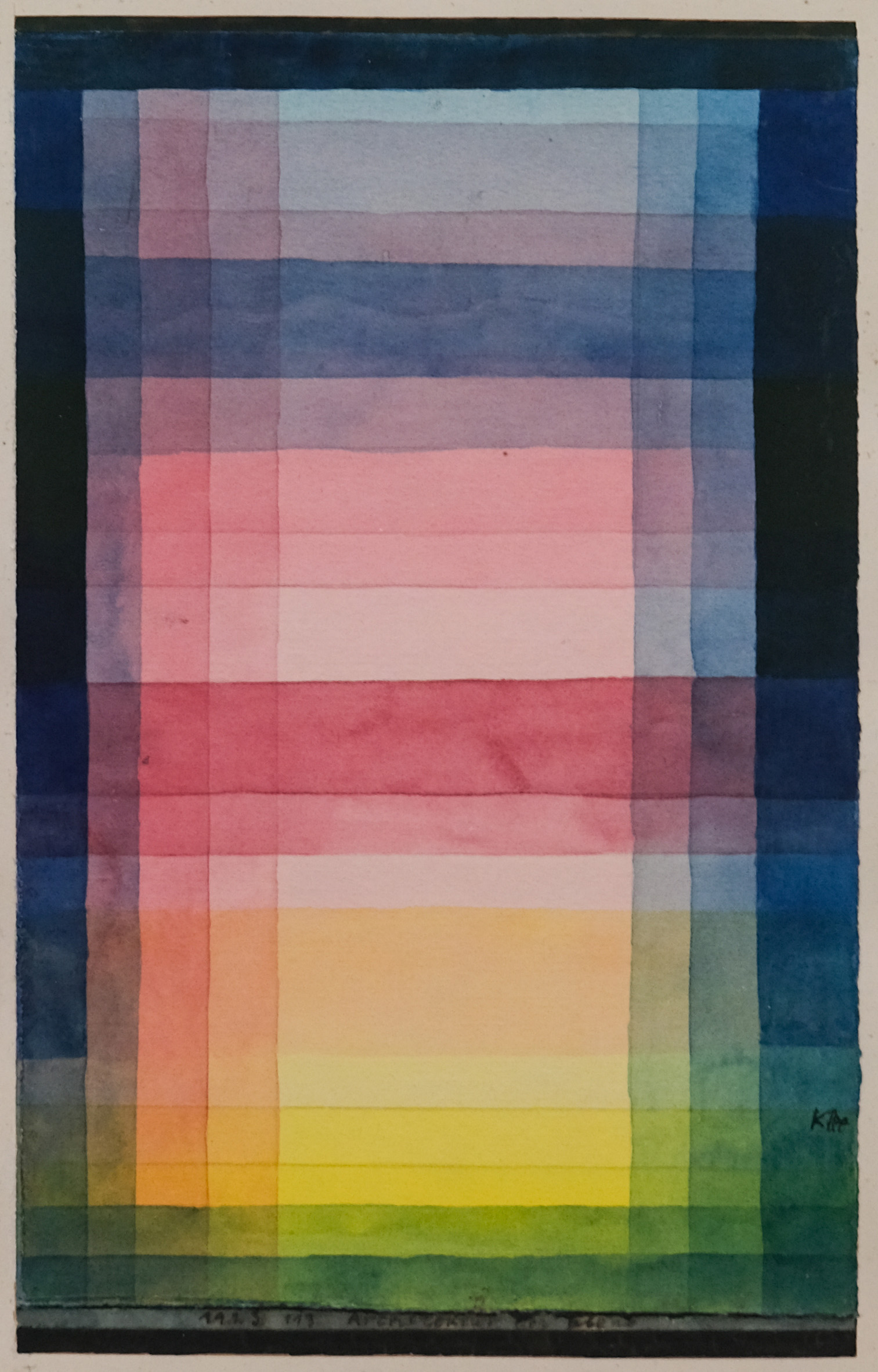
What makes this small watercolour particularly representative, to my mind, is the way it dissolves the boundary between lesson and artwork: what Klee taught his students about colour theory, he practised quite literally before their eyes, in a format that fits almost within the palm of a hand.
His Legacy
Klee’s teaching at the Bauhaus shaped a generation of artists and designers far beyond painting alone: his lectures on the theory of colour and form are still studied in art schools today. His work on chromatic grids anticipated, by several decades, the research of American Color Field painting, notably in Mark Rothko and Barnett Newman. His fondness for the sign, for pictorial writing, and for the world of childhood also left its mark on artists as different from one another as Joan Miró and, later, Jean-Michel Basquiat, both of whom claimed kinship with his graphic freedom.
Conclusion
Paul Klee occupies a singular position in twentieth-century art: that of an artist who refused, throughout his life, to be confined within any single school or movement. A trained musician and a rigorous theorist at the Bauhaus, he built a body of work in which colour and line function as a language in their own right, capable of making visible what the eye alone cannot see. Persecuted and ill, he never stopped painting, leaving behind nearly ten thousand works and a way of thinking about art whose influence is still felt today. What strikes one, in retrospect, is the coherence of this trajectory: from the violin of his Bernese childhood to the coloured grids of the Bauhaus, Klee was, at bottom, in pursuit of a single thing, a way of making visible what cannot be seen directly.
Works to Explore on VMuseum
Browse the full collection of analyses of Paul Klee’s works on VMuseum.
Frequently Asked Questions
What does it mean to “take a line for a walk”?
This is the phrase by which Klee summarised his method of drawing: allowing the line to wander freely across the page, tracing a figure, a sign, or an imagined architecture, without ever seeking to faithfully copy a real model. This freedom of graphic gesture, alongside colour, is one of the two pillars of his pictorial language.
Was Paul Klee an abstract painter?
Not entirely and this is precisely what makes his body of work difficult to classify. Klee never broke completely with figuration: even his most abstract paintings, such as Architecture of the Plain, often retain an evocative title, a trace of landscape or a recognisable motif. To my mind, Klee positioned himself deliberately on the frontier between abstraction and figuration, refusing to choose a side.
Why was his art branded “degenerate” by the Nazis?
The National Socialist regime used this term to designate the full range of modern movements it judged contrary to the official aesthetics of the Reich: Bauhaus, Cubism, Expressionism, Surrealism. In 1937, one hundred and two of Klee’s works were confiscated from German museums, and seventeen were included in the propaganda exhibition Entartete Kunst, alongside works by Kandinsky, Chagall, and Otto Dix.
What illness marked the end of his life?
From 1935 onward, Klee suffered from scleroderma, a rare and incurable disease that causes a progressive hardening of the skin and tissues, joint pain, and breathing difficulties. Despite this, his artistic output remained, paradoxically, especially intense during these final years.
Where can Paul Klee’s works be seen today?
The Zentrum Paul Klee in Bern holds the most important collection, with several thousand works. Major pieces can also be found at the Kunstmuseum Basel, the Neue Nationalgalerie, and the Museum Berggruen in Berlin, as well as at MoMA in New York. Several detailed analyses are available on VMuseum.
Bibliographical Sources
This biography draws on the archives of the Zentrum Paul Klee in Bern, institutional catalogues (Tate, MoMA, Kunstmuseum Basel), and close study of the works by Klee available on VMuseum. Browse our full analyses of Paul Klee’s works, with images and detailed notices, here.
- Art UK, Paul Klee, biographical entry
- Zentrum Paul Klee (Bern), official biographical chronology
- PMC / National Library of Medicine, The Diagnosis of Art: Scleroderma in Paul Klee
- House of Switzerland, Paul Klee’s Universe of Images and His Work in Bern
- Wikipedia, Voyage en Tunisie (1914)