Key facts
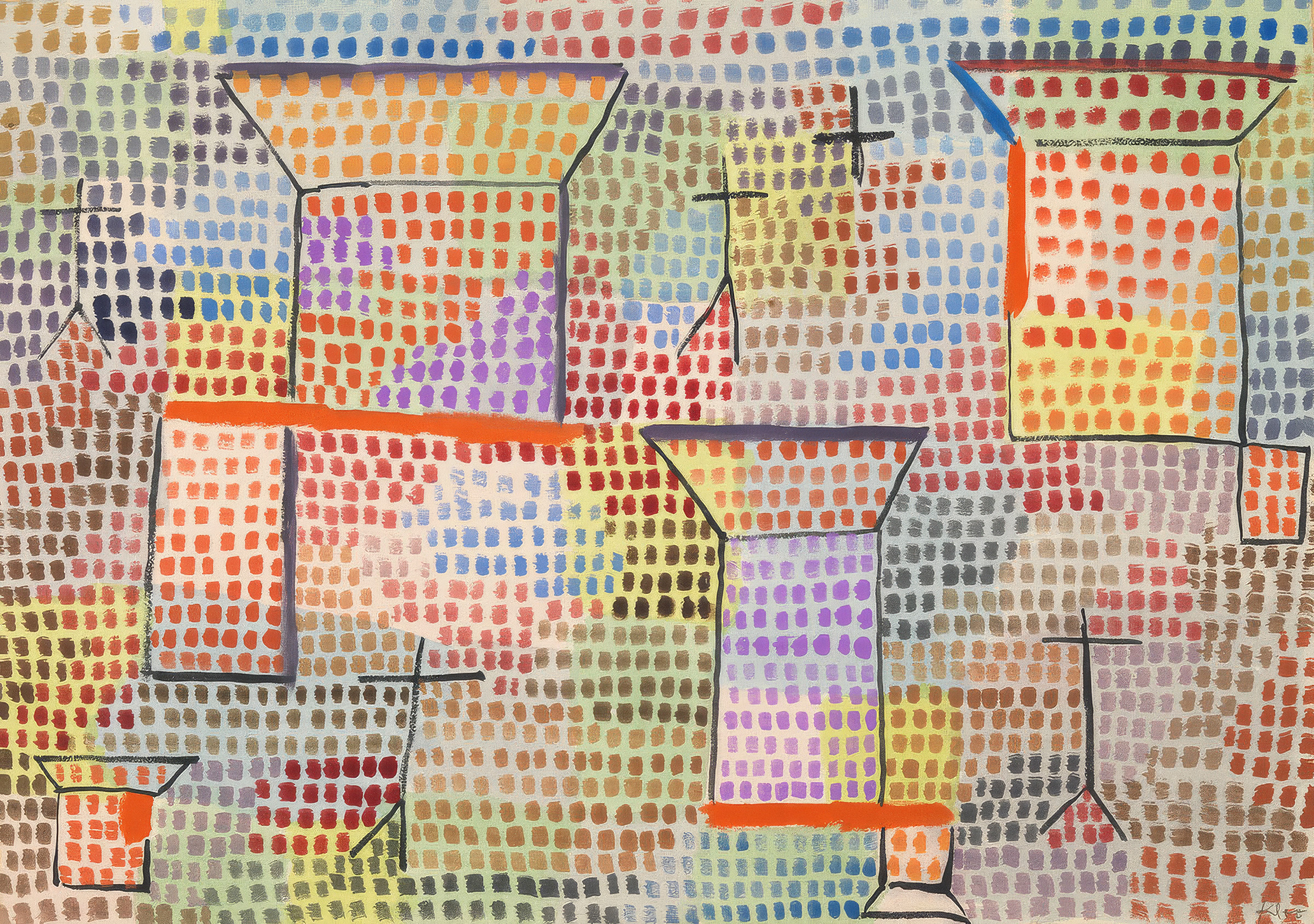
Cross and Columns is a watercolour painted by Paul Klee in 1931, on copper-plate printing paper, held at the Pinakothek der Moderne in Munich. Klee applies colour in small, regular touches, a method close to pointillism that turns the sheet into a shimmering mosaic, over which he sketches stylised columns and crosses in charcoal. The work dates from the year the artist leaves the Bauhaus in Dessau for the Düsseldorf Academy. A Swiss-German painter associated with the Bauhaus without ever being confined to it, Paul Klee develops a pictorial language poised between abstraction and figuration. The watercolour entered the Bavarian state collections in 1951, after having belonged to the collector Ida Bienert.
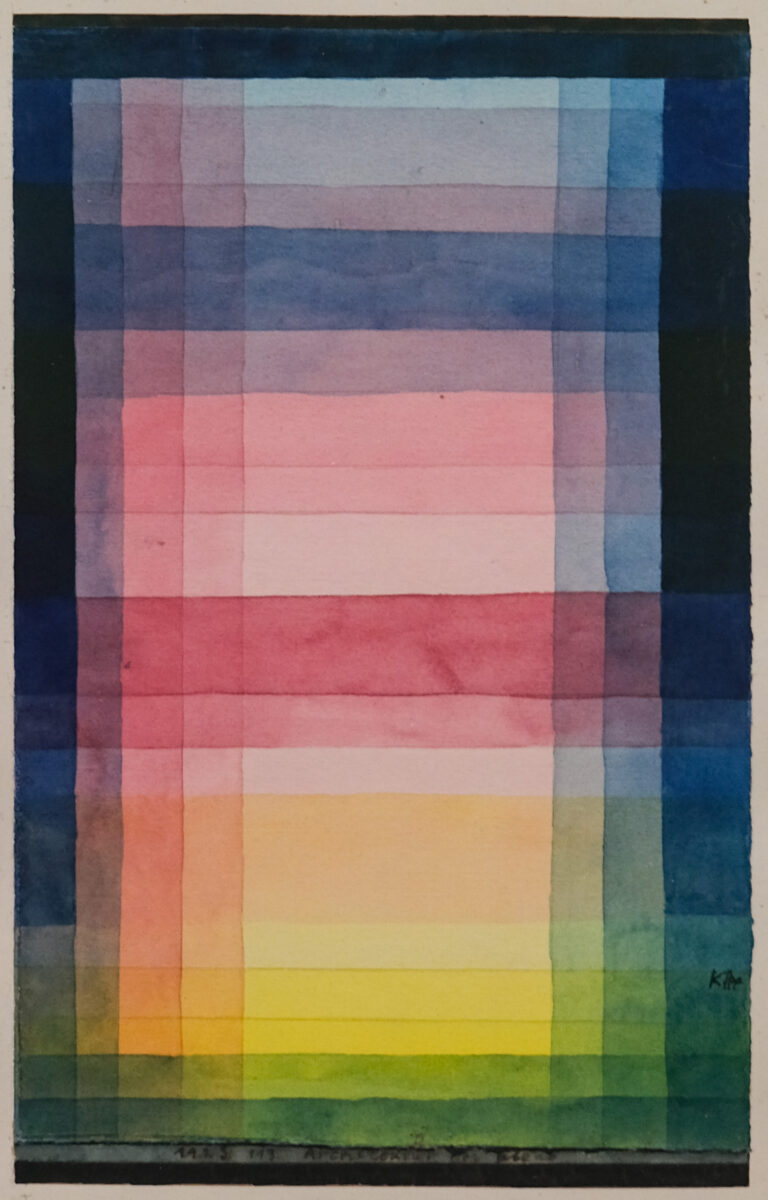
I return to Paul Klee today through this work on paper. I love the blurred line between abstraction and figuration running through it, and the handling of colour, both in the ground and in these juxtaposed touches that complete the drawing. The columns and crosses are barely sketched, the latter evoking almost stylised figures, like silhouettes that have slipped into the composition. It is a far cry from the palette of Architecture of the Plain, by the same Klee: here, the colour is more restrained, almost muted. I love this simplified, poetic work, which lets itself be looked at unhurriedly, and lets the eye travel from point to point, as one would follow a score.
Seeing Cross and Columns
A violet square sits squarely at the centre of a beige column. Around it, thousands of small square touches, orange, blue, red, ochre, cover the entire sheet like a tight weave. The grain of the paper heightens this textile quality further. The light does not come from a single point. It circulates, square by square, as though each touch carried its own source. Two black crosses, drawn with a quick line, float above this dense weave. Below, a broad orange bar cuts across the composition with a bold, almost blunt gesture. The eye looks for a starting point. It never quite finds one, and that may be the whole interest of this watercolour.
Understanding Paul Klee
In 1931, Paul Klee leaves the Bauhaus in Dessau. He joins the Düsseldorf Academy, seeking a little more time to paint. This watercolour belongs to that pivotal year. Klee works on copper-plate printing paper, a textured support that catches colour in small, regular touches. This method, close to pointillism, transforms the sheet into a vibrant mosaic. Klee explores this technique steadily through the late 1920s and into the early 1930s. Alongside it, he pursues more geometric research at the Bauhaus. Over this coloured weave, he sketches columns and crosses in charcoal, simple, almost childlike forms. Looked at closely, the crosses also resemble stylised figures, arms outstretched like small human forms. Architecture and the human figure merge here without ever resolving into one another. Paul Klee, a Swiss-German painter born in 1879, remains associated with the Bauhaus without ever being confined by it. He is neither wholly abstract nor wholly figurative. The work entered the Bavarian State Painting Collections in 1951, having previously belonged to the collector Ida Bienert.
Feeling
Before this watercolour, the eye never settles for long. It leaps from one coloured square to the next, from a cross to a column, never quite pausing. Nothing imposes a hierarchy on the forms, nor any narrative to follow. Two years later, the Nazi regime will brand Klee’s work “degenerate.” It will remove him from his post in Düsseldorf. Nothing here foretells it yet. The colour remains light, almost playful, almost carefree. Watch how it resists, in advance, the silence that is to come. Even today, this notebook of colours seems shielded from the time surrounding it.
News from the Pinakothek der Moderne
In 2026, the Pinakothek der Moderne in Munich began a sweeping, phased rehang of its permanent galleries (“Mix & Match. Die Sammlung neu entdecken”), redistributing works from the collection through the end of the year. The museum is presenting, in parallel, a new group exhibition, “Between and Beyond, Interspaces and Transitions in Art since 1960” (running since 3 July 2026). Amid this rotation, Paul Klee’s watercolour Cross and Columns is not currently on view; it remains part of the museum’s rich holdings and may reappear in a future hang. The museum’s online catalogue remains the reference point for tracking its availability.
Source: Pinakothek der Moderne, Munich
A Question for You
Standing before this grid of colour, do you look first for an architecture, or for the trace of the painter who fragmented it?
About This Work
- Cross and Columns
- Paul Klee (1879–1940)
- 1931
- Watercolour on copper-plate printing paper
- 38 × 53 cm
- Pinakothek der Moderne, Munich
- https://www.sammlung.pinakothek.de/de/artwork/8MLvgkdGz3/paul-klee/kreuze-und-saeulen