Key facts
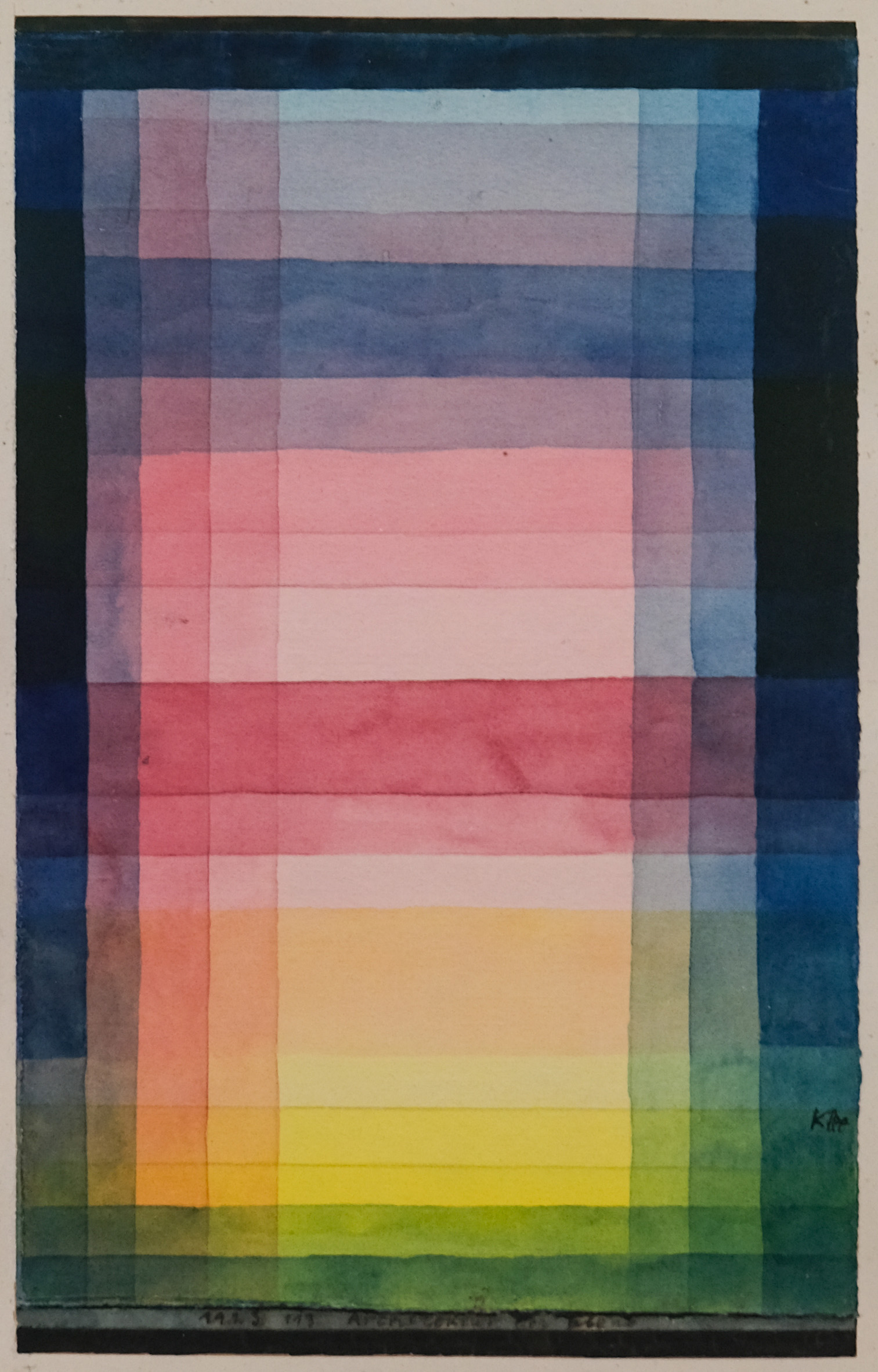
Painted in 1923, Architecture of the Plain (Architektur der Ebene) is a watercolour and pencil on paper by Paul Klee (1879–1940), held at the Museum Berggruen in Berlin. Klee made it during his teaching years at the Bauhaus, the period in which he developed his “magic squares,” grids of colour that explored his chromatic theory. Drawn freehand, without a ruler, it layers transparent veils of red, yellow and blue, from which a low light emerges. Belonging to the abstraction of the early twentieth century, it is often cited as an anticipation of American Color Field painting by Rothko and Newman. It exemplifies the central place of colour in Klee’s art.
I had the good fortune to see the Berggruen exhibition at the Orangerie in Paris in late 2024, and to discover this small watercolour by Paul Klee there. A modest scrap of paper, a few lines of colour crossing one another, and at the bottom a light that radiates, in luminous yellows. I was struck by the invigorating force that this minute format releases all on its own. I see in it a sunset over a plain, at the most colourful moment of the day: the sun still full of power, yet already close to the horizon. With very little in the way of means, and a basic design traced freehand, Klee delivers an object of rare intensity. This is what I love about him: that sometimes almost childlike simplicity, and a truth that belongs to it alone. For me, this one is a true favourite.
See
Look first at the bottom of the sheet. A warm yellow rises there, almost solar. It presses against the pink, the coral, a soft orange. Higher up, the tones grow cooler. Pink turns to blue, then to deep violet. Dark vertical bands, nearly black, frame the scene. Green surfaces at all four corners. The paper breathes beneath the transparent watercolour. The light does not fall from the sky. It wells up from below, like a warmth rising through the surface. Each square rests upon its neighbour. Nothing here is perfectly aligned. The grid trembles, alive, never quite straight.
Understand
The year is 1923. Paul Klee has been teaching at the Weimar Bauhaus for two years. There he treats colour as a sensitive science. This grid belongs to his series of magic squares. Klee traces the framework without a ruler, in fine pencil. The parallelism remains approximate, almost by hand. He then layers veils of watercolour, gradations of the three primaries. Blue shifts from ultramarine to pale azure. Red slides from bordeaux to pink. Yellow descends toward ochre. This abstraction stays bound to the visible world. Ten years earlier, a journey to Tunisia had transformed his relationship to colour. “Colour possesses me,” he notes in his diary of 1914. Here, the geometry keeps its warmth. The curator Roland März sees in it a foretelling of American Color Field painting. Rothko and Newman would paint these fields of colour forty years later.
Feel
Come closer still. The whole format fits within two hands. Yet the surface glows like a stained-glass window. This low warmth suggests a sun setting over a plain. One can almost feel the mildness of the evening. The title announces an architecture. The eye, for its part, meets no wall. It sees only light laid down, layer upon layer. The rigour of the plan dissolves into colour. Stay before the watercolour a moment. Let the yellow rise up to you. The minuscule holds the immense within it. Something living circulates through this landscape of paper. Klee achieves much with very little.
In the News
Architecture of the Plain belongs to the collection of the Museum Berggruen in Berlin, one of the world’s most important collections of modern art, assembled by the dealer and collector Heinz Berggruen. Closed since September 2022 for a complete renovation of its historic building (the Stüler Building, facing Charlottenburg Palace), the museum is due to reopen in 2026. Far from being placed in storage during the works, the collection—rich in some sixty works by Paul Klee alongside Picasso, Matisse and Giacometti—embarked on an internationally acclaimed touring exhibition, from Japan and China to Venice, the Musée de l’Orangerie in Paris, the National Gallery of Australia in Canberra, and then the Museo Thyssen-Bornemisza in Madrid in early 2026. A sign of the enduring worldwide interest in this ensemble, of which the watercolour presented here forms a part.
Source: Museum Berggruen
A Question for You
💭 Forty years before Rothko, Klee is already painting fields of colour: should we then see in this small watercolour a forgotten source of American abstraction, or merely a coincidence of vision?
About This Work
- Architecture of the Plain
- Paul Klee
- 1923
- Watercolour and pencil on paper mounted on cardboard; upper and lower borders in watercolour and pen, second lower border in watercolour and pen
- 28/28.2 × 17.2/18.1 cm
- Museum Berggruen, Berlin
- https://search.smb.museum/object/obj-965693