Today I am publishing on VMuseum a 500th work of art, The Full Moon by Paul Klee. 500 times art made me want to share, to move, to connect. Thank you each and every one of you for being here, for looking, for feeling. You are the reason art means so much.
I must confess a particular fondness for Paul Klee. Among all the great names of European modernism, his work speaks to me most directly, perhaps because it resists any rigid classification. Expressionist, Surrealist, abstract? Klee is all of these at once, and none of them entirely. He moved through the defining movements of the early twentieth century, the Blaue Reiter, then the Bauhaus, without ever being confined to a single aesthetic, always preserving a style unmistakably his own. What draws me to him is this rare ability to be at once learned and lyrical, structured and dreamlike. His paintings seem to emerge from a deeply coherent inner world, populated with signs, colours and forms. Full Moon is a fine example: a work that appears unassuming at first glance, yet refuses to leave you. That quality is precisely what I wanted to share with you today.
See
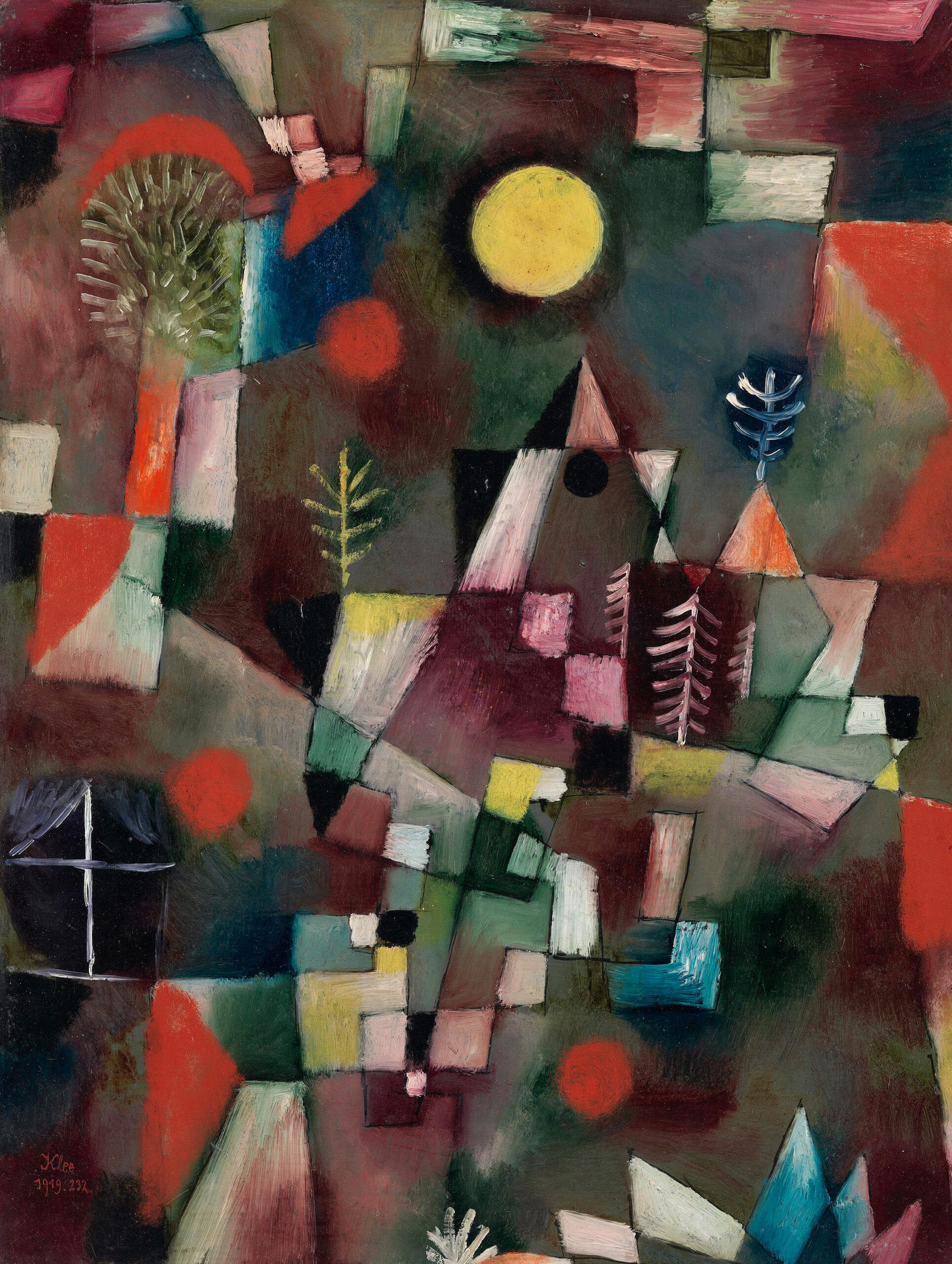
A solar yellow disc presides over a darkened sky. Around it, an imaginary city rises: triangular rooftops, fragmented façades, schematic trees. Reds blaze. Greens deepen into shadow. Look at how the geometric forms interlock like pieces of a dreamlike puzzle. Everything vibrates; nothing settles. The composition holds together through a secret, almost musical logic.
Understand
Paul Klee (1879-1940) returns from the Great War, demobilised, bruised yet unbroken in his vision. Munich is in the grip of revolution. Amid this political turmoil, Klee briefly takes part in the artistic councils of the Bavarian Republic, then rents a studio in Schwabing. It is there, in that charged atmosphere, that he paints Full Moon in oil on cardboard. The medium is deliberately modest, cardboard rather than canvas, yet the formal richness of the result is remarkable. Klee layers flat planes of colour with graphic signs, constructing a nocturnal landscape that belongs to no real geography. The following year, he joins the Weimar Bauhaus founded by Gropius, where his thinking on form and colour will reach full maturity.
Feel
Look at that yellow moon: it does not warm, it reveals. Beneath its cold light, Klee’s city becomes a theatre of inhabited shadows. One cannot tell whether one is dreaming or waking. This is precisely where Klee operates, in that fragile in-between, between sign and image, between childhood and thought. Allow yourself to be unsettled. That is where understanding begins.
Currently on view in Munich
Full Moon is currently on display as part of MIX & MATCH. Rediscovering the Collection, the rehung permanent presentation of the Sammlung Moderne Kunst, on view until 30 August 2026. Some 350 works spanning 120 years of art history are brought into dialogue across epochs and media.
Source: pinakothek.de/en/mix-and-match
A question for you
💭 When you look at this nocturnal composition: do you see a city, or a dream?
About this work
- Full Moon (Der Vollmond)
- Paul Klee
- 1919
- Oil on cardboard
- 49.8 x 38 cm
- Bavarian State Painting Collections – Sammlung Moderne Kunst, Pinakothek der Moderne, Munich
- https://www.sammlung.pinakothek.de/de/artwork/Qr4DOwbGpE/paul-klee-1879/der-vollmond-15249
An Imaginary City under the Moon
Full Moon is one of the most poetic works by Paul Klee (Münchenbuchsee, near Berne, 1879 – Muralto, 1940) in the years following his return from the war. A yellow lunar disc floats in a dark nocturnal sky above an imaginary city whose triangular rooftops, colored walls, and illuminated windows form a fairy-tale landscape. Vivid reds and intense greens punctuate the composition with a chromatic vibration that neither the darkness of the background nor the softness of the moonlight can diminish. Klee is not observing a real city: he is constructing an interior world, a space inhabitable by imagination alone.
1919: Between War and the Bauhaus
Klee painted Full Moon in 1919, the very year he joined the Weimar Bauhaus at Walter Gropius’s invitation. The moment was decisive: after four years of military service, including an assignment painting camouflage on aircraft at Gersthofen, he recovered complete creative freedom and produced within a few months a series of works that define his personal style. That style fuses theoretical rigor with poetic invention, references to childhood and to music, to abstraction and to the visible world. Full Moon belongs to this founding moment, when Klee was simultaneously inventing his pictorial language and developing the artistic pedagogy he would bring to a generation of students.
Klee’s Singular Place in Modern Art
The Pinakothek der Moderne in Munich holds an exceptional collection of modern art in which Klee’s works occupy a particularly important position. Born on the border between Switzerland and Germany, Klee is one of the most unclassifiable figures of the twentieth century, neither strictly expressionist nor surrealist, but in permanent dialogue with all the movements of his era. Full Moon illustrates this singular positioning: a work that borrows from several visual languages without belonging entirely to any of them, and that has lost none of its capacity to surprise more than a century after it was made.