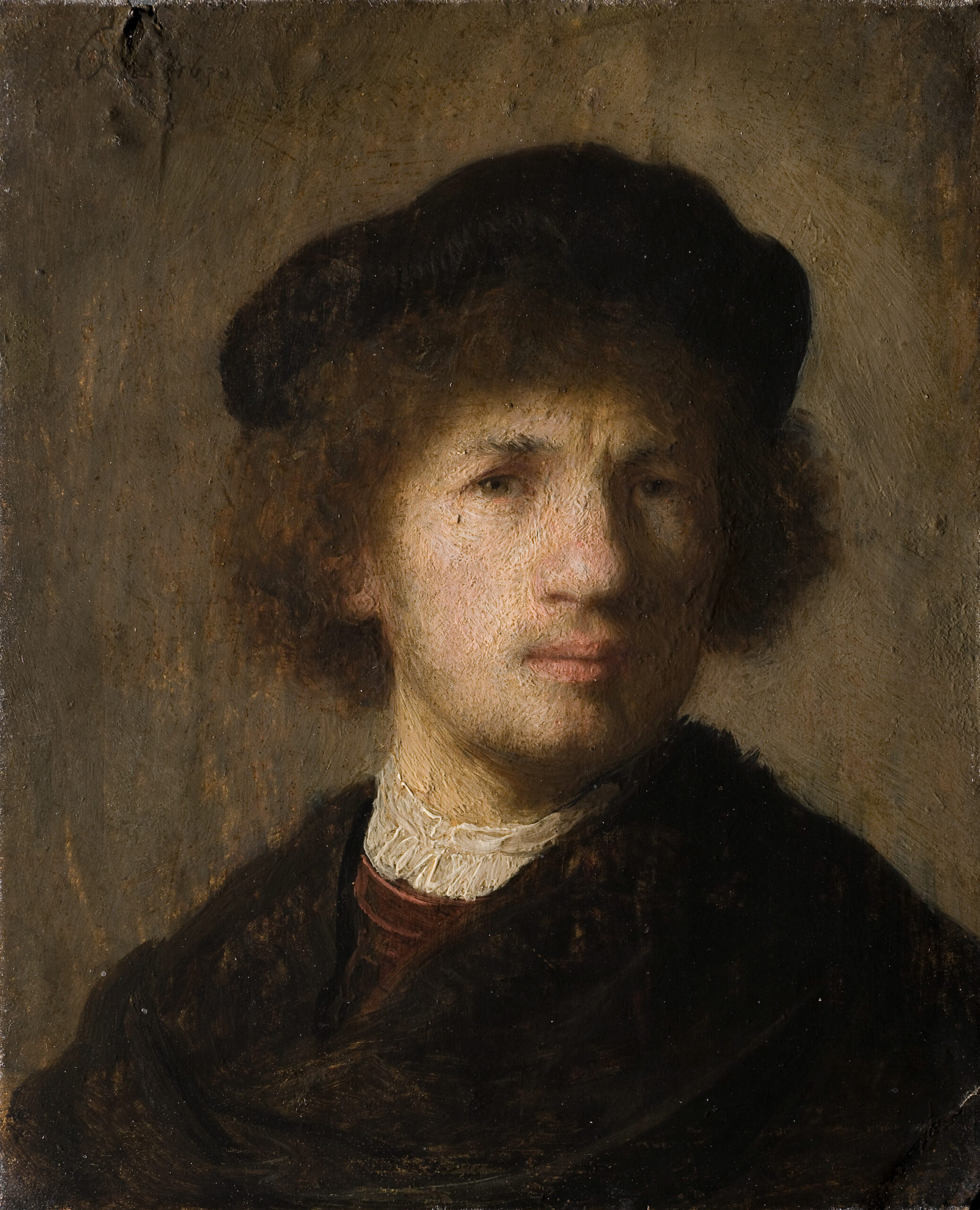
Leiden, 1630. A young man of twenty-four plants himself before his mirror. He picks up a brush. On a copper plate no larger than a postcard, he begins to paint himself. That young man is Rembrandt.
A face sculpted in gold
Look at that gaze. Focused, faintly melancholic, it searches for something beyond the frame. The dark beret bears down on his auburn curls. The light caresses the full nose, the determined chin. The white collar, slightly crumpled, cuts against the brown, velvety cape. Rembrandt paints with painstaking precision. Each brushstroke is fine, almost trembling with care. Beneath the oil paint lies a secret: a layer of gold leaf covers the lead white ground. This luminous foundation makes the colours glow from within.
Fijnschilderij at its finest
In 1630, Rembrandt was still deeply marked by the fijnschilders, the “fine painters” of Leiden. This movement prized extreme minuteness and detail invisible to the naked eye. Painting on copper demands exactly that discipline: the smooth, cold surface is utterly unforgiving. Five paintings by Rembrandt on copper are known, three of them on a gold leaf ground. This self-portrait is among them. It entered the Nationalmuseum in Stockholm in 1956, during a major Rembrandt retrospective. It has remained there ever since — a quiet little masterpiece of the Dutch Baroque.
Rembrandt Harmensz. van Rijn
Rembrandt Harmensz. van Rijn (1606–1669) was born in Leiden into a miller’s family. He became the painter of inner light. His self-portraits — more than eighty in all — form a visual diary unique in the history of art.
A question for you
💭 Rembrandt painted himself more than eighty times over the course of his life — what other artist has made their own face such a lifelong laboratory?
About this work
- Self-Portrait
- Rembrandt Harmensz. van Rijn
- 1630
- Oil on copper with gold leaf
- 15.5 × 12 cm
- Nationalmuseum, Stockholm
- https://collection.nationalmuseum.se/en/collection/item/22374/