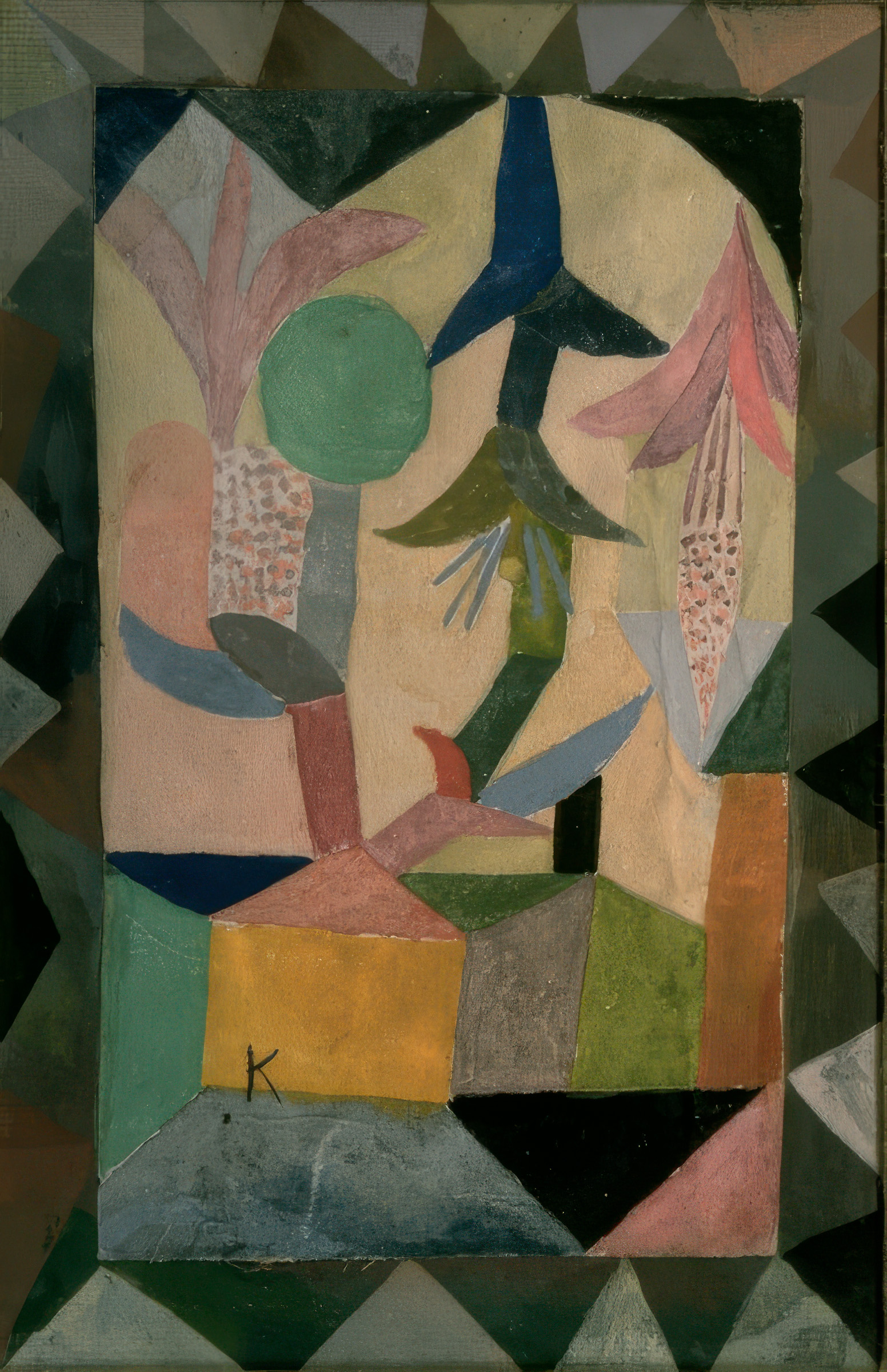
What I feel before this work is, above all, poetry.What I feel before this work is, above all, poetry. The softness of the colours, the upward sweep of these celestial flowers, the stylised houses that seem to float within the composition: everything invites wonder and a genuine dreamlike wandering. I have a deep affection for Klee’s painting, so distinct from that of his contemporaries, often skirting the edge of abstraction yet always coloured with a gentleness and variety entirely his own.
This is a work to be contemplated rather than simply viewed, one that reveals itself gradually, to those willing to take their time with it. I am, in fact, looking forward to returning to Berlin to visit the Museum Berggruen, which was unfortunately closed during my last trip, just as the pandemic was easing.
Looking
A black line, almost hidden, signs the yellow facade. It is Paul Klee‘s initial, slipped into the architecture like a secret. Around it, colours stack in muted lozenges: soft green, burnt ochre, midnight blue. Three stems rise toward the sky, each crowned with a flower of pointed petals. The frame, built from dark triangles, encircles the scene like a window onto a suspended world.
Understanding
Klee painted this watercolour in 1917, in the midst of the First World War. At the time, he served as a paymaster at the flying school in Gersthofen, far from the front line. Nothing here speaks of conflict. Before the war, Klee had drawn grotesque, elongated, ironic figures. His 1914 journey to Tunisia had transformed his relationship to colour. The triangles of the gable echo those of the frame, pointing both toward the ground and toward the sky. This double direction maps out Klee’s entire programme: a dialogue between the earthly and the cosmic. The flower reaches the sky; the house remains anchored to the ground. The chalky ground beneath allows the watercolour’s light to show through, lending the scene an almost unreal clarity. Klee works here at the threshold between Expressionism and an emerging abstraction.
Feeling
Look at these flowers rising above the rooftops. They do not grow; they ascend. The soft green of the rotunda settles the eye before it climbs toward the dark blue of the stems. Nothing here is urgent. Klee invites a slower gaze, letting it drift between coloured planes, never lingering too long on any single motif. War rumbles elsewhere; on this 23 centimetre piece of board, the world remains habitable.
News: Klee across the Atlantic
Through 26 July 2026, the Jewish Museum in New York presents Paul Klee: Other Possible Worlds, organised with the Zentrum Paul Klee and the Kunstmuseum Bern. A hundred paintings and drawings, including the Angelus Novus, trace the final decade of the artist’s life.
Source: thejewishmuseum.org/exhibitions/paul-klee-other-possible-worlds
A question for you
💭 Does this watercolour already anticipate the geometric abstraction Klee would develop at the Bauhaus a few years later?
About this work
- Celestial Flowers above the Yellow House (The Chosen House)
- Paul Klee
- 1917
- Watercolour and gouache on primed linen mounted on paper, bordered in watercolour, mounted on board
- 23 x 15 cm
- Museum Berggruen, Berlin
- https://recherche.smb.museum/detail/965924/himmelsbl%C3%BCten-%C3%BCber-dem-gelben-haus-das-auserw%C3%A4hlte-haus
Klee and the Museum Berggruen
The work is today held at the Museum Berggruen in Berlin, one of the most singular museums in the German capital. Founded on the personal collection of Heinz Berggruen (1914-2007), a Berlin-born art dealer who emigrated in 1936, first to the United States then to France, who had formed personal ties with Picasso, Matisse, Giacometti, and Klee, the museum holds one of the most important Klee collections in the world, gathering works from every period of his career. Celestial Flowers above the Yellow House finds a particularly coherent home in a collection assembled through passion as much as knowledge.