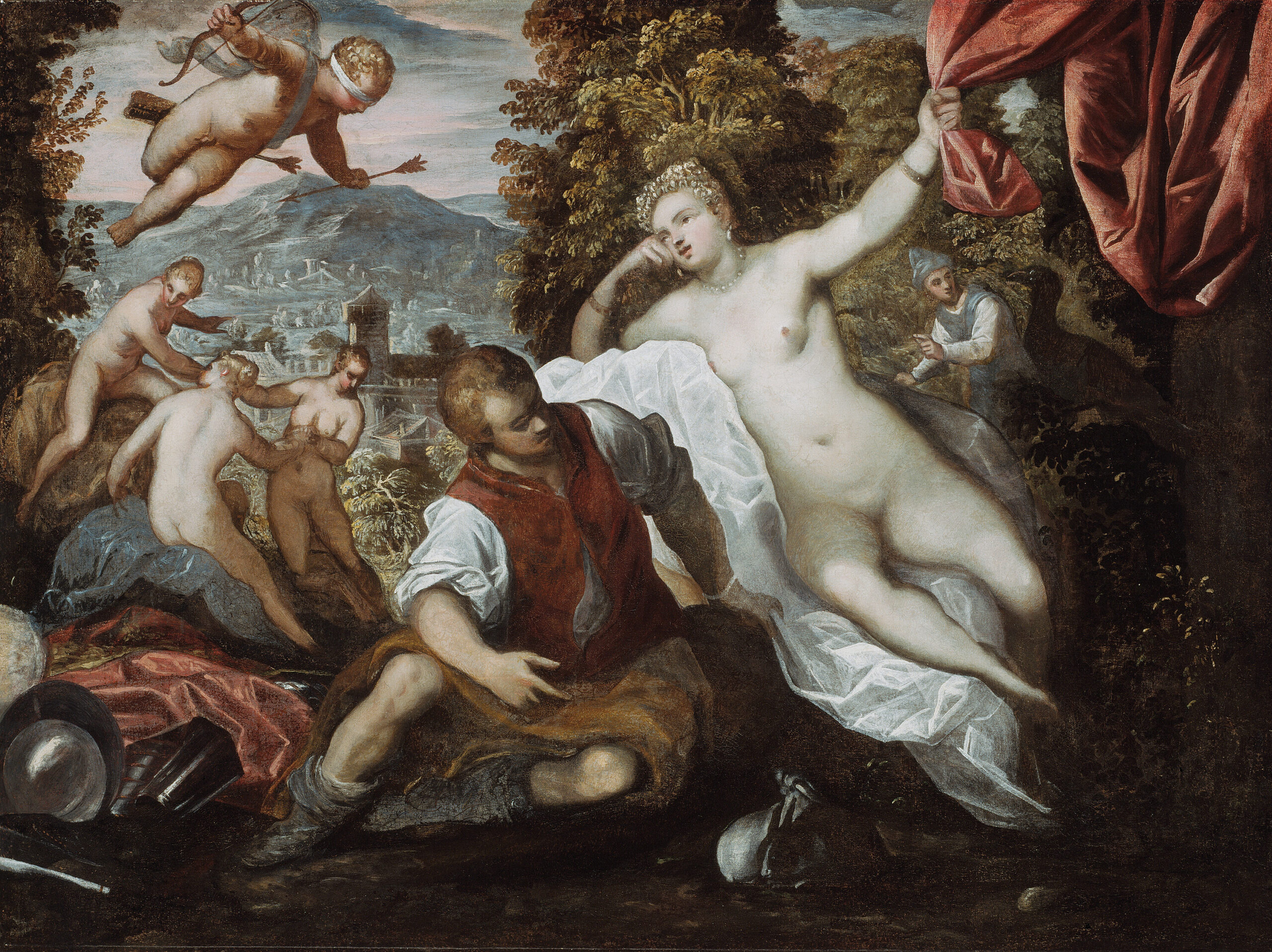
This depiction of Venus and Mars with Cupid and the Three Graces is one of the works that surprised me most in building the VMuseum collection. We all know the father, Jacopo Tintoretto, one of the giants of sixteenth-century Venetian painting, but Domenico, his eldest son, too often remains in his shadow. Yet looking carefully at this canvas, one perceives a distinctly different sensibility: where the father favoured dramatic sweep and striking light, Domenico integrates a background landscape of remarkable softness, almost poetic, that envelops the mythological scene and lends it an intimacy rare in Venetian painting of the period. It is precisely this treatment of landscape, a true signature of his early period, that makes this work so singular in my eyes. A fine way in to (re)discovering an unjustly overlooked painter, to explore right now on VMuseum.
Your eye settles first on Venus. Nude, luminous, she occupies the centre of the composition. Mars, at her feet, has laid down his arms. Cupid flies above. The Three Graces embrace in the background. Everything breathes softness and seduction.
What lies beneath the surface
Look beyond the figures. Domenico Tintoretto constructs this mythological scene across several skilfully articulated planes. In the foreground, the martial attributes of Mars, helmet, shield, breastplate, lie abandoned. Love triumphs over war: the message is clear, but the handling is subtle. The oil on canvas technique reveals a warm palette dominated by reds and ochres, inherited from the Venetian school. Look especially at the landscape stretching behind the figures: bluish hills, distant architecture, a pearlescent sky. This is where Domenico parts ways with his father. That background is not a backdrop, it breathes, it participates. Light moves through it with a particular fluidity, creating an atmospheric depth that almost anticipates the landscape painting of the following century.
The artist and his time
Domenico Tintoretto was born in Venice in 1560. Trained in his father Jacopo’s workshop, he absorbed the foundations of Venetian Mannerism, but quickly developed his own preoccupations: poetic and literary subjects, complex mythological themes treated in multiple versions with subtle variations. This Venus and Mars, painted between 1585 and 1595, belongs to his first creative period. It is today held at the Art Institute of Chicago. Domenico died in Venice in 1635, leaving a rich body of work that remains too little explored.
The Tintoretto family in the spotlight at the Accademia in Venice
The Tintoretto family is more than ever at the heart of the international art world. The Gallerie dell’Accademia in Venice is currently devoting a major exhibition to the cycle of the Stories of Genesis by Jacopo Tintoretto, Domenico’s father, on view until 7 June 2026. An event that underscores the considerable importance of this family workshop in the history of Venetian painting at the close of the sixteenth century, the very period in which Domenico Tintoretto painted Venus and Mars with Cupid and the Three Graces in a Landscape.
Source: gallerieaccademia.it/tintoretto-racconta-la-genesi-ricerca-analisi-e-restauro
A question for you
💭 And you, in this painting, is it Mars, Venus or the landscape that catches your eye first?
About this work
- Venus and Mars with Cupid and the Three Graces in a Landscape
- Domenico Tintoretto
- 1585–1595
- Oil on canvas
- 41⅞ × 56¼ in. (106.5 × 142.8 cm)
- Art Institute of Chicago
- https://www.artic.edu/artworks/4089/venus-and-mars-with-cupid-and-the-three-graces-in-a-landscape