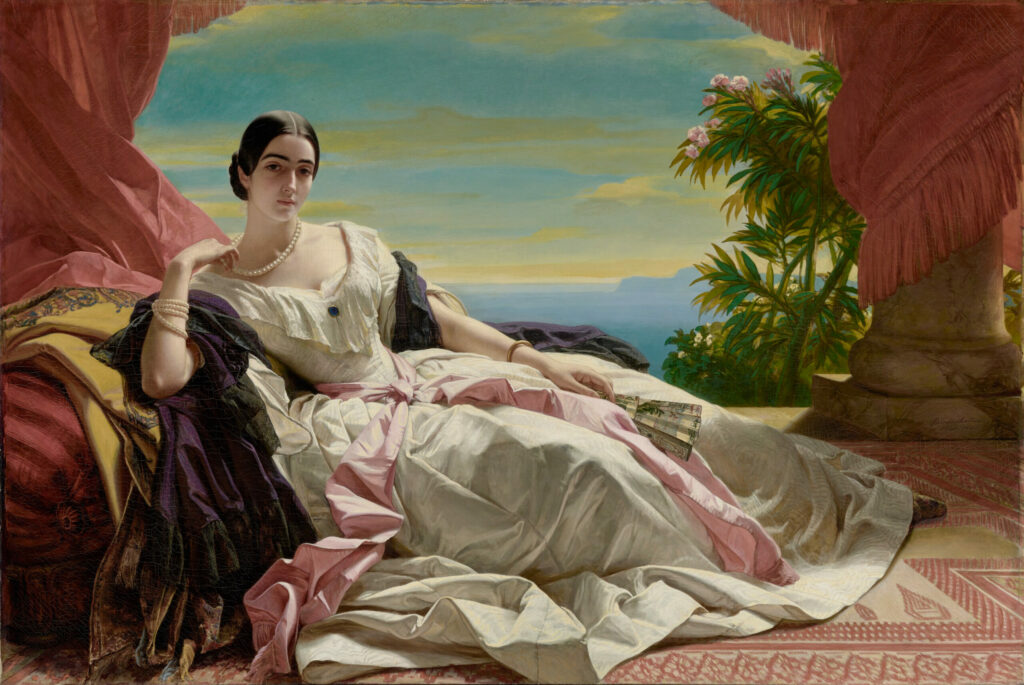
Paris, 1843. Franz Xaver Winterhalter must paint Princess Leonilla of Sayn-Wittgenstein-Sayn. He chooses audacity: an odalisque pose, sensual and orientalizing, ordinarily reserved for harem scenes. Only the unquestionable social rank of his model authorizes such freedom.
Controlled Sensuality
Reclining on a low Turkish divan, Leonilla contemplates the viewer with languor. Her half-closed eyes, her delicately arched eyebrows, her hand playing with the pearls of her necklace: every detail breathes elegance. Winterhalter displays remarkable virtuosity in rendering textures. The ivory silk moiré of the gown captures light with precision. The deep crimson coat cascades over her bare arms. Behind her, a veranda opens onto a lush tropical landscape. The painter contrasts the sumptuous fabrics with the creamy skin to accentuate the sensual dimension.
Orientalism in Service of the Aristocracy
This portrait testifies to the 19th century’s fascination with oriental exoticism. Romantic Europe fantasized about harems and the mysterious Orient. Winterhalter transposes these codes into society portraiture. He creates a sophisticated image where the princess embodies both distinction and refinement. Renowned for her beauty and intelligence, Leonilla appears as a cosmopolitan figure.
Franz Xaver Winterhalter
Official portraitist to European courts, Winterhalter (1805-1873) excelled in the art of flattering his models while remaining faithful to their personality. He painted Empress Eugénie, Queen Victoria, and high society. His style combines academic precision with romantic sensitivity.
Think about it
💭 Why does the odalisque pose, popularized by Ingres and Delacroix, become acceptable in the 1840s?
About this Work
- Portrait of Leonilla, Princess of Sayn-Wittgenstein-Sayn
- Franz Xaver Winterhalter
- 1843
- Oil on canvas
- 142.2 × 212.1 cm (56 × 83 1/2 in.)
- The J. Paul Getty Museum, Los Angeles
- https://www.getty.edu/art/collection/object/103RHJ
A Russian Princess Between Two Worlds
Portrait of Leonilla, Princess of Sayn-Wittgenstein-Sayn is one of the most ambitious works of Franz Xaver Winterhalter (Menzenschwand, 1805 – Frankfurt, 1873). The sitter, Princess Leonilla Baryatinskaya (Moscow, 1816 – Lausanne, 1918), born into the Russian aristocracy and married since 1834 to Prince Ludwig zu Sayn-Wittgenstein-Berleburg, reclines on a Turkish divan in an attitude of languid elegance. Her ivory silk gown catches the light with the precision of a miniaturist, a deep purple mantle cascades over her bare arms, and a tropical landscape opens behind her through the columns of a veranda. Winterhalter borrows the visual language of the Orientalist tableau, typically reserved for imaginary harem scenes, and turns it into a portrait of state, evoking the exotic without leaving the register of aristocratic respectability.
Winterhalter and the European Courts
Born in the Grand Duchy of Baden and trained at the Munich Academy of Fine Arts, Winterhalter established himself in Paris in 1833 and rapidly became the most sought-after portraitist of the European courts. Queen Victoria first sat for him in 1842; the ruling families of Europe, Habsburg, Bourbon, Romanov, Bonaparte, all commissioned him to celebrate their rank and beauty. This portrait of Leonilla, painted in 1843 at the height of his prestige, exemplifies what made him irreplaceable: the ability to flatter a subject while preserving their individual personality, to reconcile academic precision with Romantic warmth in a single sustained performance.
A Century of History in One Life
Princess Leonilla herself led an extraordinary life that spanned the entire arc of European aristocratic civilization. Born in Moscow in 1816, she died in Lausanne in 1918 at the age of one hundred and one, having lived through the Napoleonic aftermath, the revolutions of 1848, two world wars, and the collapse of the Russian Empire. The world Winterhalter painted in 1843, where a Russian-born princess with a German title could be depicted as a languid Orientalist fantasy for the admiration of European society, no longer existed by the time she died. The Getty Museum’s decision to make this canvas one of the centrepieces of its nineteenth-century collection reflects a recognition that it is not only a masterpiece of technical painting but a document of a vanished world.