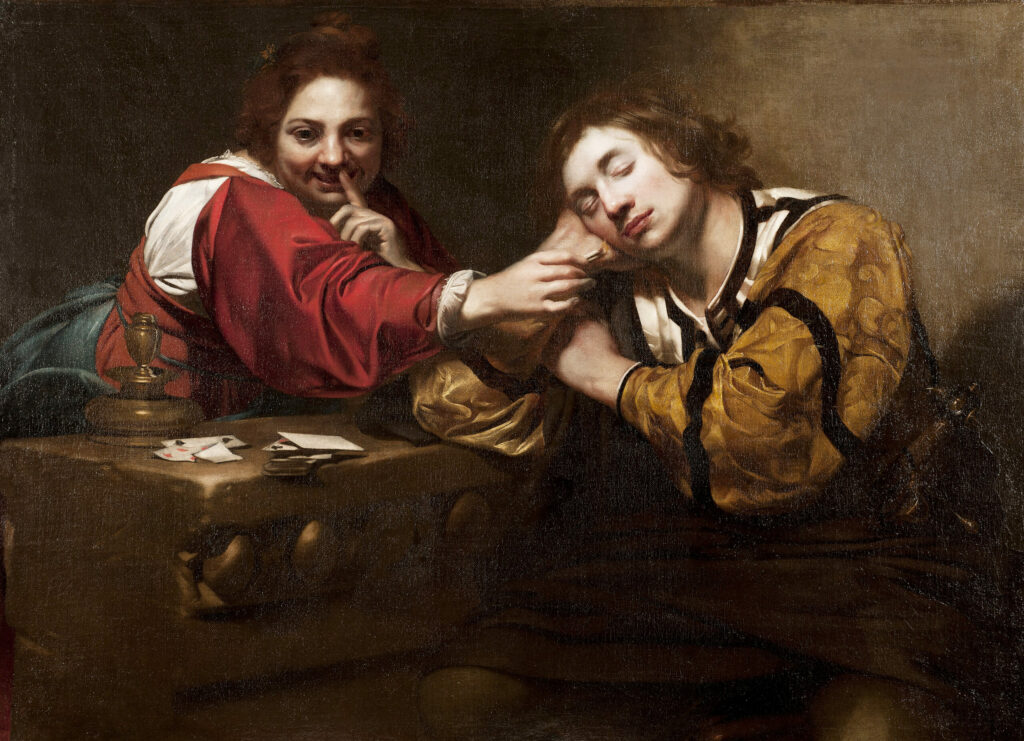
Behold the art of seduction transformed into ribald comedy! Régnier orchestrates a ballet of mischief where every gesture reveals the dissolute mores of the Grand Siècle.
The courtesan, becoming the viewer’s playful accomplice through her finger pressed to her lips, prepares to ignite more than tobacco. Her gaze, sparkling with irony, contrasts sharply with the blissful abandon of the soldier—an archetypal figure of the warrior undone by earthly pleasures.
The artist masterfully employs Caravaggesque chiaroscuro: pearlescent flesh emerges from golden shadows while blood-red and ochre-yellow fabrics pulse with theatrical sensuality. Scattered cards upon the table evoke the hazards of both gaming and love. This genre scene, oscillating between edifying morality and unabashed ribaldry, captures the libertine spirit of an age when art dared to laugh at its own conventions.
Work Details
- Sleeper Awakened by a Young Woman with Fire, Nicolas Régnier, early 1620s
- Oil on canvas, 101 × 133 cm
- Nationalmuseum, Stockholm (Gallery 1621, 17th Century)
- Collection: https://collection.nationalmuseum.se/en/collection/item/132616/
Nicolas Régnier (1591-1667) perfectly embodies the generation of Northern Caravaggisti. Born in Maubeuge, trained in Flanders, and established successively in Rome and Venice, he developed a personal style that merged the dramatic naturalism of the Lombard master with a lighter palette characteristic of Flemish painting. Working for both papal Rome and the Venetian Republic, Régnier excelled in popular genre scenes, alternating between mythological subjects and everyday vignettes with equal virtuosity.
The Gallant Scene as Nocturnal Comedy
A courtesan turns toward the viewer, finger pressed to her lips in a conspiratorial gesture of mischief. Scattered playing cards evoke capricious fortune, as unpredictable in gambling as in matters of the heart. The Caravaggesque lighting, a single source, the candle, models faces and hands out of shadow, making luminous flesh emerge from red and ochre drapery. This nocturnal treatment owes something to Caravaggio but also to the Utrecht painters, Honthorst, Ter Brugghen, who had popularized candlelit scenes in Holland and Flanders.
Nicolas Régnier: From Maubeuge to Venice
Nicolas Régnier, born in Maubeuge in the Southern Netherlands (now France), trained in Antwerp under Abraham Janssens before leaving for Rome around 1615-1616. There he lived within the orbit of international Caravaggism for a decade, mixing with the northern painters who frequented the same taverns and studios. It is in Rome that Sleeper Awakened by a Young Woman with Fire was most likely painted, in the early 1620s, a period of full Caravaggesque maturity for Régnier. Around 1626, he settled permanently in Venice, where he spent the rest of his life and died in 1667. In Venice, he gradually adopted a lighter palette and more diffuse lighting inherited from the Venetian masters, moving away from strict Caravaggism while preserving his sense of luminous dramaturgy.
The Sleeping Soldier and Suspended Morality
The scene belongs to a repertory of subjects, sleeping or drunk soldiers, card players, fortune-tellers, musicians, that allowed Caravaggist painters to represent the world of the tavern and venal pleasure with a freedom that religious or mythological subjects did not permit. The morality here is suspended rather than absent: the viewer is invited to laugh with the mischievous young woman rather than to condemn the soldier defeated by sleep. This ethical ambiguity, characteristic of the genre scene, is precisely what made these paintings so successful with 17th-century collectors who wished to own an image of real life without the endorsement of an explicit moral programme.