Key Facts
Johannes Vermeer (1632-1675) is one of three great masters of the Dutch Golden Age, alongside Rembrandt and Frans Hals.
- Only 34 paintings are attributed to him with certainty, over a career of twenty years.
- The identity of his teacher remains unknown to this day.
- He worked almost exclusively for a single private patron, Pieter van Ruijven.
- His fortunes collapsed in 1672; he died three years later, deeply in debt.
- Forgotten for two centuries, he was rediscovered in 1866 by the critic Théophile Thoré Bürger, who gave him the nickname “the Sphinx of Delft.”
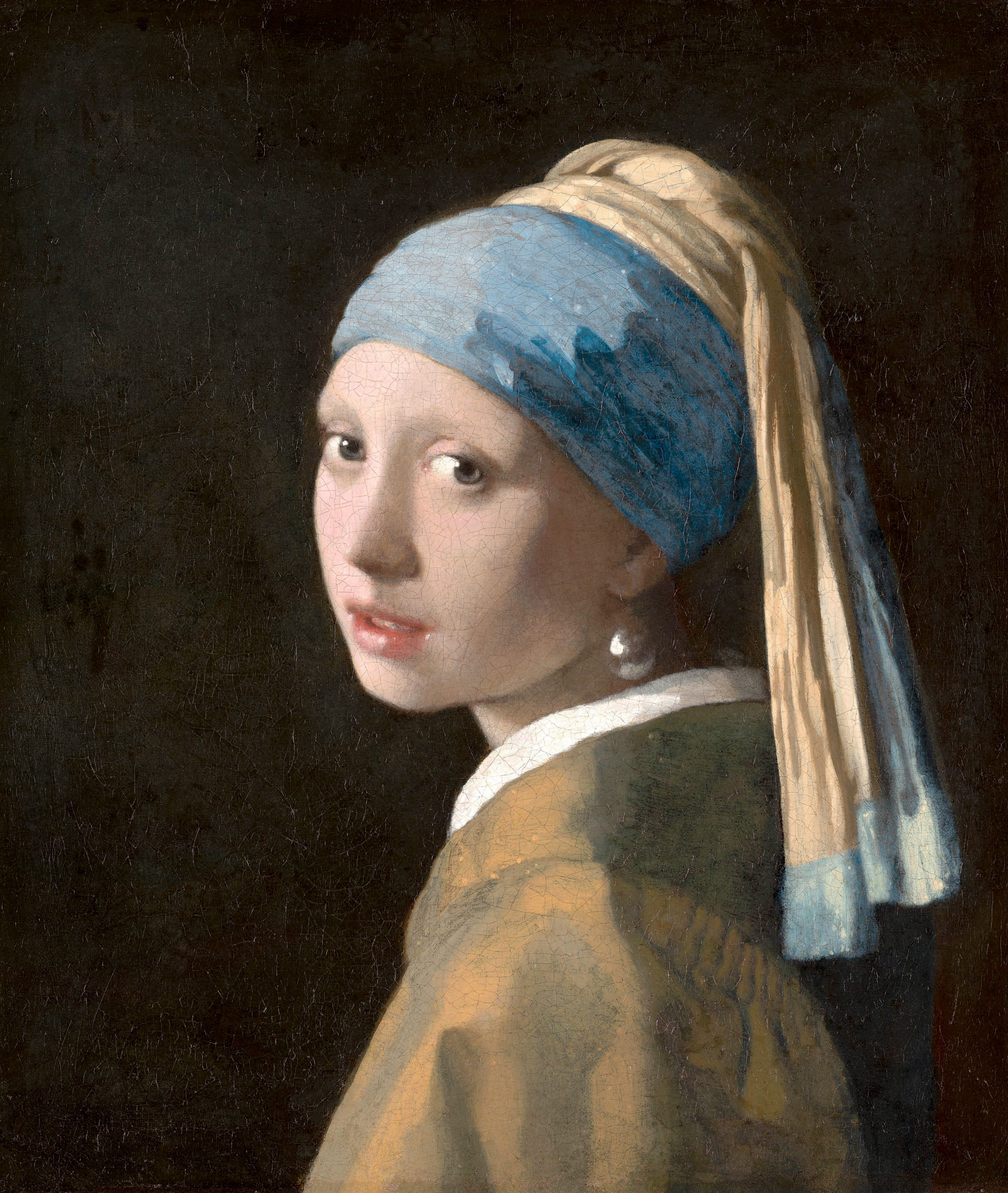
- Girl with a Pearl Earring is today one of the most recognised paintings in the world.
Biography of Johannes Vermeer
From Weaver’s Son to Master Painter (1632-1653)
The son of Reynier Janszoon, an innkeeper, weaver, and art dealer, Vermeer grew up in a household where paintings, fine textiles, and commerce intersected daily. In 1653, at the age of twenty-one, he was admitted to the Guild of Saint Luke in Delft. Yet the question of who trained him remains unanswered: no apprenticeship contract has survived. Historians have proposed Carel Fabritius, a gifted pupil of Rembrandt who settled in Delft, or a direct influence from the Caravaggisti of Utrecht. This gap in the record, unusual for a guild painter, is likely to remain unresolved.
The Marriage That Changed Everything (1653)
His marriage to Catharina Bolnes, a well-to-do Catholic from a family of brick merchants in Gouda, left a lasting mark on his art. The couple had eleven children, a considerable burden for the period, and Vermeer appears to have converted to Catholicism, then a marginalised faith in the Dutch Republic. This conversion arguably shaped more than his private life: it can be traced in several of his canvases, including The Allegory of Faith, a work likely commissioned within this same Catholic circle.
Private Patronage and a Deliberate Pace (1653-1672)
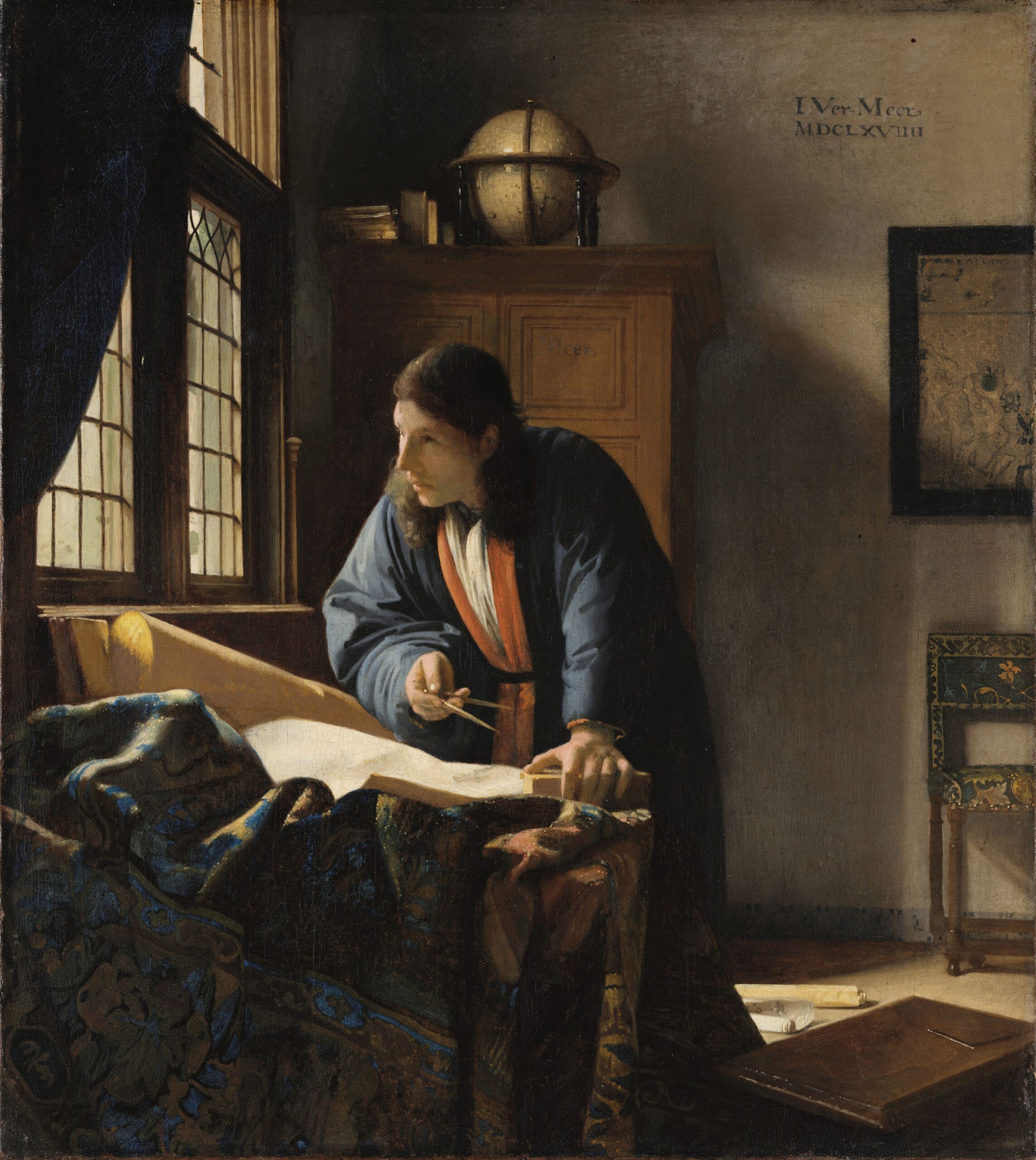
What stands out about Vermeer is his firm rejection of the open market. He worked almost exclusively for Pieter Claesz. van Ruijven, a wealthy tax collector who alone acquired some twenty of his paintings. Producing barely three works a year, Vermeer made the deliberate choice of a perfectionist, working against the grain of a market that demanded speed. This unhurried method produced paintings such as Girl with a Pearl Earring and The Geographer, works in which every detail appears weighed rather than merely painted.
The Collapse of 1672 and Vermeer’s Death (1675)
The Rampjaar, the disastrous year of 1672, brought about Vermeer’s ruin. The invasion by Louis XIV and the attack of the English fleet caused the art market to collapse, while Maria Thins lost the income from her flooded farms. In July 1675, Vermeer borrowed 1,000 guilders in Amsterdam. A few months later, his widow testified that he had been unable to sell his own work, and that paintings by other masters he had traded in remained on his hands, unsold. He died in December 1675, by his widow’s account within the space of a day or a day and a half, leaving his family heavily in debt.
Rediscovery and Recognition (1866 to the Present)
Vermeer did not vanish entirely from the auction record after his death, but he fell into relative critical obscurity for nearly two centuries. It was in 1866 that the French critic Théophile Thoré Bürger brought him back into public view, giving him the nickname “the Sphinx of Delft” in reference to the enduring mystery surrounding his life. Since then, Girl with a Pearl Earring has become one of the most recognisable images in the world, and exhibitions devoted to this painter of the Dutch Golden Age continue to draw audiences well beyond specialist circles.
Frequently Asked Questions About Vermeer
Who exactly was Johannes Vermeer?
Vermeer was a Dutch master of the Golden Age, nicknamed “the Sphinx of Delft” owing to the scarcity of biographical documents concerning him. With only 34 known paintings, he remains one of the most enigmatic painters of his era.
Why did Vermeer paint so little?
His extremely slow output, roughly three paintings a year, reflects a deliberate perfectionism. Working almost exclusively for private patrons such as Pieter Claesz. van Ruijven, he was under no pressure to meet the demands of a faster, open market.
Did Vermeer really use a camera obscura?
Vermeer left no record confirming his use of this optical device. The hypothesis, first proposed in 1891 by Joseph Pennell, nonetheless rests on persuasive visual evidence: perspective distortions, calculated passages of blur, and small halos of light visible in several of his paintings.
What is Vermeer’s most famous painting?
Girl with a Pearl Earring, painted around 1665, is often called the “Mona Lisa of the North.” This modestly sized canvas distills the essence of Vermeer’s art: a fleeting expression, an incomparable quality of light, and a face that resists any certain identification.
Where can Vermeer’s paintings be seen today?
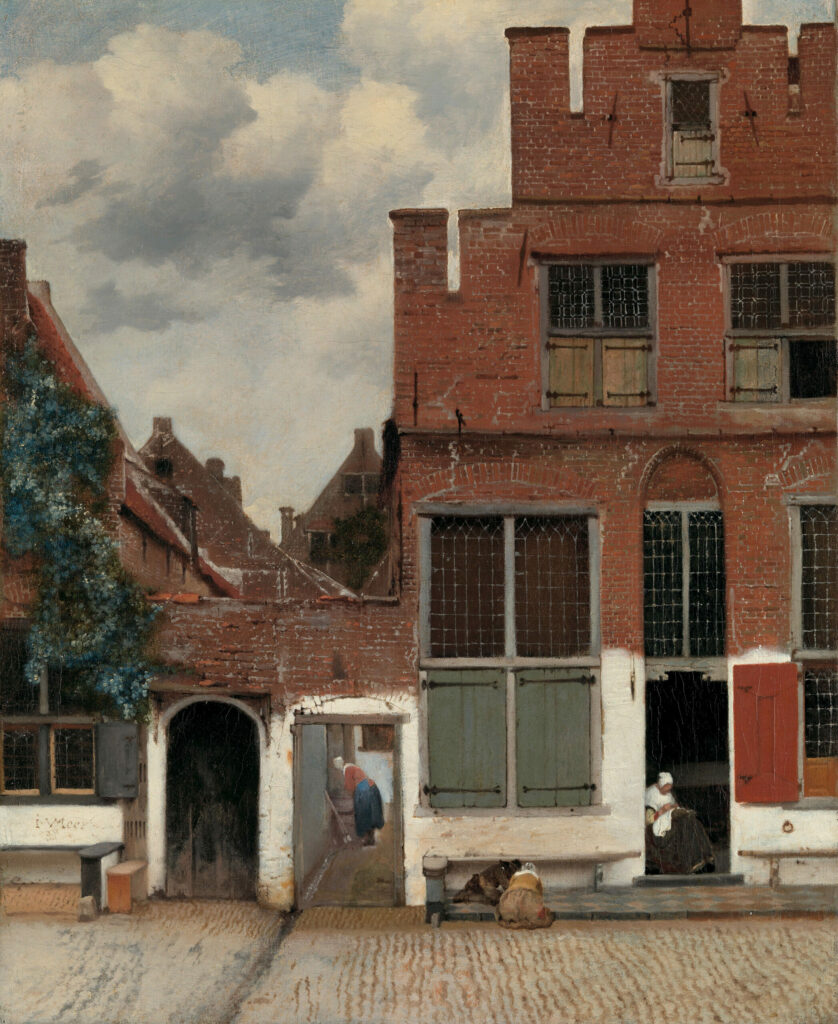
No painting by Vermeer remains in Delft, the city of his birth. The Mauritshuis in The Hague holds View of Delft and Girl with a Pearl Earring, the Rijksmuseum in Amsterdam holds The Milkmaid, and The Geographer can be found at the Städel Museum in Frankfurt.
Who was Han van Meegeren, and why is he linked to Vermeer?
Han van Meegeren was Vermeer’s most notorious forger. During the 1930s and 1940s, he produced several religious paintings falsely attributed to the master, one of which was acquired by Hermann Göring. Arrested in 1945 on suspicion of selling a national treasure to the Nazis, he confessed to the forgery as his defence.
Why is Vermeer’s blue so distinctive?
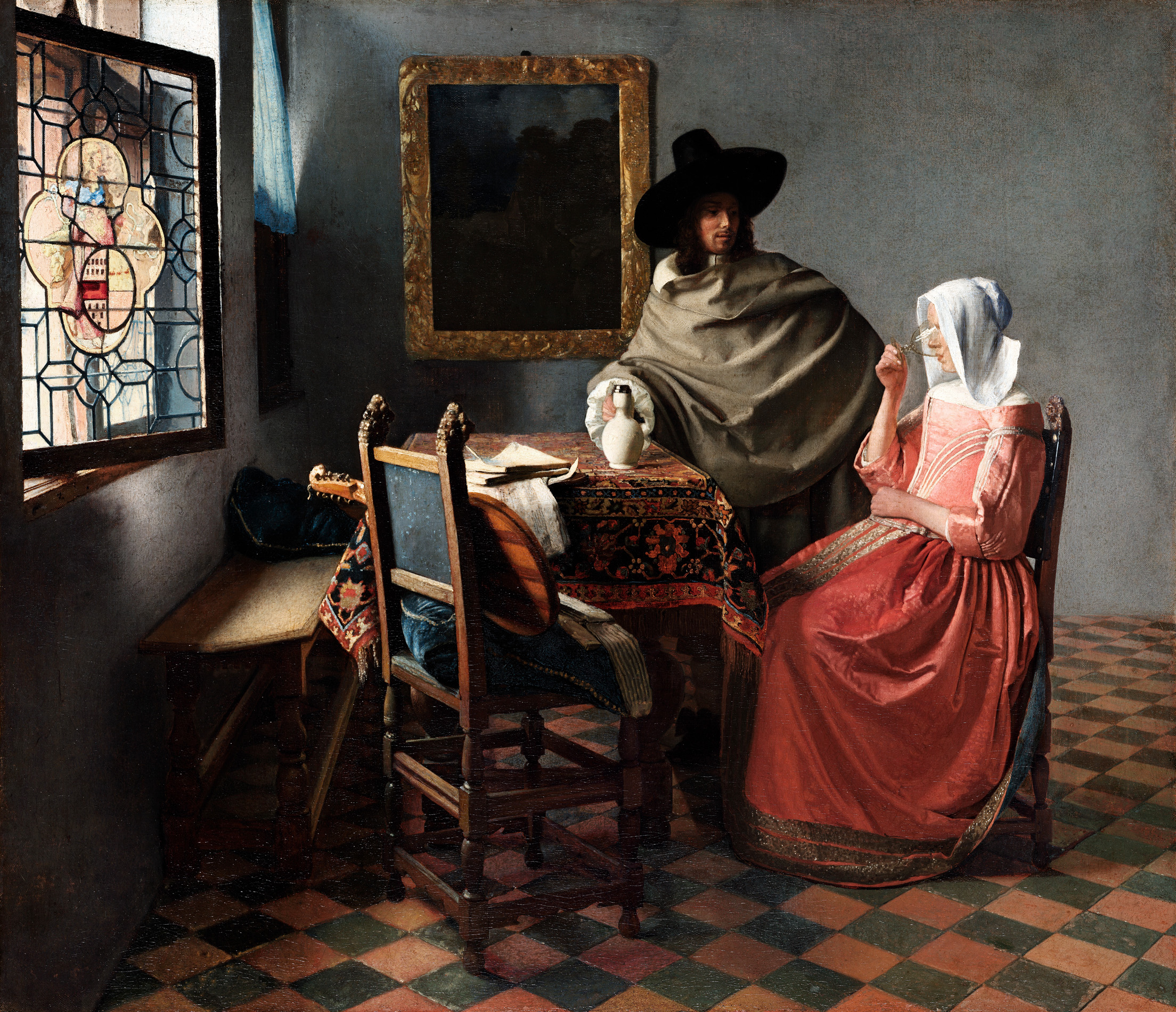
Vermeer used natural ultramarine, a pigment ground from lapis lazuli and considerably more costly than most colours available at the time. He applied it with unusual generosity, including in underlayers, a practice also evident in The Glass of Wine.
Further Reading
Explore all of Vermeer’s works analysed on VMuseum.
Bibliography
- John Michael Montias, Vermeer and His Milieu: A Web of Social History (1989): the standard biography, grounded in extensive archival research conducted in Delft.
- Daniel Arasse, Vermeer, Questions de style (2001): an accessible and perceptive reading of Vermeer’s painting by one of France’s leading art historians.
- Vermeer exhibition catalogue, Rijksmuseum, Amsterdam, 2023: the most comprehensive and recent catalogue, bringing together nearly the entire known body of work.
- Mauritshuis (The Hague) and Rijksmuseum (Amsterdam): the institutional websites of these museums offer reliable notices on each of the works they hold.