Paris, 1913. In his studio, Henri Matisse revolutionizes the still life. Before him, a humble nasturtium becomes a pure chromatic symphony. The painter does not seek to reproduce reality, but to liberate color from all spatial constraints.
When Color Becomes Space
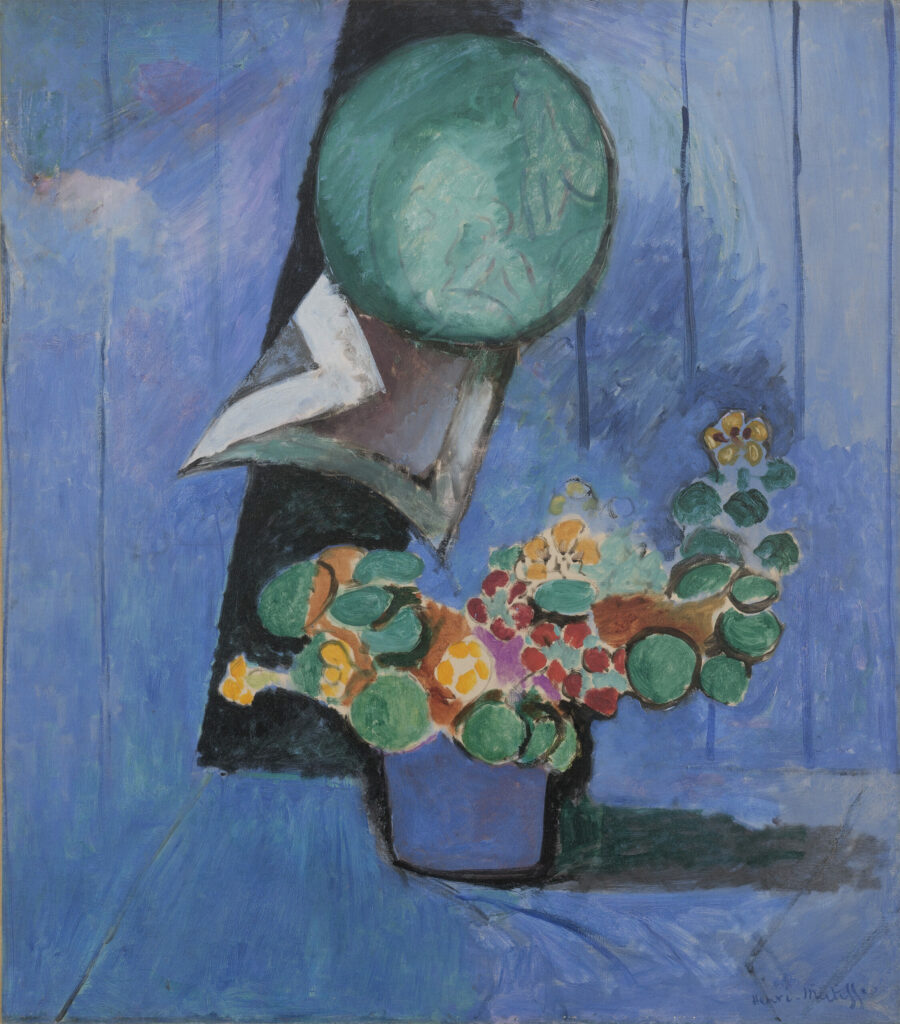
A deep blue invades the canvas. It is no longer background, wall, or sky. It exists for itself, vibrant, sovereign. The flowering plant unfolds with its round emerald green leaves and its yellow, red flowers. Above, a turquoise plate floats like a mysterious moon. Matisse abolishes traditional perspective. Objects no longer rest in credible three-dimensional space. They inhabit a world of pure colors, where each hue dialogues with the others. The oil is applied with disconcerting freedom, the contours structure the composition.
The Revolution of Still Life
This work marks a turning point in 20th-century art. Matisse breaks free from academic conventions to assert the primacy of color. Influenced by Fauvism, which he cofounded, he pushes decorative logic to its peak here. The still life becomes a pretext for bold exploration. The motif transforms into a purely pictorial element, in service of an unprecedented visual harmony.
Henri Matisse, Master of Color
Henri Matisse (1869-1954) ranks among the most influential artists of his time. His constant search for balance through color runs throughout his career. Here, in 1913, he opens the way to abstraction while retaining the recognizable subject.
Think about it
💭 Observe how Matisse liberates color from its descriptive role: do you recognize in your daily life those moments when a color seizes you independently of the object that carries it?
About This Work
- Flowers and China (The Capuchin Cress)
- Henri Matisse
- 1913
- Oil on canvas
- 93.5 × 82.5 cm
- Städel Museum, Frankfurt am Main
- https://sammlung.staedelmuseum.de/en/work/flowers-and-china-the-capuchin-cress