Mary Cassatt (1844-1926) was the only American painter to join the Parisian Impressionist circle, a trajectory best understood through her paintings rather than through the conventional chronology usually told about her.
Key facts
- Mary Cassatt (1844-1926) was an American painter, the only woman and the only American artist to exhibit with the Impressionist group in Paris.
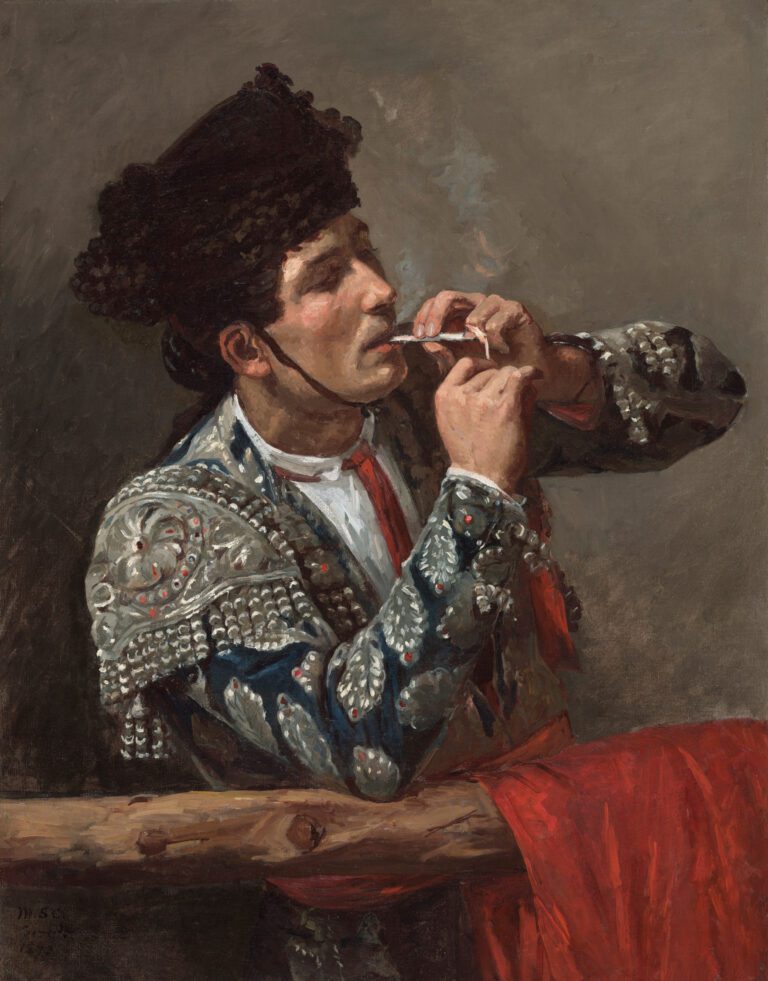
- Trained in Philadelphia and then in Paris under Gérôme, she made a decisive trip to Spain in 1872-1873, where her bullfighting scenes reveal a bold, still little-known side of her work.
- Noticed by Edgar Degas in 1874, she joined the Impressionist movement and exhibited alongside the group from 1879 onward.
- She became famous for her scenes of motherhood and childhood, treated with a modern, unsentimental eye that set her apart from the conventions of her time.
- She also played a key role in the spread of Impressionism in the United States, advising major collectors such as the Havemeyer family.
- Going blind from 1914 onward, she died in 1926 at the Château de Beaufresne, in the Oise region of France, where she had lived for nearly sixty years.
Her life is often summarized in a few lines: born in Pennsylvania, academic training, settling in Paris, friendship with Degas, scenes of mothers and children. This summary almost always leaves out a decisive episode: her 1872-1873 stay in Spain, where she painted bullfighting scenes that reveal a far bolder side of the artist than the tidy image usually attached to her. Rather than unfolding a chronology separate from the gallery of works, this biography follows Mary Cassatt’s life through four paintings on view at VMuseum: After the Bullfight, Offering the Panal to the Bullfighter, Woman with Baby, and In the Garden. Each corresponds to a turning point in her career and helps explain, through a close reading of brushwork, subject matter, and composition, why she painted the way she did at that particular moment in her life.
At a glance
| Full name | Mary Stevenson Cassatt |
| Born | 22 May 1844, Allegheny City (now Pittsburgh), Pennsylvania |
| Died | 14 June 1926, Château de Beaufresne, Le Mesnil-Théribus (Oise, France) |
| Nationality | American, settled in France from 1874 |
| Movement | Impressionism |
| Teachers and influences | Jean-Léon Gérôme, Thomas Couture, Édouard Manet, Edgar Degas |
| Favourite subjects | Intimate scenes of women’s daily life, motherhood, portraits of children |
| Distinction | The only American artist to exhibit with the Impressionist group in Paris |
1861-1871: Training, between Philadelphia and Europe
The daughter of a wealthy banker, Mary Cassatt grew up in a family that travelled regularly to Europe, she lived in Paris from the age of seven, then in Germany, before returning to the United States. Against her father’s wishes, she enrolled in 1861 at the Pennsylvania Academy of the Fine Arts in Philadelphia, where she quickly found the classical academic teaching too limited. In 1866 she returned to Europe to train under respected Salon painters Jean-Léon Gérôme and Thomas Couture, absorbing a rigour in drawing that she would never abandon, even after her conversion to Impressionism.
1872-1873: The Spanish turning point, revealed through After the Bullfight and Offering the Panal to the Bullfighter
This is the chapter most general biographies skip over, even though it marks a major stylistic turning point. In 1872-1873, Cassatt travelled through Italy and then Spain, settling for several months in Seville. There she discovered the Prado’s collections and engaged directly with Velázquez and Spanish Golden Age painting, while closely following Manet’s work, then at the heart of a pictorial revolution in Paris.
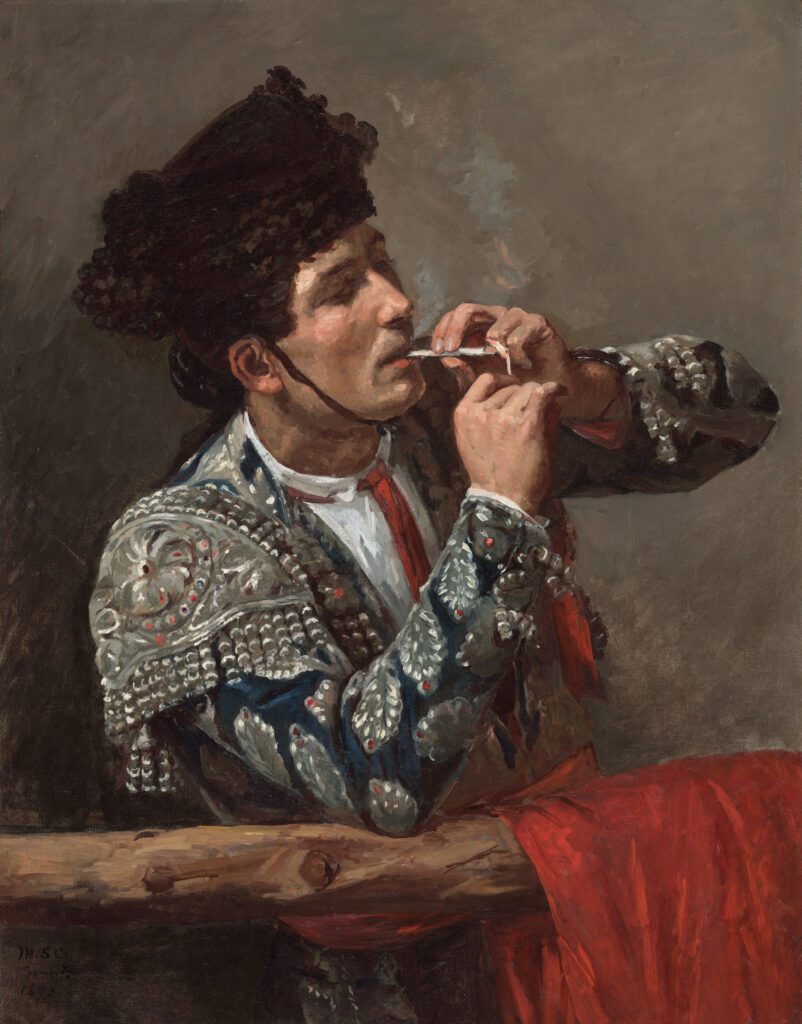
After the Bullfight (1873) comes directly out of this period. Its subject, a masculine, violent, spectacular world, stands in sharp contrast to the image of an intimate painter that would later define Cassatt. The brushwork is broader and the palette more contrasted than in her earlier academic work: one can sense the rapid absorption of Manet’s lessons, applied to a subject that contemporary critics considered unbecoming for a woman painter.
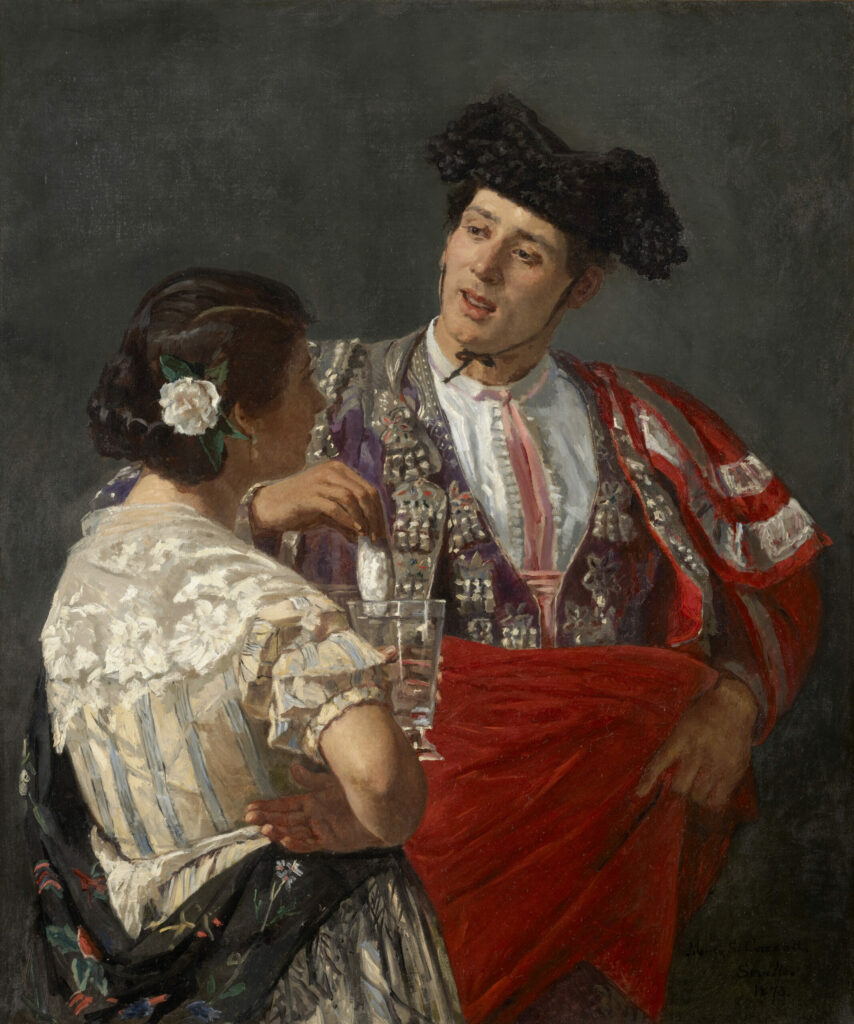
Offering the Panal to the Bullfighter, painted the same year, takes a more narrative, anecdotal approach, close to the Spanish costumbrismo then fashionable among American collectors. It shows a Cassatt still eager to please the Salon market, yet already capable of the fine psychological observation of relationships between figures that would become her signature.
Read together, these two paintings show an artist in full experimentation, ready to step outside the repertoire expected of a woman painter of her standing, well before she ever met the Impressionists. Most online biographies mention this episode in a single sentence, without ever grounding it in an analysis of the works themselves.
1874-1879: Paris, meeting Degas, and joining Impressionism
In 1874, Cassatt settled permanently in Paris with her sister Lydia and later with her mother. She exhibited at the official Salon but faced several rejections that pushed her closer to the Impressionist group. Edgar Degas, struck by the mastery of her drawing, invited her in 1877 to join the independent exhibitions, an offer she accepted with relief, later recalling: “I had recognized who my true masters were; I admired Manet, Courbet, and Degas. I hated conventional art. I was beginning to live.” She went on to take part in the Impressionist exhibitions of 1879, 1880, 1881, and 1886. From Degas, she absorbed asymmetrical framing, the plunging viewpoints inherited from Japanese prints, and a use of pastel that she quickly made her own.
1880-1904: Motherhood as subject, beyond the cliché
This is the period that fixed Cassatt’s reputation in the popular imagination as the “painter of mothers and children.” A superficial reading sees this as a retreat into subjects deemed suitable for a woman of her background. A closer look at the surviving paintings, including those on view at VMuseum, invites a more nuanced view.
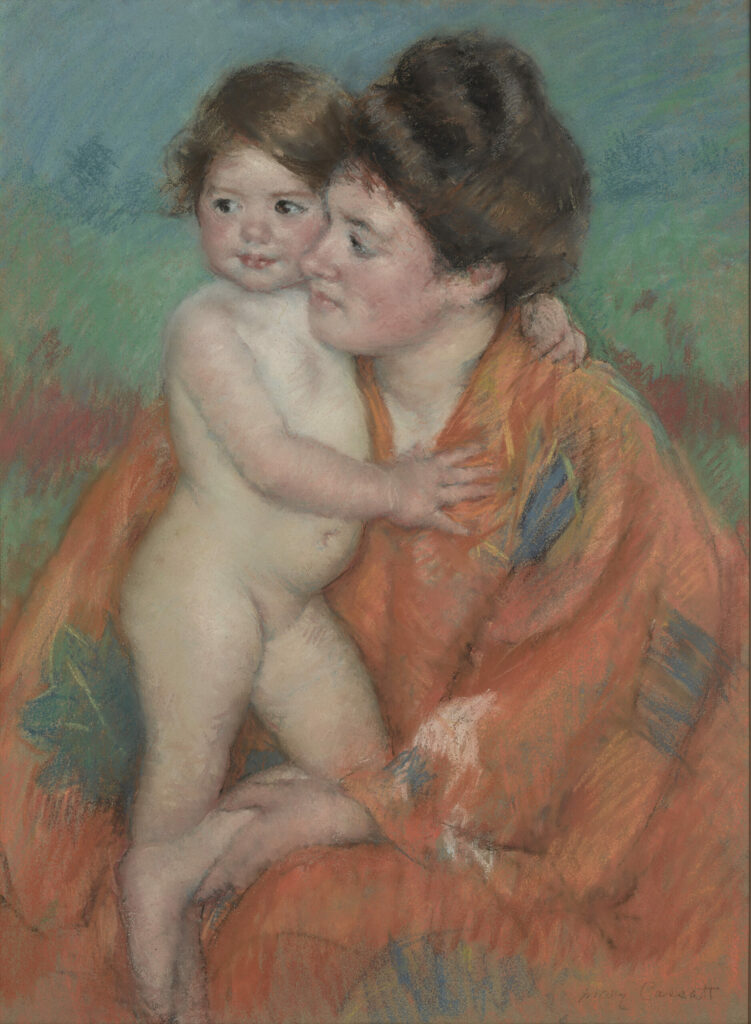
In Woman with Baby (c. 1902), the mother is not frozen in an idealized pose: the tight framing, the child’s natural gesture, and the absence of any anecdotal setting shift the subject away from sentimentality and toward an almost clinical observation of an everyday gesture. Cassatt paints motherhood as a skill and a form of labour, not as an allegory.
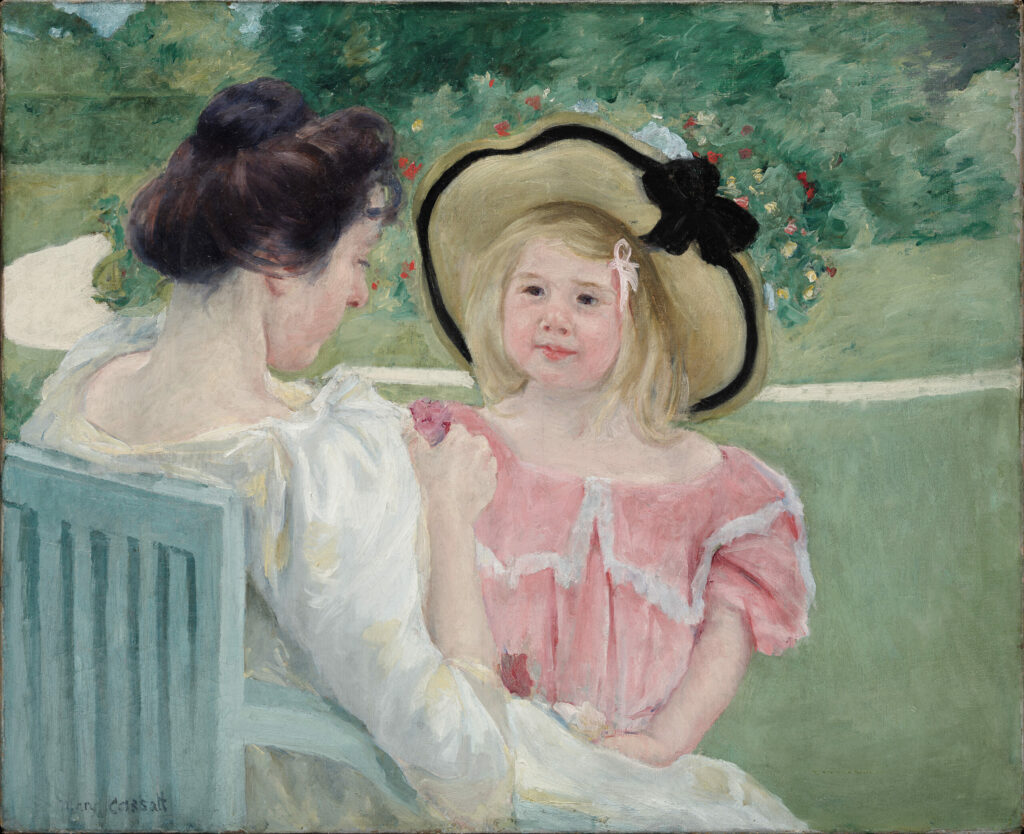
In the Garden (1903-1904), a later work, shows her brushwork evolving toward broader flat areas of colour and a composition shaped by the Japanese prints she had herself been producing as a printmaker since 1879-1880. The subject, a domestic scene set outdoors, continues her research into light, while retaining the economy of means that characterizes her late period.
This reading connects with the analysis developed on our page devoted to women in the history of art: Cassatt did not paint passive mothers, but autonomous figures, active in their role, at a time when women’s suffrage was only just beginning to be debated in the United States, a cause she would publicly support from 1915 onward.
1900-1926: Recognition, blindness, and the end of her career
Cassatt played a decisive, though often underestimated, role in spreading Impressionism in the United States: she advised Louisine Havemeyer, whom she had known since Louisine’s teenage years and remained close to for the rest of her life, whose collection would become one of the major bequests to New York’s Metropolitan Museum. In 1894, she bought the Château de Beaufresne in the Oise region, where she continued to paint until cataracts, starting in 1914, gradually forced her to give up her art. She died at Beaufresne on 14 June 1926, remaining relatively underrepresented in French public collections despite her status as a historic figure of Impressionism.
What VMuseum’s paintings reveal about Mary Cassatt
Taken together, these four paintings trace a coherent arc: a young painter experimenting outside the expected path in Spain (After the Bullfight, Offering the Panal to the Bullfighter), before finding, in Paris and under Degas’s influence, the subject that would become her signature, the lives of women and children, treated without complacency or sentimentality (Woman with Baby, In the Garden). Far from a simple retreat into domesticity, this is the trajectory of an artist who, from the Seville bullring to the Parisian garden, consistently sought to observe with precision the gestures and situations that academic painting considered unworthy of attention.
Frequently asked questions
Why did Mary Cassatt paint bullfighting scenes?
During her stay in Seville in 1872-1873, she immersed herself in Spanish culture and discovered the masters of the Prado. Bullfighting, a subject then considered highly unconventional for a woman painter, allowed her to experiment with a freer brushwork, under the influence of Manet and Velázquez.
What was the connection between Mary Cassatt and Edgar Degas?
Degas noticed her work at the 1874 Salon and invited her in 1877 to join the Impressionist group. He became her artistic mentor and a close friend; their relationship had a lasting influence on how Cassatt built her compositions and used pastel.
Where can you see Mary Cassatt’s work in France?
French museums hold very few of her paintings. Temporary exhibitions, such as the one held at the Musée Jacquemart-André in 2018, have made it possible to show more of her works, borrowed from American institutions.
Note: to mark the centenary of her death, the Musée d’Orsay is devoting Mary Cassatt’s very first major monographic retrospective in France to her, titled “Mary Cassatt, l’Indépendante” (“Mary Cassatt, Being Independent”), running from 6 October 2026 to 31 January 2027. Organized in collaboration with the National Portrait Gallery in London and the Museum of Fine Arts, Boston, the exhibition brings together nearly 80 paintings, pastels, and prints spanning her entire career, along with a digital restoration of her lost mural, Modern Woman. It is an unprecedented opportunity, in France, to see a significant portion of her work brought together.
Source: https://www.musee-orsay.fr/en/program/whats-on/exhibitions/mary-cassatt-being-independent
Was Mary Cassatt a feminist?
While she did not describe herself as an activist in the modern sense, she publicly supported women’s suffrage from 1915 onward and consistently defended her artistic and financial independence, refusing to depend on the sale of her work to survive.
Further reading: a few accessible titles
The following titles are in French, written for a general audience; they remain useful for their illustrations and documentation even for English-speaking readers.
- Florence Gentner, Mary Cassatt, une Américaine au cœur de l’impressionnisme, Fayard, 2026, a recent, general-audience biography blending art history and women’s history.
- Laurent Manœuvre, Mary Cassatt, au cœur de l’impressionnisme, Éditions À Propos, 2018, a richly illustrated, accessible and thorough book, published alongside the Musée Jacquemart-André retrospective.
- Mary Cassatt, “Les Carrés d’Art” series, Éditions Victoires, a short, inexpensive illustrated monograph, ideal as a first introduction.
- Larousse illustrated biography series, Mary Cassatt. Le choix de l’indépendance, 2026, a lively, easy-to-read format aimed at general readers.
- Exhibition catalogue, Mary Cassatt, une impressionniste américaine à Paris, Musée Jacquemart-André, 2018, a good way to extend a visit with a selection of annotated works.