Key facts
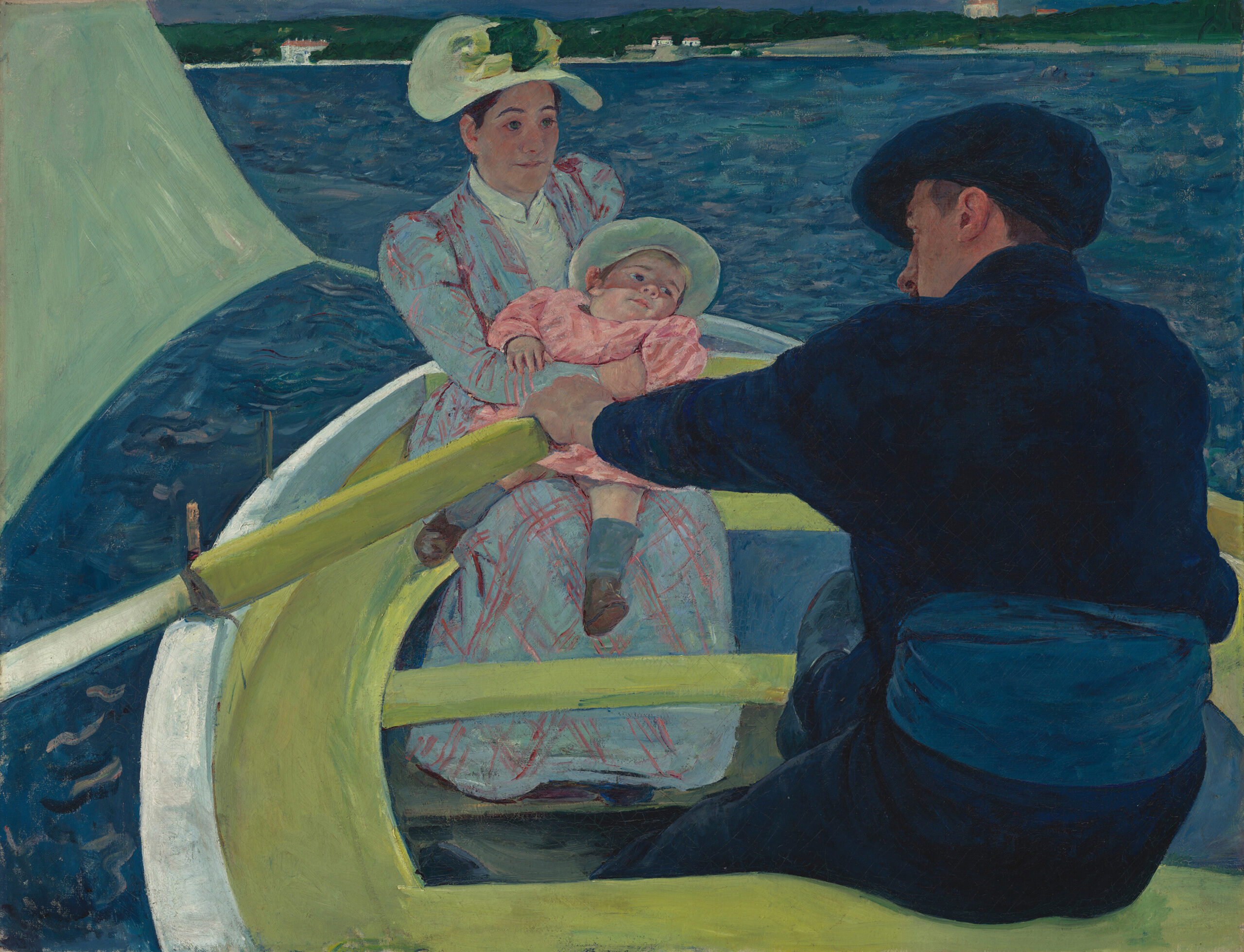
Painted in oil by the American artist Mary Cassatt in Antibes during the winter of 1893-1894, The Boating Party depicts a woman holding a child facing an oarsman seen from behind, in a yellow boat on the Mediterranean. A member of the Impressionist group, Cassatt adopts here flat areas of color, a raised horizon and a plunging viewpoint inspired by Japanese prints. These choices bring her close to the Post-Impressionism of Gauguin and Van Gogh. The National Gallery of Art in Washington, which holds the painting, ranks it among her most ambitious works. It was the centerpiece of her first solo exhibition in the United States, in 1895.
When I contemplate this major work by Mary Cassatt, I immediately sense the influence of the Japanese print. In 1890, the artist had indeed visited the great exhibition of Japanese prints at the École des Beaux-Arts in Paris. This influence shows in the simplified lines, the flat areas of color and the limited number of hues, dominated by the lemon yellow of the boat and the intense blue of the sea. The composition interests me particularly for its frontal quality, its shallow perspective and its very high horizon, which leaves the eye little room to escape. The dark silhouette of the oarsman in the foreground compresses the space even further and draws attention back to the mother and child. Painted in Antibes during the winter of 1893-1894, this canvas shows a handling that already moves away from Impressionism, in a more personal search that makes me think of Gauguin rather than Monet.
A brown rope binds the oar to the side of the boat, in the lower left. You can almost feel its rough fibers under your fingers. Now follow the yellow oar. It runs diagonally toward the center of the canvas. There, a baby in a pink dress lies relaxed on a woman’s lap. Its little brown boots dangle in the air. The Mediterranean sun warms the faces without gilding them.
Flat colors from Japan
Rest your eyes on the sail, on the left. This large sea-green triangle has almost no modeling. The color holds there like cut paper. This is the lesson of Japanese prints, then fashionable in Paris. Look at the paint surface too. In the sea, the brushstroke becomes short, wavy, almost calligraphic. On the dress, pink hatching crosses a pale blue. Elsewhere, the paint spreads in smooth, firm surfaces. The yellow thwarts divide the boat into compartments. You look down on it, as if leaning over it. The shore and its white villas press against the top edge. Depth fades away. Under the sun of Antibes, Mary Cassatt pushes her colors toward lemon and blue. The museum counts this oil on canvas among the artist’s most ambitious paintings. It was the centerpiece of her first solo exhibition in the United States, in 1895.
From Manet to Antibes
Mary Cassatt is born in Pennsylvania in 1844. Settled in Paris, she joins the Impressionists in 1877. She is the only American to exhibit with them. In 1893, she completes a monumental mural for the World’s Columbian Exposition in Chicago. Yet The Boating Party invites comparison with an earlier painting. In 1874, Édouard Manet paints Boating, now at the Metropolitan Museum of Art in New York. The same cropped sail, the same water filling the background, the same debt to Japan. Cassatt admires this canvas. She regards it as the culmination of the painting of her time. She even advises her friends, the New York collectors Louisine and Henry Havemeyer, to buy it. This gesture recalls her role as a bridge between France and America. In Manet’s work, boating remains an elegant pastime for two. Cassatt brings in her favorite subject, woman and child. The title promises a pleasure outing. Yet no one smiles. The man rows with his back to you. Here you are, sitting in his place.
News: Mary Cassatt honored on the centenary of her death
In 2026, one hundred years after the artist’s death, Mary Cassatt is the subject of two major events. In Paris, the Musée d’Orsay presents “Mary Cassatt: Being Independent” from October 6, 2026 to January 31, 2027, the very first major exhibition devoted to the painter by a French national museum. Nearly 80 paintings, pastels and prints trace her career, from early works inspired by the Old Masters to her later, more modern explorations of color. Organized for the Musée d’Orsay’s 40th anniversary, in partnership with the National Portrait Gallery in London and the Museum of Fine Arts, Boston, the exhibition also uses unpublished letters to highlight a professional artist who lived from her painting and supported women’s suffrage. Across the Atlantic, the Art Institute of Chicago devotes its exhibition “Mary Cassatt: After Impressionism” (September 6, 2026 – January 3, 2027) to the later phases of her career, the very period to which The Boating Party belongs.
Sources: Musée d’Orsay and Art Institute of Chicago.
A question for you
Japanese prints, Manet or the sun of Antibes: which of these influences seems strongest to you in this canvas?
About this work
- The Boating Party
- Mary Cassatt (1844-1926)
- 1893-1894
- Oil on canvas
- 90 x 117.3 cm
- National Gallery of Art, Washington D.C.
- https://www.nga.gov/artworks/46569-boating-party