Key Facts
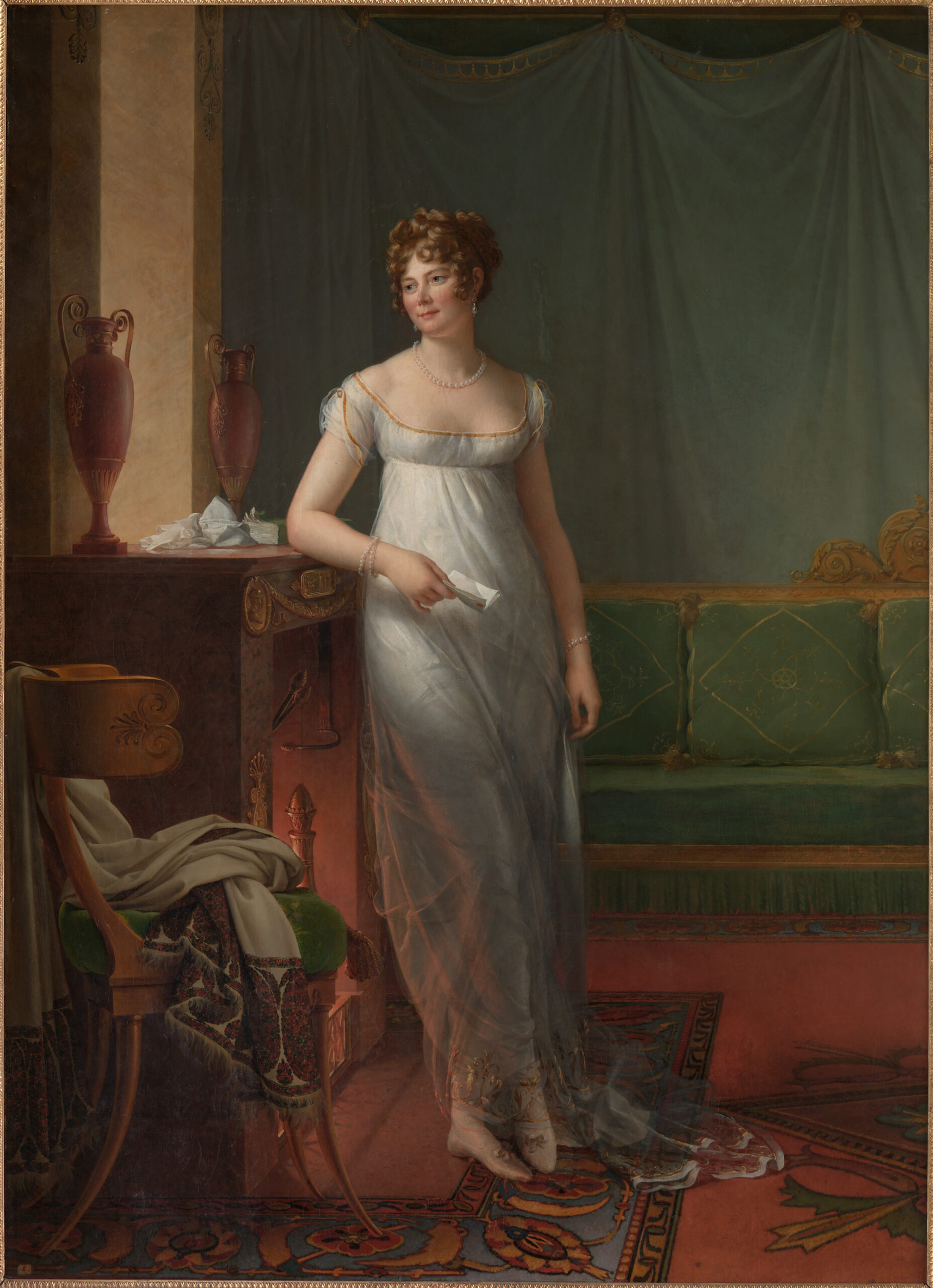
This portrait of Madame Charles Maurice de Talleyrand-Périgord, painted around 1804 by Baron François Gérard, exemplifies the height of Neoclassical portraiture under the First Empire. A pupil of Jacques-Louis David and official painter to Empress Joséphine, Gérard established himself as one of the most sought-after portraitists of his day. This oil on canvas, now in the collection of The Metropolitan Museum of Art in New York, depicts the wife of the diplomat Talleyrand in a carefully composed Empire interior. The painting belongs to a tradition of formal portraiture in which setting, costume, and posture assert the sitter’s social rank, while capturing, beneath a polished surface, the complexity of a marriage already at its end by the time the work was completed.
Here is Neoclassicism at its finest. Baron Gérard trained under David, and his master’s influence is unmistakable here, in the rigor of the drawing and the clarity of the composition. The sitter is shown full-length, in an Empire-style salon, before a handsome mantelpiece set beneath a window. I am drawn to the quiet stillness of the scene and to the poise of Madame de Talleyrand-Périgord. She stands with grace, assured of her rank and standing. Looking closely, one notices the interplay of light between sunlight and firelight, the near-transparent lightness of the dress, and the cashmere shawl draped over a chair, a fashionable accessory of the period, though one that also quietly recalls her origins, since she was born near Pondicherry. Everything, from the furnishings to the dress, is precisely arranged and speaks to her place within her era. A state portrait that fulfills its purpose perfectly.
Who is this woman, really, in this Empire salon, bound by a forced marriage to a diplomat already unfaithful?
What the Portrait of Madame Charles Maurice de Talleyrand-Périgord Whispers
Look first at that right hand, closed around a folded letter. The tulle of the gown lifts ever so slightly, nearly translucent in the mingled light of day and fire. Madame de Talleyrand-Périgord’s gaze does not meet the viewer’s; it drifts toward some point elsewhere in the room, as if caught mid-movement. The cashmere shawl, left behind on a nearby chair, awaits her return. Two vases keep watch over the mantelpiece, between the green velvet of the sofa and the polished marble of the hearth. Every surface is rendered with precision, almost coolly, without visible impasto, in keeping with the Neoclassical idiom inherited from David. The silence of the scene carries as much weight as its luxury.
What History Answers
Baron François Gérard painted this portrait around 1804, at the height of the Empire style, on a canvas over two meters tall. In 1802, the sitter’s affair with the diplomat Talleyrand caused a scandal in Paris; Napoleon demanded that they marry. Yet the couple was already living apart by the time Gérard completed the canvas. Nothing in the pose or the setting betrays this private rupture. The salon remains a stage for display: a mantelpiece, carefully arranged furnishings, abundant light, a letter visible in her hand. She had already been painted as a young woman by Élisabeth Vigée Le Brun, in a portrait now held in the same museum.
Baron François Gérard
A pupil of Jacques-Louis David, François Gérard rose to become one of the most sought-after portraitists of the First Empire. Official painter to Empress Joséphine, he also painted Napoleon and the leading figures of the court. His studio drew a clientele eager for this clear, restrained style, rooted in Neoclassicism.
Current News
This work is on view today at The Metropolitan Museum of Art in New York, in the galleries devoted to European paintings from the fourteenth through nineteenth centuries. In fall 2026, the Museum presents Krasner and Pollock: Past Continuous (October 4, 2026–January 31, 2027), an exhibition on the artistic relationship between Lee Krasner and Jackson Pollock, accompanied by a new season of Met Live Arts performances. While this programming has no direct bearing on nineteenth-century French art, it reflects the Museum’s continued vitality as an institution that preserves and presents this portrait by Gérard.
Source: The Metropolitan Museum of Art
A Question for You
Can Neoclassicism truly be called cold, when it composes light such as this?
About This Work
- Madame Charles Maurice de Talleyrand-Périgord
- Baron François Gérard
- ca. 1804
- Oil on canvas
- 225.7 x 164.8 cm (88 7/8 x 64 7/8 in.)
- The Metropolitan Museum of Art (MET), New York
- https://www.metmuseum.org/art/collection/search/438546