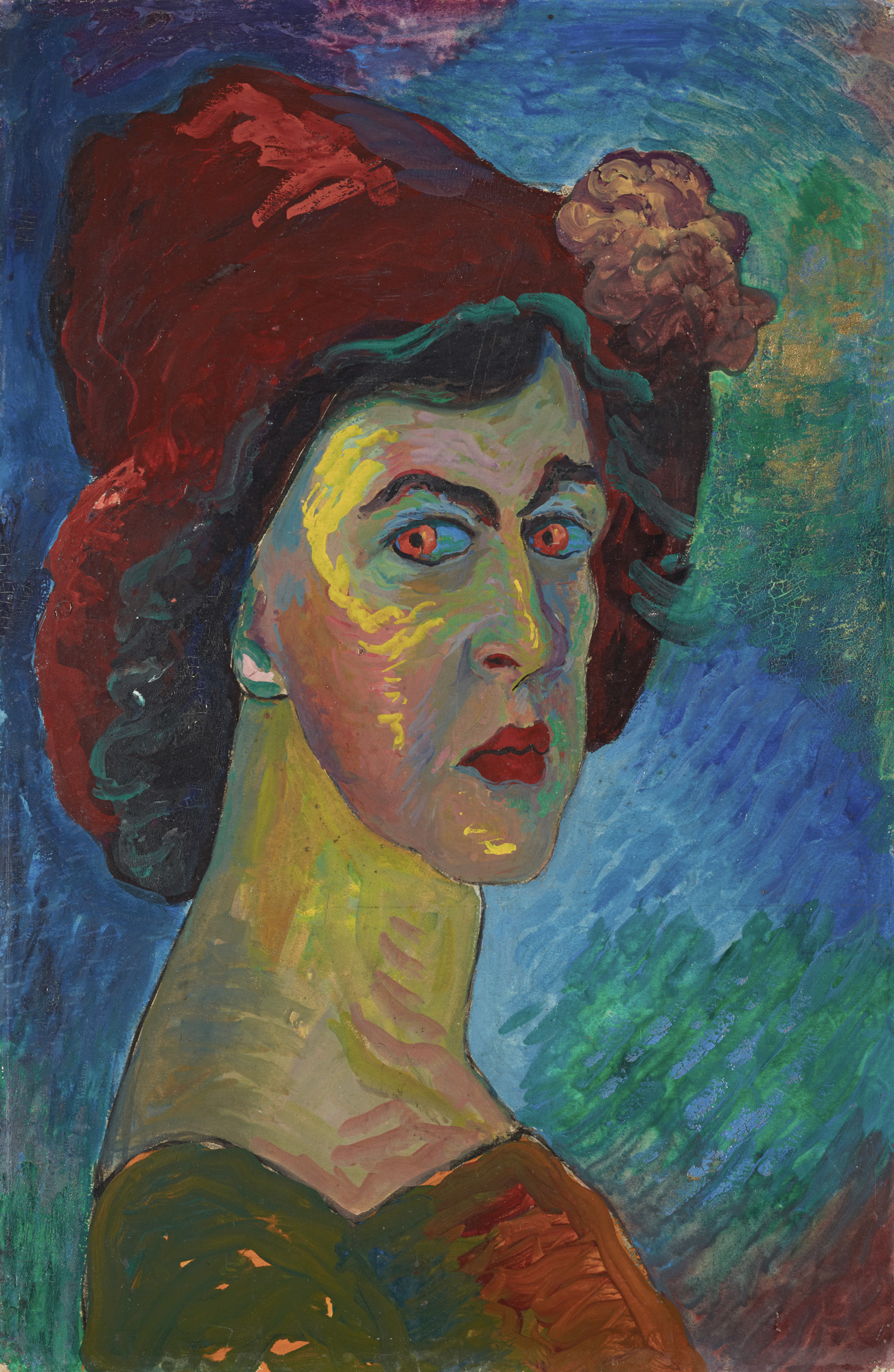
What a surprising self-portrait this is! From the very first glance, its power is undeniable: the bold colours, the tight framing around the face, and above all that expression, assured, almost defiant, of a woman who depicts herself without concession. It is this combination of inner strength and formal audacity that led me to choose this work for VMuseum today. It forms part of the series we regularly devote to artists of the Blaue Reiter, a movement whose avowed ambitions included the transformation of society through art. And this self-portrait is, in my view, one of its most eloquent illustrations: Marianne von Werefkin does not paint herself as a passive subject — she asserts herself as an artist in her own right, in an art world then largely dominated by men. This portrait is an act as much as it is a work of art.
That gaze stops you in your tracks. Marianne von Werefkin’s vermilion-red eyes fix the viewer with an intensity that is almost uncomfortable. The face turns at three-quarters. Nothing here is gentle. The lips, in a warmer red, hint at a slight bitterness. The hat frames the elongated face like a suit of armour. You do not look at this portrait. It looks at you.
What lies beneath the surface
Werefkin painted this self-portrait around 1910, in tempera and bronze lacquer on paper laid down on cardboard — a rare technique, the gesture expressive. The nervous brushstrokes of the steel-blue background bear the imprint of Van Gogh. The complementary blue-green and yellow tones recur across the face, creating a chromatic vibration close to the Fauves. This is not a portrait of likeness. It is a portrait of inner state. Werefkin paints her energy, her contradictions, her will to exist. The work is held at the Städtische Galerie im Lenbachhaus in Munich, at the heart of the Blue Rider collection.
The artist and her time
Born in 1860 in Russia, Marianne von Werefkin arrived in Munich in 1896. There she held a salon on Giselastraße in Schwabing that became a major intellectual hub. Kandinsky, Jawlensky and Franz Marc debated within its walls. She was the dominant figure, described as a transmitter of almost tangible waves of energy. For ten years she suspended her own practice to support Jawlensky’s career. Around 1906, she picked up her brush again. This self-portrait marks that return to full power.
In the news
That legacy remains alive. Since 1990, the Verein der Berliner Künstlerinnen 1867 has honoured her memory through the Marianne-Werefkin Prize, Germany’s first artistic award dedicated exclusively to women. In November 2025, its 13th edition recognised Mehtap Baydu at a ceremony held at the Kommunale Galerie Berlin.
(Source : https://www.vdbk1867.de/werefkin-preis-2/)
A question for you
💭 Can a self-portrait be a political act? What do you read in that gaze?
📌 About this work
- Self-Portrait I
- Marianne von Werefkin
- c. 1910
- Tempera and bronze lacquer on paper laid down on cardboard
- 20⅛ × 13⅜ in. (51 × 34 cm)
- Städtische Galerie im Lenbachhaus und Kunstbau, Munich
- https://www.lenbachhaus.de/en/digital/collection-online/detail/selbstbildnis-i-30020411
A Self-Portrait as Manifesto
Self-Portrait I (c. 1910) is a turning-point work in the career of Marianne von Werefkin. Born in 1860 in Tula, Russia, von Werefkin had suffered a serious injury to her right hand in a hunting accident in 1888. Rather than ending her painting career outright, she adapted her practice. But it was a different reason that kept her away from painting for nearly a decade: settling in Munich in 1896 with her partner Alexej Jawlensky, she renounced her own artistic production to support and promote his work, convinced that a man better embodied the revolutionary ambitions of the new art. This renunciation ended around 1906, when she returned to the brush. Self-Portrait I, painted on cardboard (51 × 34 cm, tempera and bronze lacquer), renders this return with remarkable expressive force: vermilion-red eyes fix the viewer with an intensity that is almost uncomfortable, the contrasts of blue-green and yellow vibrate like those of the Fauves. It is not likeness that von Werefkin seeks here, it is presence, a will to exist.
The Munich Salon and the Blaue Reiter
Von Werefkin was a central figure in Munich’s avant-garde during these years, not only as a painter but as an intellectual force. Her involvement in the Neue Künstlervereinigung München (NKVM), founded in 1909, and her close ties with Kandinsky and Franz Marc made her a decisive interlocutor in the discussions that led to the creation of the Blaue Reiter in 1911. The Lenbachhaus in Munich, which holds Self-Portrait I, is also the museum that preserves the largest collection of Blaue Reiter works in the world, giving this painting a conservation context that is singularly coherent with its history.
Ascona and Belated Recognition
When war broke out in 1914, von Werefkin left Munich and emigrated to Switzerland, settling permanently in Ascona in 1918, where she founded the Grosser Bär artistic group in 1924. She died there in 1938. Her international recognition as an artist in her own right, rather than simply as Jawlensky’s companion or muse, is a phenomenon of the late 20th and early 21st centuries, driven by the critical reassessment of women artists of Expressionism.