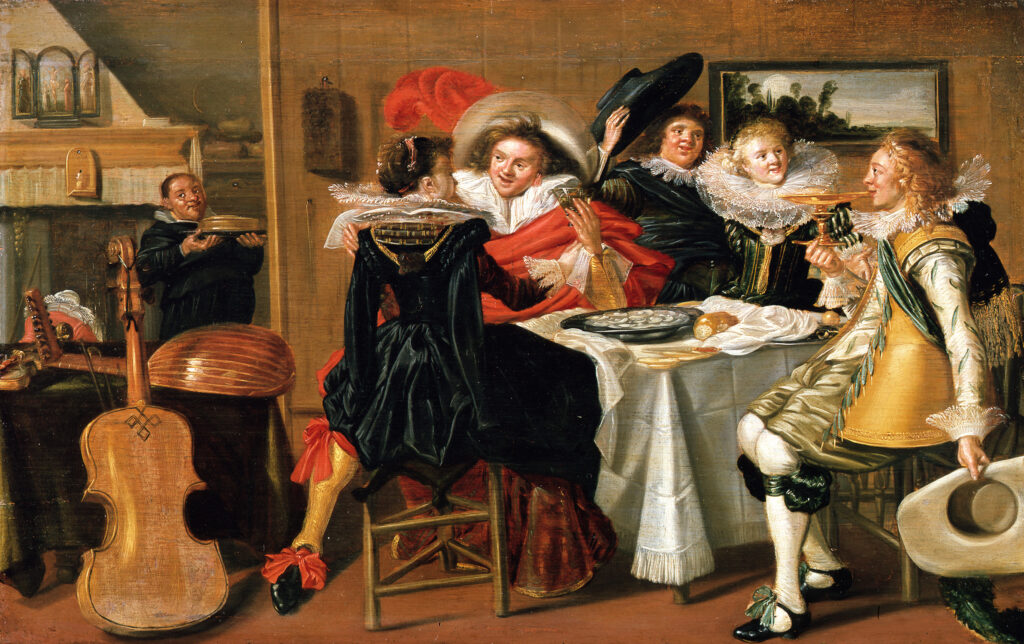
Haarlem, circa 1620. Dirck Hals captures the moment when five young people seated at a table let their joy burst forth in a bourgeois interior. Laughter rings out, hands gesticulate, an abandoned lute testifies to the party in full swing.
A Virtuoso Genre Scene
The lace collars catch the light and frame faces flushed with merriment. Dirck Hals deploys a brilliant palette. The immaculate white of the tablecloth contrasts with the warm tones of the room and costumes. The oil-on-wood technique allows remarkable precision in rendering textures: one can discern each fabric fold, each reflection on the tableware. To the left, a servant anchors the scene in the daily life of the Dutch Golden Age elite.
Pleasure Under Divine Surveillance
This “merry company” is not merely a carefree celebration. In the adjacent room, an altarpiece depicting the Crucifixion discreetly recalls the dangers of excess. Dirck Hals inscribes his work in the Dutch moral tradition: these festive scenes often carry a message about the vanity of earthly pleasures. The painter draws inspiration from Willem Buytewech for certain motifs, while developing his own manner of capturing the casual elegance of Haarlem’s youth.
Dirck Hals, Master of Merrymaking
Younger brother of the celebrated Frans Hals, Dirck Hals (1591-1656) specialized in these animated interiors that made his reputation. His precise and colorful touch captures the energy of banquets, musical parties, and conversations that characterized 17th-century Dutch sociability.
A Question for You
💭 Observe the gestures and gazes of each figure: how does Dirck Hals construct the group dynamic and guide our eye through this animated composition?
About this Work
- Interior with a Group of Merry People at a Table
- Dirck Hals
- circa 1615-1640
- Oil on oak panel
- 27.9 × 43.6 cm
- Staatliche Museen zu Berlin, Gemäldegalerie
- https://recherche.smb.museum/detail/863164/interieur-mit-fr%C3%B6hlicher-tischgesellschaft
Dirck Hals and the Gezelschap: Dutch Bourgeois Sociability as Subject
Interior with a Group of Merry People Seated at a Table is characteristic of the genre most personal to Dirck Hals (Haarlem, 1591 – Haarlem, 1656): the gezelschap, or merry company scene, depicting figures from the prosperous bourgeoisie gathered to drink, play cards, listen to music, or simply converse. The younger brother of the celebrated Frans Hals, whose brushwork virtuosity he does not match but whose taste for expressive figures and animated interiors he shares, Dirck specialised in these scenes of sociability that constitute one of the great innovations of seventeenth-century Dutch painting: the representation of subjects without historical, mythological, or religious justification, validated solely by their capacity to describe contemporary life and produce aesthetic pleasure. Here, five young people at a table burst with gaiety, white lace collars, animated faces, lifted cups, a servant in the background rooting the scene in the reality of bourgeois domesticity.
The Moral Hidden Beneath the Gaiety
What attentive looking discovers in these Dutch scenes of merry-making is frequently a moral layer beneath the surface that the country’s pictorial and theological tradition imposes even on the most festive representations. A crucifix visible in an adjacent room offers a quiet reminder that Christian faith is never absent even from the most worldly interiors. This device, the discreet vanitas concealed within an apparently hedonistic scene, is characteristic of Dutch genre painting: feasts, music-making, and gallant conversation are all veiled reminders of the brevity of earthly pleasures, without ever burdening the composition with an overly explicit lesson. Dirck Hals practises this art of equivocation with considerable lightness, his figures radiate joy, and the moral warning remains a hypothesis for the viewer who knows where to look. The painting is now in the Gemäldegalerie in Berlin, one of the world’s foremost collections of Dutch Golden Age painting.
A Family Name and an Independent Voice
To be the brother of Frans Hals was both an advantage and a burden for Dirck. His association with the family name opened doors in Haarlem’s artistic milieu; the comparison with his older brother’s bravura technique has sometimes overshadowed the recognition of his own considerable gifts as a narrator of bourgeois sociability, a colourist of textures, and a composer of small-format scenes in which everything, posture, glance, object, carries meaning.