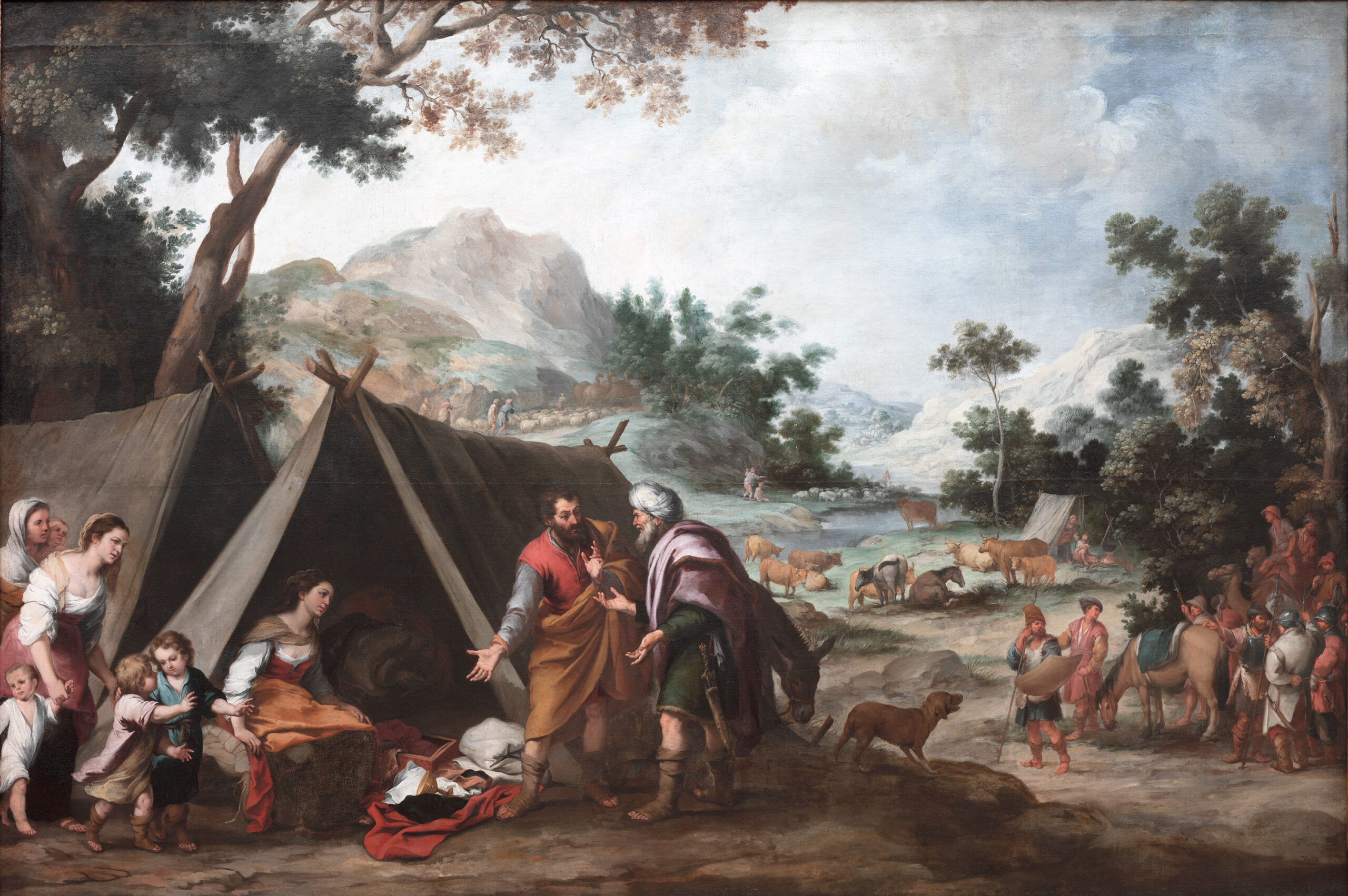
Somewhere in Canaan, centuries before our era. An furious father confronts his son-in-law. Between them, a secret that only Rachel holds. In the foreground, Laban, the old patriarch in a white turban, points at Jacob with a trembling hand. Jacob opens his arms: he has nothing to hide. To the left, Rachel sits on the saddlebag. Calm. Impassive.
Murillo’s golden light
Murillo bathes the scene in an almost golden light. The ochre and rust tones of the clothing vibrate against the grey-green of the tent. In the background, flocks graze across a mountainous landscape. The Baroque composition arranges itself along diagonals. Every face expresses a distinct emotion: anger, feigned innocence, childlike curiosity.
A biblical narrative at the heart of the Golden Age
Painted c. 1665–1670, this canvas belongs to the great tradition of Spanish narrative painting of the Golden Age. Murillo draws from Genesis: Rachel has stolen the household idols of Laban, her own father. Jacob, unaware of the theft, invites Laban to search freely. Rachel, seated on the stolen goods, plays her part. The scene depicts reconciliation in the aftermath of betrayal. Laban will find nothing. The quarrel will subside. Family peace will triumph over suspicion.
Murillo
Bartolomé Esteban Murillo (Seville, 1617–1682) is the undisputed master of Sevillian Baroque painting. Trained in the workshop of Juan del Castillo, he developed a singular style, a soft, luminous Spanish sfumato. Murillo excels equally in religious scenes and in humanised biblical narratives, such as this one.
A question for you
💭 In this canvas, the eye follows Laban, then Jacob, then Rachel, in precisely that order. How does Murillo orchestrate this journey of the gaze without ever forcing the demonstration?
About this work
- Laban Searching for His Stolen Household Gods
- Bartolomé Esteban Murillo
- c. 1665–1670
- Oil on canvas
- 243 × 362 cm
- Cleveland Museum of Art, Cleveland, Ohio
A Genesis Scene on a Monumental Scale
Laban Searching for His Stolen Household Gods is one of the great narrative compositions of Bartolomé Esteban Murillo (Seville, 1617-1682). The subject is drawn from Genesis 31: Jacob, husband to both of Laban’s daughters, secretly departs from his father-in-law’s household with his flocks, wives, and children. Rachel, one of his wives, has stolen her father’s household idols, the teraphim, small tutelary figurines of the home, and conceals them under a camel’s saddlebag on which she then sits. Laban, furious, pursues them and searches Jacob’s tents one by one. The precise moment Murillo chooses, Laban approaching Rachel as she sits on the hidden objects, pleading that she cannot rise because of her menstrual period, is the pivot point of the narrative: deception succeeds, and it is a woman’s wit that outwits patriarchal authority. Murillo renders this as a nearly monumental composition, almost the scale of a history painting, with a horizontal frieze of figures set in an open mountain landscape.
Seville Baroque and the Humanisation of Sacred Narrative
What defines Murillo’s approach in this mature work is the way he domesticates an episode that might have remained purely didactic. Laban is not an avenging patriarch but a bewildered old man, his gesture uncertain; Jacob raises his hands in performed innocence with an almost theatrical naturalness; Rachel remains impassive, her secret shared with the viewer alone. This psychology of posture is Murillo’s signature in his large compositions: figures interact with a domestic fluency that makes sacred texts immediately accessible. The warm golden light, deep ochres and rusts flooding the scene, belongs to the Sevillian baroque of the second half of the seventeenth century, steeped in Titian and Rubens without ever losing a distinctly Spanish sensibility.
The Séville School and Its European Dimension
Murillo trained under Juan del Castillo and developed his craft within the rich Sevillian painting culture that also produced Zurbarán and Velázquez. By the 1660s, when this canvas was made, he was the undisputed centre of Sevillian pictorial life and a founder, in 1660, of the Seville Academy of Fine Arts. His large narrative compositions from this period show a confidence in handling vast canvases and multiple figures that confirms his standing as one of the great masters of Spanish Golden Age painting.