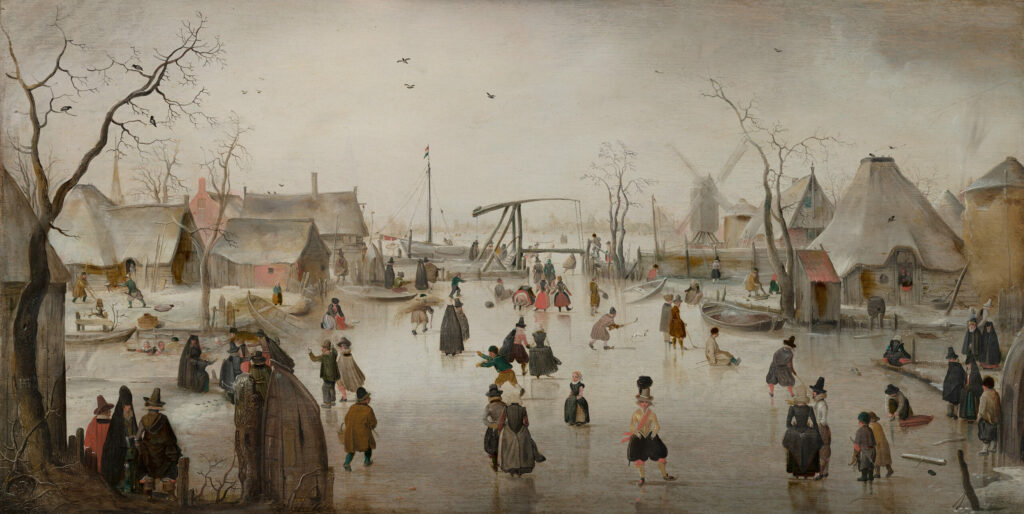
Kampen, circa 1610. The water has frozen and the entire village gathers on the ice. Hendrick Avercamp, nicknamed the “Mute of Kampen,” transforms this winter setting into a life-size theater where each character tells a story.
A Mosaic of Lives on the Ice
Observe this motley crowd bustling on the frozen canal. In the foreground, an elegant skater sports a plumed top hat. Couples glide hand in hand. Some play kolf, the ancestor of ice hockey. A woman washes her laundry in a hole, near a half-submerged boat. The humorous touch? That fallen skater, skirt raised, exposing her bare bottom. But Avercamp also paints danger: four people have fallen through the ice, rescuers arrive with a ladder. The painting meticulously captures each costume, each gesture, revealing all social classes united.
The Little Ice Age as Inspiration
This work emerges during the Little Ice Age that struck northern Europe from 1550 to 1850. Between 1600 and 1700, two-thirds of Dutch winters were extremely harsh. Navigation became impossible, public life paralyzed. Avercamp painted these extreme winters between 1600 and 1625, the period of the most intense cold. This winter landscape tradition has its roots in Pieter Bruegel the Elder and 16th-century Flemish painting.
Hendrick Avercamp, Pioneer of the Winter Genre
Avercamp (1585-1634) was the first artist to specialize in Dutch ice scenes. Deaf since childhood, he developed an acute sense of visual observation. Trained in Amsterdam, he returned to Kampen where he created his characteristic winter panoramas.
Think about it
💭 When have you felt that collective joy of a suspended moment, where an entire community shares the same instant?
About This Work
- Ice Scene
- Hendrick Avercamp
- circa 1610
- Oil on panel
- 36 × 71 cm
- Mauritshuis, The Hague
- https://www.mauritshuis.nl/en/our-collection/artworks/785-ice-scene
“The Mute of Kampen” and the Little Ice Age
Hendrick Avercamp (1585-1634) was born deaf-mute, and his contemporaries referred to him by this characteristic: “de Stomme van Kampen” (the Mute of Kampen). Trained in Amsterdam, most likely in the workshop of Pieter Isaacsz, he returned to settle in Kampen, in the province of Overijssel, where he spent most of his life. It was in this provincial, riverside context that he developed his genre of choice: the winter ice scene. The climatic context is not incidental. Historians have established that between approximately 1550 and 1850, north-western Europe underwent a significant cooling period known as the Little Ice Age, during which two-thirds of Dutch winters between 1600 and 1700 were extremely harsh. Canals and rivers froze regularly, transforming navigable waterways into spaces of collective life. Avercamp documented this climatic reality with precision and a keen eye for social observation.
A Rijksmuseum Work on Loan to the Mauritshuis
Ice Scene (inv. 785) is on display at the Mauritshuis in The Hague, but it belongs to the collections of the Rijksmuseum in Amsterdam, which acquired it at an auction held by Frederik Muller & Co on 29 April 1886 (Rijksmuseum inventory number SK-A-1320). Since 1924, the work has been on permanent loan to the Mauritshuis. This practice of inter-institutional loans is common in the Netherlands, where collections are regularly distributed between museums to ensure broad geographical access to the national heritage. The panoramic composition (36 × 71 cm) assembles elegant skaters, kolf players, washerwomen, and struggling skaters in a complete social portrait of Dutch winter life.