Key Takeaways
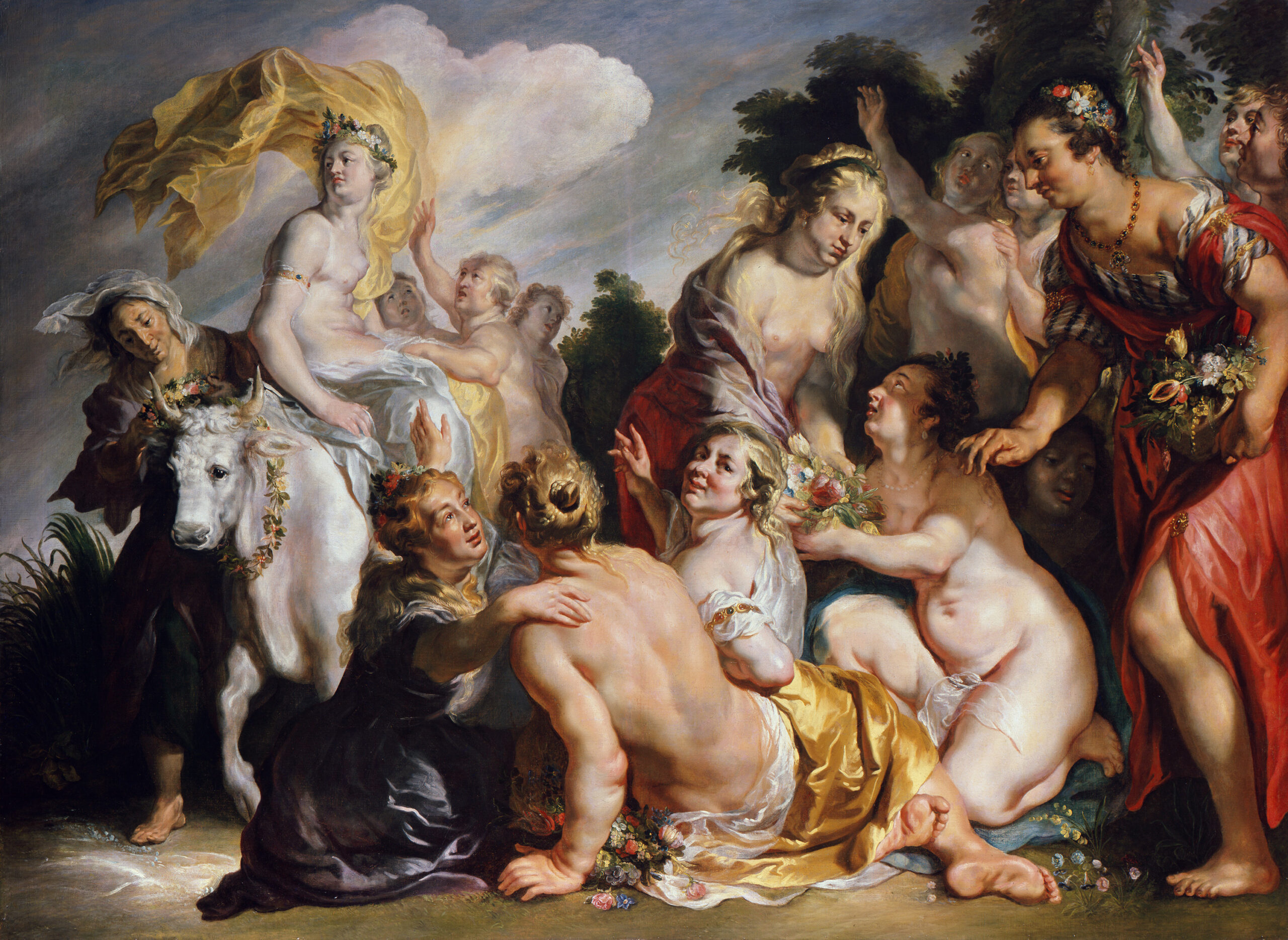
The Rape of Europa is an oil on canvas painted by Jacob Jordaens between 1615 and 1616, now held at the Gemäldegalerie in Berlin. The Antwerp-born painter, trained under Adam van Noort and closely associated with Peter Paul Rubens, depicts the episode from Ovid’s Metamorphoses in which Jupiter, transformed into a white bull, abducts the princess Europa from the shores of Phoenicia. Belonging to seventeenth-century Flemish Baroque painting, the composition brings together sixteen life-size female figures arranged in overlapping tiers, with no developed narrative setting. The canvas ranks among Jordaens’s earliest major works, marking his stylistic emergence from Rubens’s shadow and the assertion of a more earthy, corporeal style.
Here is a masterpiece by Jordaens. I chose it because it depicts a major mythological scene, the one Ovid recounts in his Metamorphoses. The composition is dense, centred on the bodies of Europa’s companions: as she is carried off on the back of Jupiter’s white bull, they still seem unaware of the fate unfolding before them. What strikes me most is the sheer physical density of the bodies, the almost choreographed poses of the women, and the treatment of light and colour, brilliant and unmistakably Flemish.
Look at this painting by Jordaens
A hand closes around a lock of blonde hair. Another lifts a garland of flowers toward a grey sky. In Jacob Jordaens’s canvas, sixteen life-size female bodies press together above a barely sketched shoreline. No clear horizon, no detailed landscape. Only flesh occupies the space. A sharp light carves out shoulders, knees, the folds of a golden cloth. To the left, an old woman veiled in white holds a bull by a garland of flowers. Her eyes follow the scene with a gravity the younger women do not yet possess.
Understanding this scene from Ovid’s Metamorphoses
The subject comes from Ovid. In his Metamorphoses, the poet tells how Jupiter, transformed into a white bull, seduces Europa on a beach in Phoenicia. Jordaens paints the moment the princess is already being carried away on the animal’s back, while her companions remain unaware of what is taking place. The painter organises his figures in tiers: reclining, crouching, kneeling, then standing. Nothing is narrated in the strict sense. Everything is built through the density of bodies. The canvas dates from around 1615-1616, shortly after Jordaens obtained his master’s title in Antwerp. Trained under Adam van Noort, he soon established himself as the city’s third great history painter, after Rubens and Van Dyck. Rubens’s influence is clearly legible in Europa’s pose, close to a sketch Rubens himself painted a few years earlier, now held at Windsor. Jordaens nonetheless retains a distinct roughness, an almost rustic gaiety, foreign to his elder’s noble ideal. The vivid colours of the garments, combined with sun-warmed flesh tones, lend the scene a festive, sumptuous character.
Feeling the tension
Notice the tension between innocence and threat. Europa’s companions laugh, adorn themselves with flowers, unaware of the abduction unfolding before their eyes. This blind gaiety creates a quiet unease. The colour, meanwhile, does not lie: it is bright, warm, almost joyful, even as the subject remains an abduction. Jordaens paints beauty and menace in the same gesture, refusing to choose between them. The viewer sees what the companions still cannot: Europa’s fate, already sealed.
Current affairs: the Gemäldegalerie, a museum on the move
The Gemäldegalerie, where The Rape of Europa is currently housed, may one day change address: the Museumsinsel Masterplan envisages relocating its Old Masters collection to a new building on Museum Island, opposite the Bode Museum, reuniting painting and sculpture, two collections separated since the Second World War. A long-term project, estimated at around €150 million, still under debate and with no confirmed timeline.
Source: Museumsinsel Berlin
A question for you
What, in Europa’s pose, still betrays the hand of Rubens and what, already, belongs to Jordaens alone?
About this work
- The Kidnapping of Europa
- Jacob Jordaens
- 1615-1616
- Oil on canvas
- 172.6 x 236.2 cm
- Gemäldegalerie, Berlin
- https://search.smb.museum/object/obj-863992