Key facts
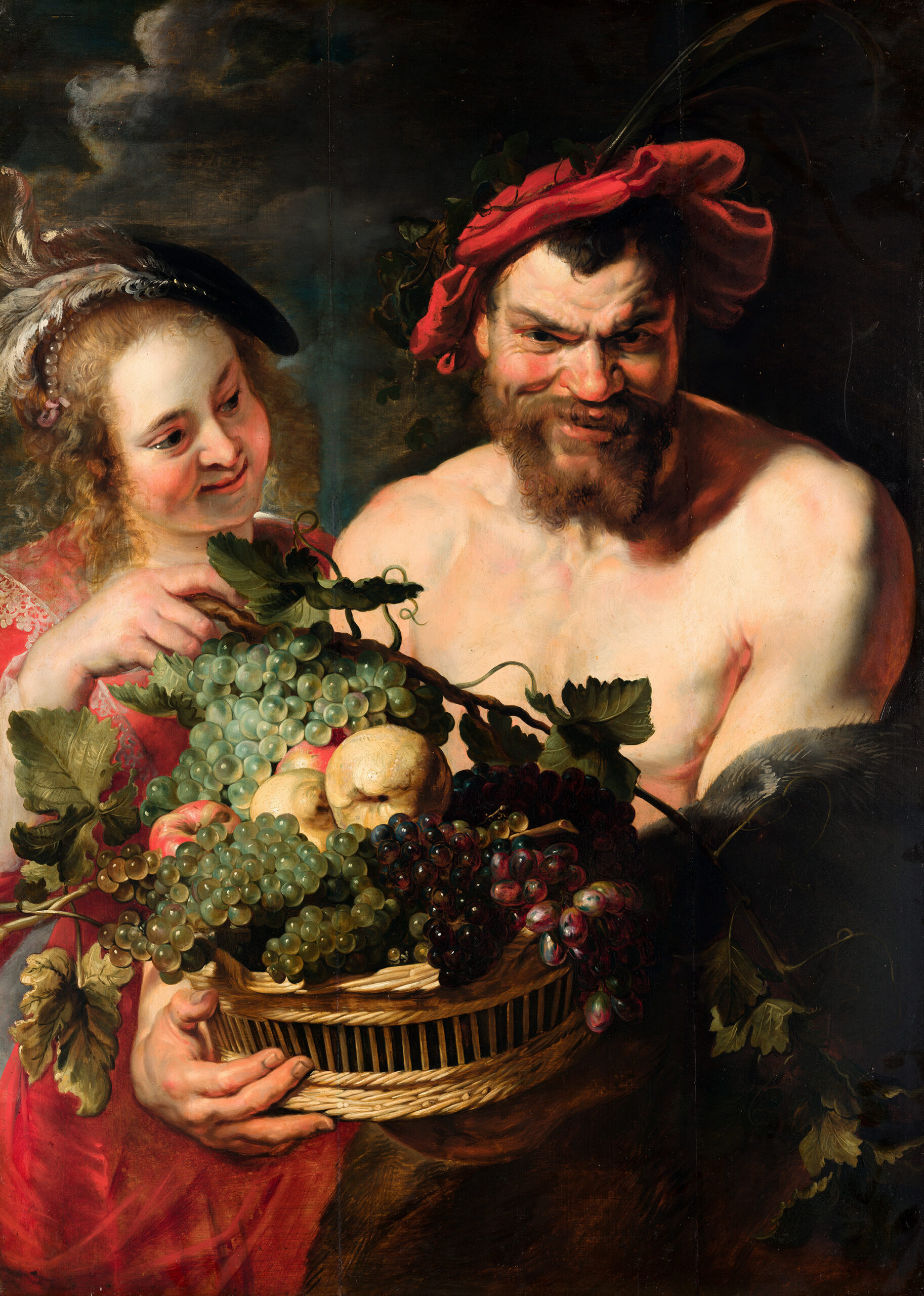
Nymph and Satyr is an oil on panel held at the Mauritshuis in The Hague, catalogued by the museum as “after Peter Paul Rubens”. Painted around 1600-1700 by a hand the museum does not name, it draws on the world of Flemish Baroque painting, of which Rubens (1577-1640) is the leading figure. A satyr, companion of Bacchus, and a young woman dressed in 17th-century fashion present a basket of grapes and autumn fruit. The composition blends mythological fable, genre scene and seasonal allegory. Donated to the museum in 1844 by Jonkheer J.L. Cremer van den Bergh, the panel illustrates how Rubens’s models were spread by his copyists and followers.
Here is a genre scene disguised as a mythological one. To me, the nymph, with her feathered beret, the pearls in her hair and her lace collar, belongs far more to the genre scene than to ancient fable: she looks like a young 17th-century woman from Antwerp rather than a woodland deity. The satyr, on the other hand, keeps all his wildness, with his shaggy beard, the fur we glimpse in the shadows and above all that crooked smile and squinting gaze he aims straight at us, as if to make us his accomplices. It can also be read as an allegory of autumn, with its basket overflowing with white and black grapes, apples and yellow fruit that look like quinces. I find the work interesting for that reason, because the painter plays on several readings at once. The artist drew deeply on Rubens here, and I love the earthy exuberance you feel in this scene: the rosy flesh, the vivid red of the cap echoing the red of the dress, the grapes catching the light like pearls. There is something joyful and sensual about it that makes me smile every time I look at this panel. I believe Rubens and his followers loved this blend of genre scene and mythology, which allowed them to speak of very earthly pleasures beneath the elegant varnish of Antiquity. I don’t know whether there is also a moralising reading, as so often in paintings of the period. The contrast between the nymph’s youth and the satyr’s lust could suggest a warning against temptation, but the mood seems more festive than stern to me. What do you think?
A white dot. Placed on top of a grape, it is enough to swell it with light. Look at the basket: every berry carries this tiny highlight. You can almost feel the taut skin of the fruit under your finger. Then the satyr’s gaze catches you. It does not let go.
What lies beneath the surface of Nymph and Satyr
Step closer to the panel. Two thin vertical lines run through the scene from top to bottom. They suggest the joins between the boards assembled to form the support. Wood offers a smooth surface, without the grain of a canvas. Light therefore glides over the flesh as over polished skin. Look at the satyr’s shoulder: the pink melts into ochre in very gentle transitions. The fur, by contrast, bristles in small, dry strokes. The painter sets smooth against rough, the nymph against the beast. The vine leaves are already turning russet at their edges. It is autumn, the season of the grape harvest and of Bacchus. The satyr belongs to the retinue of this god of wine. The nymph, for her part, wears the fashion of Flemish towns. Ancient fable or everyday life? The scene refuses to choose.
Peter Paul Rubens and his time
Peter Paul Rubens was born in Siegen in 1577 and died in Antwerp in 1640. He embodies Flemish Baroque painting. His inventions circulate, copied and reinterpreted by other hands. The Mauritshuis accordingly catalogues this panel as “after Rubens”. The dating remains broad: around 1600-1700. A whole century for a single image. The painting entered the museum in 1844, donated by Jonkheer J.L. Cremer van den Bergh. Its record can be viewed on the Mauritshuis’s official page.
News: the Mauritshuis in autumn 2026
Note before your visit: according to the museum’s record, this Nymph and Satyr is currently listed as not on display. The Mauritshuis, however, is enjoying a high point: from 15 October 2026 to 17 January 2027, it hosts an exhibition organised with the Museo Nacional Thyssen-Bornemisza in Madrid, as part of an exceptional exchange in which 25 masterpieces from The Hague travel to Spain while 25 major works from the Madrid collection come to the Netherlands. Built around the theme of love, it brings together Jan van Eyck, Albrecht Dürer, El Greco, Antonello da Messina, Piero della Francesca and Bronzino, among others. For Rubens lovers, the Rubenshuis in Antwerp is also worth a visit: a double-sided sheet from 1607 combining an autograph drawing and a handwritten letter by Rubens, acquired at TEFAF by the King Baudouin Foundation, is on show at the Rubens Experience until the end of November 2026.
Sources: Mauritshuis and Rubenshuis.
A question for you
What do you see here: a joyful genre scene, or a moralising scene warning against temptation?
About this work
- Nymph and Satyr
- after Peter Paul Rubens
- c. 1600-1700
- Oil on panel
- 108 x 78 cm
- Mauritshuis, The Hague
- https://www.mauritshuis.nl/en/our-collection/artworks/246-nymph-and-satyr