Key Facts
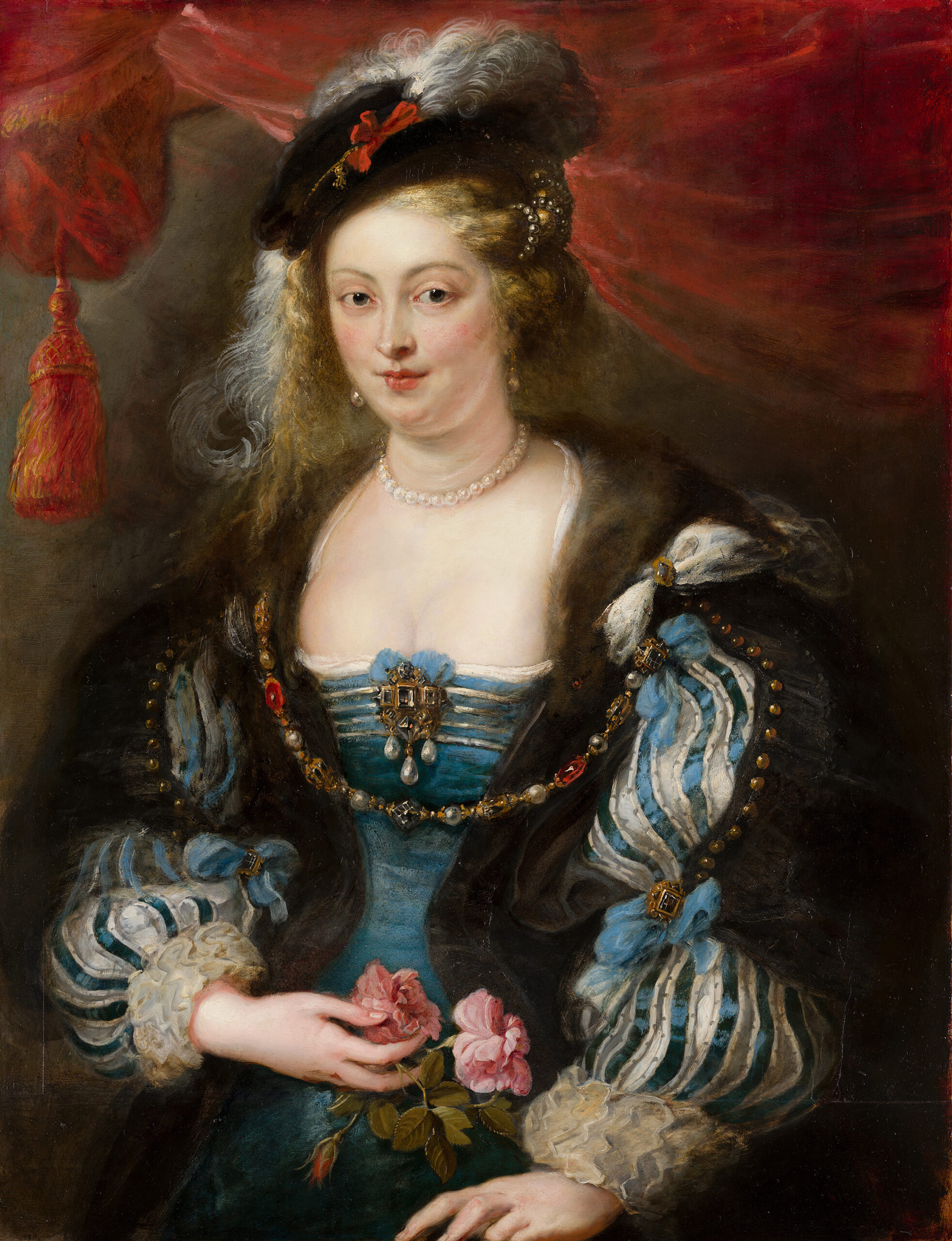
Painted around 1620–1630, Portrait of a Young Woman is an oil on panel attributed to Peter Paul Rubens and his workshop, held at the Mauritshuis in The Hague. A leading figure of the Flemish Baroque, Rubens ran one of the largest studios in Europe from Antwerp, where assistants such as Anthony van Dyck and Jacob Jordaens worked alongside him. The portrait exemplifies the commissioned work produced for the seventeenth-century elite: pearls, ostrich plumes and sumptuous fabrics all assert social standing. The sitter’s identity remains unknown, and the precise share falling to the master, as opposed to the workshop, is still debated by art historians.
What a portrait! As I made my way through the Mauritshuis collection, I was struck at the very first glance. There is a graciousness here, a quiet presence in this face, and a costume rendered with a care that commands admiration. And what colours: up close, you take the measure of the precision of the brushwork, the way the paint catches the light on the panel. The delicate hand and the roses it holds speak, to my mind, of a precious openness to life, a small gesture that softens the whole picture. I love this portrait. It stands apart from the scene of the old woman and the young boy with candles that we looked at recently on Vmuseum: there, everything turned on shadow and flame; here, it is light and colour that stay with me most.
Look first at her hand. Two pink roses rest in it, petals already open, almost loose. A touch of red, dark green foliage, a stem that bends. Then the eye travels upward, slowly: the pear-shaped pearl hanging at the bodice, the gold chain, the deep blue of the satin. Everything here invites touch. And yet she scarcely looks at you. Her smile hovers, almost suspended.
Beneath the Surface
Come closer still. The oil on panel, this polished oak, holds the light as few supports do. Peter Paul Rubens lays translucent glazes over the flesh tones, then strikes the pearls with a white impasto, bright, almost wet. The blue satin shimmers with parallel strokes. The dark fur, for its part, drinks in the light and quenches it. Feel the difference of the materials under the brush: the hard nacre, the weightless plume, the warm skin. Ostrich feathers foam above the black beret. A red ribbon casts a brief note there. Behind her, a red curtain falls in heavy folds; a passementerie tassel hangs to the left, warm and silken. At the throat, a string of pearls; on the breast, a brooch set with stones and pearl drops. This luxury can be read at the fingertips. The eye slides, returns, lingers on each blue bow, each drop of nacre. And yet several hands have moved across this panel. The master of Antwerp and his workshop paint together, as was the practice of the Flemish Baroque. The flesh breathes, the costume dazzles. The name of this young woman, though, has been lost.
Rubens and His Age
Peter Paul Rubens reigns over Antwerp in the seventeenth century. Painter, diplomat, scholar, he directs the largest studio in Europe. Van Dyck and Jordaens learn their craft there. The courts of Madrid, Paris and London vie for his canvases. Around 1620–1630, he multiplies portraits of dazzling luxury: pearls, plumes, brocades, gold chains. His sitters wish to be seen as much as immortalised. This unknown woman belongs to that elite. Her finery places her very high. Her face, though, keeps an almost ordinary gentleness, at odds with the splendour. The title says a young woman; the painting shows a rank, not an identity.
A Recent Discovery That Sheds Light on the Workshop
In January 2026, the attribution of Rubens’s works was once again in the news: at BRAFA, the Brussels dealer Klaas Muller unveiled a head study long left anonymous, a bearded old man, around 1609, now given back to the master of Antwerp, with the cautious endorsement of Ben van Beneden, former director of the Rubens House. Remarkably, restoration brought back to the surface an earlier, reversed composition beneath the beard: the head of a young girl, reused and then painted over, revealing the habits of the workshop. This case sheds light on the “and workshop” attached to our Portrait of a Young Woman: within Rubens’s teeming output, telling the master’s hand from that of his collaborators, and unravelling the layers of a single panel, remains to this day one of the great challenges facing art historians.
Source: Artprice
A Question for You
💭 Would you place this portrait on the side of Titian, whose colour Rubens inherited, or of Van Dyck, who served as his assistant, for its elegance?
About This Work
- Portrait of a Young Woman
- Peter Paul Rubens (and workshop)
- around 1620–1630
- Oil on panel
- 98 × 76 cm
- Mauritshuis, The Hague
- https://www.mauritshuis.nl/fr/decouvrir-la-collection/oeuvres-d-art/251-portrait-of-a-young-woman