Key points
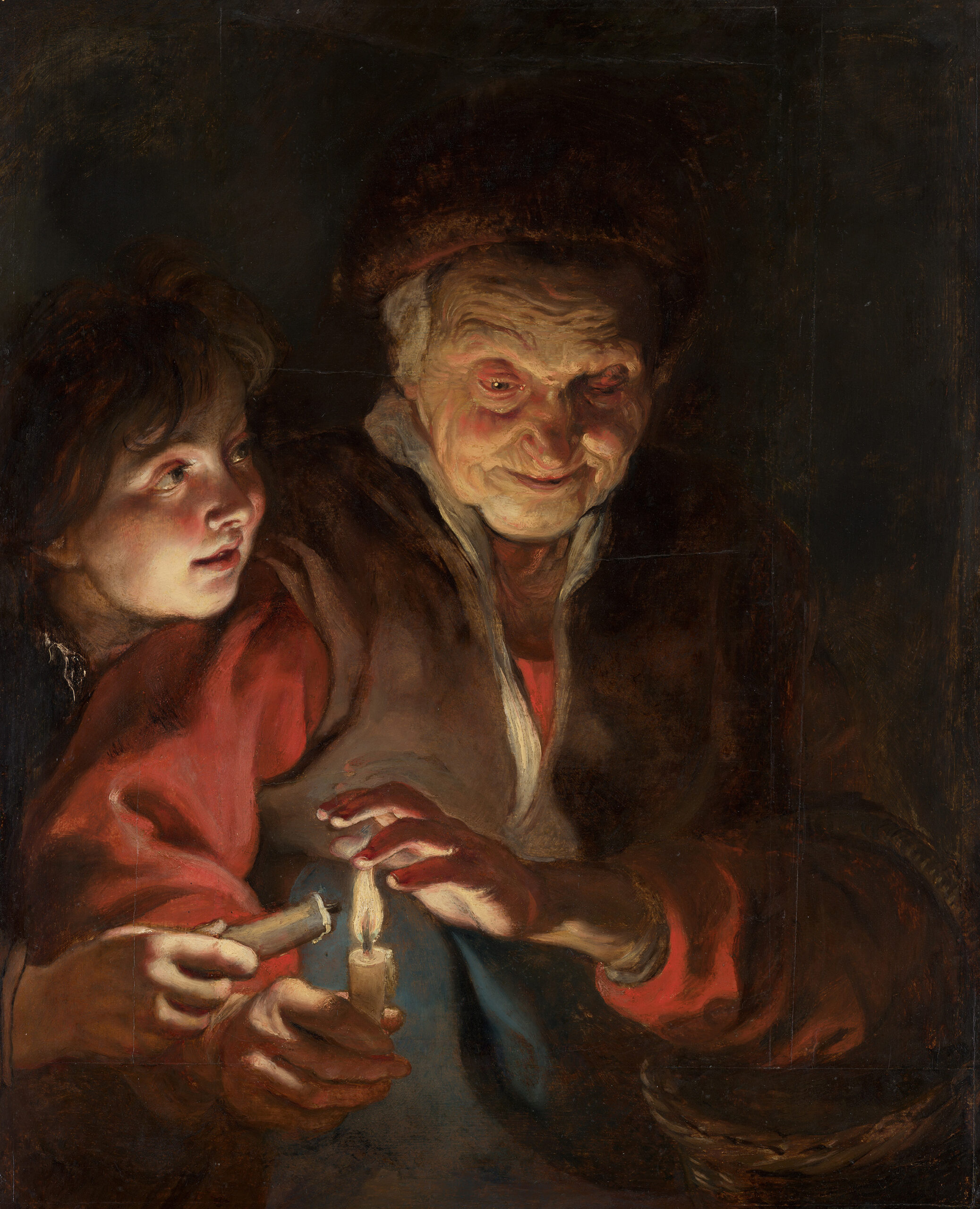
Painted around 1616–1617 by Peter Paul Rubens, Old Woman and Boy with Candles shows an elderly woman holding a candle from which a young boy lights his own. Held at the Mauritshuis in The Hague, it is among the earliest night scenes produced in the Netherlands in the manner of Caravaggio, whose work Rubens had discovered in Italy between 1600 and 1608. Its pronounced chiaroscuro and its subject, bound to a line by Ovid on light that is passed on without being lost, make it a landmark of Baroque Caravaggism. Rubens kept the panel until his death in 1640.
What strikes me in this Rubens is the tiny gesture that holds the whole painting: the boy, leaning over the old woman’s shoulder, lights his candle from hers. A light handed on to youth. The chiaroscuro, inherited from the Caravaggio that Rubens had discovered in Italy, draws the scene tight around these two faces bathed in a reddish glow and lets the rest sink into shadow, an intimacy built from a single flame. I see in it a beautiful symbolism, that of transmission, all the more unsettling because the old woman, her gaze turned inward, seems barely to notice the child. Rubens himself distilled the idea on an engraving of the composition, quoting Ovid: a light may be taken a thousand times from another and never be spent.
You are standing before a tender scene. Or rather, you believe you are. A flame warms two faces in the dark. The rest of the panel withdraws. Look at the light first, before the meaning.
What the panel tells you
The old woman holds a candle. The boy tips his own toward the flame. Her hand shields the fire. The glow turns reddish and carves out the wrinkles. Here Rubens works the chiaroscuro typical of Caravaggism, discovered in Italy.
What the age tells you
Rubens does not sell this painting. He keeps it for his studio. Around 1617, he has the scene engraved. On it he inscribes a line by Ovid, drawn from the Art of Love: a light may be taken a thousand times from another without being diminished. The poet paints there an old woman alone at night, dwelling on the loves she has lost.
Peter Paul Rubens (1577–1640), the Baroque master of Antwerp, returns from Italy steeped in Caravaggio. This nocturne is among his first Caravaggesque attempts in the Netherlands. He keeps it until his death.
Mauritshuis news: an unprecedented exchange
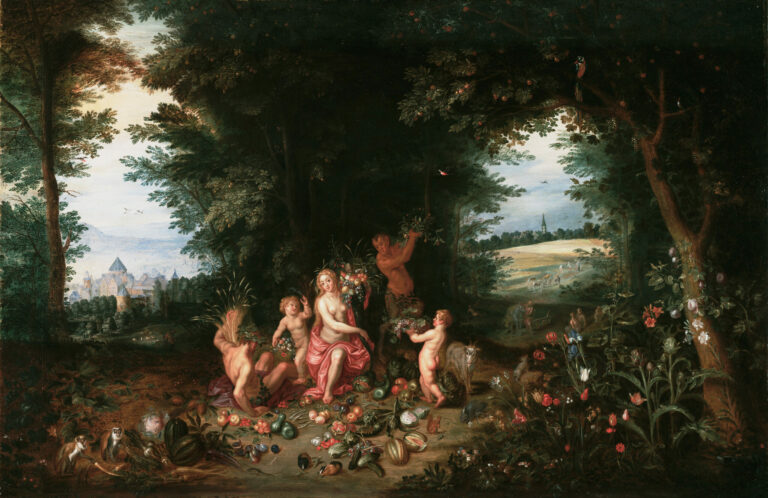
The Mauritshuis continues to bring its Flemish holdings to life. In autumn 2026, the museum in The Hague joins with the Museo Nacional Thyssen-Bornemisza in Madrid for an unprecedented exchange: twenty-five masterpieces from each collection travel at the same time, a first between two major international museums. Among the works lent to Madrid is another painting involving Rubens, The Garden of Eden with the Fall of Man (c. 1615), painted with Jan Brueghel the Elder, a sign of the place the Antwerp artist holds in the collection that is also home to our Old Woman and Boy with Candles. The exhibition Thyssen-Bornemisza ❤ Mauritshuis runs from 15 October 2026 to 17 January 2027.
Source: mauritshuis.nl
A question for you
💭 What if this flame, passed from one candle to the next, also told the story of Rubens handing the art of Caravaggio to the painters of the North?
About this work
- Old Woman and Boy with Candles
- Peter Paul Rubens
- c. 1616–1617
- Oil on panel
- 77 × 62.5 cm
- Mauritshuis, The Hague
- https://www.mauritshuis.nl/en/our-collection/artworks/1150-old-woman-and-boy-with-candles